📅 Last updated:
Search for incontinence supplements and you will find chews containing soy isoflavones, pumpkin seed, cranberry, corn silk, and herbal blends, often labelled “bladder control.” It is worth being direct: the evidence behind most of these is thin, and the most common type of incontinence in dogs, spay-related urethral sphincter weakness, is usually treated very effectively with prescription medication. Supplements may have a supporting role in some dogs, and some have a reasonable rationale, but they should not delay a vet visit. This guide explains what each ingredient is meant to do and what the evidence actually shows.
📋 Table of Contents
Quick answer: For most people in 2026, the best dog supplement for dogs with incontinence is the Soy isoflavones (phytoestrogens) — our #1 rated choice. See the full ranked comparison, alternatives and buying advice below.
Get a diagnosis first
Leaking urine can be caused by urethral sphincter mechanism incompetence (USMI), urinary tract infection, bladder stones, diabetes, kidney disease, Cushing’s disease, spinal problems, or, in young dogs, congenital abnormalities. Each needs different treatment. A urine test is quick and inexpensive, and treating an infection or stone may stop the leaking entirely. See your vet before starting any supplement, and especially if your dog is drinking more, straining, or passing blood.

NaturVet Senior Advanced Incontinence Dog Supplement - 60 Ct
Included for 'Best Dog Supplement for Dogs with Incontinence' because the listing specifies 60 Ct, details this guide uses to compare options.
View on Amazon
Nutri-Vet Bladder Control for Dogs, Dog Urinary Health Support, 90 Tablets
Included for 'Best Dog Supplement for Dogs with Incontinence' because the listing specifies Dog Urinary Health Support and 90 Tablets, details this guide uses to compare options.
View on Amazon
NaturVet Senior Advanced Incontinence Dog Supplement - 120 Ct
Included for 'Best Dog Supplement for Dogs with Incontinence' because the listing specifies 120 Ct, details this guide uses to compare options.
View on Amazon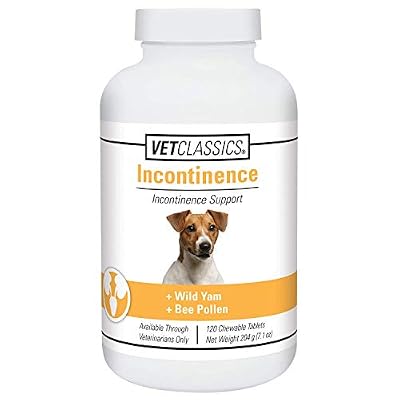
Vet Classics Bladder, Incontinence Support Dog Supplement - 120 Count
Included for 'Best Dog Supplement for Dogs with Incontinence' because the listing specifies Incontinence Support Dog Supplement and 120 Count, details this guide uses to compare options.
View on AmazonPrescription treatment for USMI
See also: How to Pick a Heating Pad for an Arthritic Senior Dog • How to Transition a Picky Cat to a New Food
For spayed females with USMI, vets commonly prescribe phenylpropanolamine, which tightens the urethral sphincter, or estriol, a hormone that improves sphincter tone. Many dogs become fully or mostly dry on these. Some dogs need a combination, and a few need procedures such as urethral bulking injections. Supplements are sometimes used alongside, or in dogs that cannot take these medications.
Common supplement ingredients
| Ingredient | Proposed action | Evidence in dogs | Notes |
|---|---|---|---|
| Soy isoflavones (phytoestrogens) | Weak estrogen-like effect on sphincter | Limited, small studies | Rationale similar to estriol; far weaker |
| Pumpkin seed extract | Traditional bladder support | Minimal | Low risk; unproven |
| Cranberry (PACs) | May reduce bacterial adhesion in bladder | Some evidence for UTI prevention; not for USMI | Helps only infection-related cases, if at all |
| D-mannose | Binds E. coli in urine | Limited in dogs | For recurrent UTI, not sphincter weakness |
| Corn silk, saw palmetto, herbal blends | Various | Very limited | Quality varies; possible interactions |
| Omega-3 fatty acids | General anti-inflammatory | Not specific to incontinence | Useful for joints in seniors |
Matching supplements to the cause
For recurrent urinary tract infections
Cranberry extract standardised for proanthocyanidins (PACs) or D-mannose may reduce recurrence in some dogs, based on limited evidence. They do not treat an active infection, which needs antibiotics chosen by culture.
For sphincter weakness
Soy isoflavone products have a plausible rationale but modest evidence. They are sometimes tried in mild cases or in combination with medication, with vet approval. Do not combine with prescribed estriol without your vet’s advice.
For senior dogs with mobility problems
Some older dogs have accidents because arthritis makes getting outside hard. Joint supplements such as omega-3 fatty acids may help indirectly by improving mobility.
Dosing by size
USMI is most common in larger dogs, often over 20 kg. Weight-banded supplements usually group dogs into bands such as under 11 kg, 11 to 23 kg, 23 to 34 kg, and over 34 kg. Follow the band closely, and avoid splitting a large-dog product for small dogs. Check the actual amount of each active ingredient, since many chews list several ingredients at small doses.
Safety points
Phytoestrogens are not suitable for intact females or dogs with hormone-responsive conditions without vet advice. Some herbal products interact with medications. Avoid products containing xylitol. Tell your vet about every supplement so they can interpret the response to any prescribed drug.
Measuring whether it works
Keep a simple log: number of wet spots on bedding per week and when they occur. Give any supplement at least four to six weeks. If leaking is unchanged, stop and return to your vet rather than adding more products.
FAQ
Is there a natural alternative to phenylpropanolamine?
Soy isoflavone supplements are sometimes suggested, but the evidence is much weaker than for prescription options. For many dogs, medication is the most reliable way to stay dry, and it is well tolerated by most.
Can cranberry stop my dog leaking urine?
Only if the leaking is caused by recurrent infection, and even then evidence is limited. Cranberry does not strengthen the urethral sphincter.
Bottom line
Supplements for incontinence have modest evidence at best. Get a diagnosis first, because USMI and infections respond to specific treatments. Cranberry or D-mannose may help some dogs with recurrent UTIs, and soy isoflavones may be a mild adjunct for sphincter weakness under vet guidance. Track results carefully and do not let a supplement delay effective treatment.
Ready to decide? Our #1 pick for 2026 is the Soy isoflavones (phytoestrogens).
Live price & availability on Amazon.