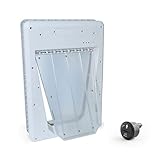
- Top Pick: PetSafe Electronic Pet Door, Collar Key Sensor, Dogs Up to 100 lb, Large
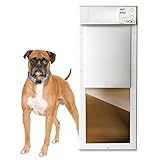
- Best Value: Power Pet Automatic Electronic Pet Door by High Tech Pet – Pet Operated Dog Door, High Security, Air Tight, for Large Dogs 30-100 lbs. (12 1/4" x 16" Pet Opening), Door Mount, Easy Install – PX-2DM
- Premium Choice: Power Pet Smart Automatic Electronic Pet Door by High Tech Pet (Wall Mount, Large, Non-WiFi)
📅 Last updated:
As an Amazon Associate, All Ears Pet Care earns from qualifying purchases. This article contains affiliate links — if you buy through them we may earn a small commission at no extra cost to you. We only recommend products we believe in.

TL;DR: An automatic pet door uses microchip or RFID collar-key recognition to let your dog in and out without manual operation — while keeping wildlife, stray animals, and drafts out. The best models offer programmable curfew scheduling, insulated flaps, and wall or door installation options for most home configurations.
As an Amazon Associate we earn from qualifying purchases.

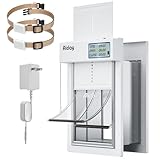


Best Automatic Pet Door: Smart Dog Doors That Lock Out Wildlife and Drafts
A standard pet flap solves the dog’s access problem while creating three new ones: neighborhood cats wander in, raccoons help themselves to the food bowl, and winter drafts add meaningfully to your heating bill. An automatic pet door eliminates all three by using electronic recognition — either your dog’s existing microchip or a dedicated RFID collar key — to unlock the flap only for registered animals. The mechanism stays sealed the rest of the time, blocking unauthorized entry and weather infiltration simultaneously.
This guide covers recognition technology types, installation requirements across door and wall configurations, energy efficiency, and what to look for if you have multiple dogs or a dog and a cat sharing the same entry point.
🛒 Best Price Today on Amazon
Prime members get fast, free shipping on everything above, plus member-only deals. New members get a 30-day free trial — cancel anytime.
📋 Table of Contents
- Top Automatic Pet Door Pick
- Recognition Technology Compared: Microchip vs. RFID Collar Key
- Automatic Pet Door Spec Comparison
- Installation: Door vs. Wall vs. Sliding Glass
- Sizing for Your Dog
- Curfew and Access Scheduling Features
- FAQ: Automatic Pet Doors
- Multi-Pet Household Considerations
- Final Verdict
- Related Guides
- Frequently Asked Questions
- Related Articles
Top Automatic Pet Door Pick

9
In Stock






As an Amazon Associate we earn from qualifying purchases. Product prices and availability are accurate as of the date/time indicated.
9
In Stock
As an Amazon Associate we earn from qualifying purchases. Product prices and availability are accurate as of the date/time indicated.
9
In Stock
As an Amazon Associate we earn from qualifying purchases. Product prices and availability are accurate as of the date/time indicated.
Recognition Technology Compared: Microchip vs. RFID Collar Key
See also: 7 Best Refillable Frozen Dog Treat Toys for Long-Lasting Licks • Best Dog Door Mat for Muddy Paws: Sizing, Materials and Picks by Entryway
The two dominant recognition systems each have meaningful practical differences beyond the marketing surface:
Microchip recognition reads your dog’s existing implanted ISO-standard microchip (134.2 kHz or 125 kHz depending on chip generation). Advantages: nothing to attach to the dog, nothing to lose, works with animals already chipped. Limitations: read range is short (2–4 cm), requiring the dog to present its shoulder directly to the sensor panel. Microchip doors require the dog to pause and orient correctly — some dogs learn this quickly, others circle repeatedly before triggering. Also: not all microchip generations are universally compatible with all door readers.
RFID collar key attaches a small tag to your dog’s existing collar. Read range is longer (up to 12 inches on premium models), allowing the door to unlock as the dog approaches rather than requiring direct contact. Collar keys can be lost, destroyed by dogs that chew tags, or left inside if the dog is collarless. For multi-dog households with different access needs, individual collar keys allow per-dog permission settings — microchip doors typically allow or deny all registered chips equally.
Automatic Pet Door Spec Comparison
| Feature | Basic Electronic Flap | Mid-Range Auto Door | Premium Smart Door |
|---|---|---|---|
| Recognition | RFID collar key | Microchip or RFID | Microchip + RFID dual-mode |
| Read Range | 2–4 inches | 4–8 inches | Up to 12 inches |
| Curfew Scheduling | No | Basic (in/out modes) | Full time-based scheduling |
| Insulation Rating | Single flap | Double flap | Triple-flap + magnetic seal |
| Power Source | Battery only | Battery or AC adapter | AC primary + battery backup |
| Max Dog Weight | Up to 25 lbs | Up to 100 lbs | Up to 220 lbs |
| App / Smart Home | None | Rarely | Wi-Fi app + usage logs |
Installation: Door vs. Wall vs. Sliding Glass
Installation type determines which products are compatible with your home and what level of DIY skill or contractor work is needed:
- In-door installation — the most common and simplest. Cut an opening in a wood or steel entry door, insert the door frame, secure with screws. Most automatic pet doors specify minimum door thickness (typically 1.375–2.25 inches). Insulated steel doors and fiberglass doors require more precise cutting; consult door manufacturer before cutting to avoid voiding structural warranties.
- Wall installation — required when the preferred exit is a solid wall rather than a door. A tunnel section extends through wall thickness (standard 2×4 framing = ~4.5 inches; 2×6 = ~6.5 inches). More complex installation — framing modification may be needed. Provides better insulation than door installations because the longer tunnel reduces air infiltration.
- Sliding glass door installation — uses a panel insert that fills the sliding door track opening. No cutting required — the panel slides into the existing track and seals around the pet door frame. Fastest installation; least permanent. Limitations: panel reduces usable door opening width and may not seal as tightly as cut-in installations at the top and bottom track interface.
- Screen door installation — lightweight inserts for screened porches or secondary access points. Not weatherproof; suitable for mild climates only.
Sizing for Your Dog
Manufacturers list flap dimensions — measure your dog’s height at the widest point of shoulder, and width at the widest point of their body (usually hips or chest depending on breed). The flap opening should exceed your dog’s shoulder height by at least 2 inches to allow natural, unhurried movement. A door sized too small causes dogs to hesitate and crouch, which can discourage use and creates long-term joint stress for large breeds forced to hunch through repeatedly.
For dogs that are still growing, size for adult weight projections rather than current measurements. Most automatic pet door frames are fixed — replacing the entire unit for a larger opening is a recurring cost many owners don’t anticipate when buying for puppies.
If your dog has mobility issues that affect their ability to step through a raised threshold, pair the door choice with appropriate ramp solutions — our guide on dog ramps and stairs covers threshold and step height considerations for senior or arthritic dogs navigating home transitions.
Curfew and Access Scheduling Features
Premium automatic pet doors offer time-based access scheduling that goes beyond simple locked/unlocked modes. Practical applications include:
- Night lockout — prevents dogs from going out after a set time (typically dusk or 9pm), reducing exposure to nocturnal wildlife encounters and neighbors’ complaints about barking.
- Morning access window — auto-unlocks at a set time so dogs can access the yard before you wake, useful for early-rising dogs in households where owners sleep in.
- In-only mode — allows entry but prevents exit, useful when a dog needs to come inside before weather events or after surgery when outdoor activity must be restricted.
- Out-only mode — opposite application, useful for keeping a dog outside during a cleaning or maintenance window while allowing them to re-enter when needed.
FAQ: Automatic Pet Doors
Will an automatic dog door work with my dog’s existing microchip?
Most modern microchip pet doors read ISO 11784/11785 standard chips (134.2 kHz), which covers the majority of chips implanted in the US after 2010. Older 125 kHz chips (common in dogs chipped before 2010) may not be recognized by all readers. Check your dog’s microchip documentation or call your vet to confirm the chip frequency before purchasing a microchip-dependent door. Some premium doors include dual-frequency readers that handle both standards — worth the extra cost for dogs with older chip generations.
Can raccoons or other wildlife learn to use an automatic pet door?
An unrecognized animal pressing against the door panel will not trigger opening on any properly functioning electronic unit — the door only unlocks when a registered microchip or RFID signal is detected at close range. Wildlife cannot manipulate the sensor. The physical flap itself may be accessible to strong animals if the motor-driven lock fails or the door loses power, which is why battery backup systems matter. A purely passive magnetic-seal flap (no electronic lock) remains vulnerable to manually-dexterous animals like raccoons regardless of electronic features — confirm that your chosen model uses a motor-driven lock bolt, not just a passive magnet.
How energy-efficient are automatic pet doors compared to standard flaps?
Significantly more efficient. Standard single-flap pet doors are among the biggest sources of air infiltration in a home — equivalent to leaving a window partially open year-round. Premium automatic doors with triple-flap construction and magnetic perimeter seals can achieve insulation values approaching the surrounding door panel. The motor-driven lock ensures the seal is positively engaged rather than relying on gravity or magnetism alone. In cold climates, the energy savings on heating often recover the cost premium of a quality automatic door within 2–3 heating seasons.
What happens to the automatic door during a power outage?
Products vary in their power-failure default behavior — this is a critical spec to verify before purchasing. Some doors default to locked (closed) on power loss, which strands your dog outside or traps them inside depending on where they are at the time. Others default to unlocked, which defeats the security purpose. Best-practice designs include a battery backup that maintains normal operation during brief outages and allow you to configure the power-failure default mode via the control panel. Always check this spec explicitly, especially if your area experiences frequent outages.
Can I train an older dog to use an automatic pet door?
Yes — age is not a limiting factor for training, though patience requirements increase with dogs that have established habits. The key is separating the mechanical familiarity (pushing through a flap) from the electronic trigger training. Start with the door unlocked and the flap propped open, using high-value treats to reward independent passage. Once the dog is comfortable moving through the opening, lower the flap and continue treat-rewarding successful passages. Finally, engage the electronic lock with the dog wearing their collar key or microchip registered — the door will open as they approach, which they quickly learn to associate with the trigger action. Most dogs complete training within 1–2 weeks using this systematic approach.
Multi-Pet Household Considerations
Households with both dogs and cats benefit from size-selective technology available in some premium automatic doors — an internal sensor detects animal size and only opens for animals above or below a weight threshold, allowing a 12-pound cat through while blocking a 60-pound dog from the cat-only zone, or vice versa. This is particularly valuable for preventing dogs from accessing cat food, litter boxes, or quiet zones the cat uses for stress retreat. For the litter box access management side of multi-pet households, our guide on multi-cat automatic litter boxes covers how automated cleaning and access control work together.
Final Verdict
An automatic pet door is a meaningful quality-of-life upgrade for dog owners whose schedules don’t align with their dog’s bladder and activity cycles — and a genuine security and energy-efficiency improvement over standard flap designs. Prioritize microchip or dual-mode recognition over RFID-only for reliability, verify the power-failure default behavior before purchasing, size the opening to adult dimensions with margin, and choose a model with insulated multi-flap construction if energy efficiency matters in your climate.
Related Guides
Frequently Asked Questions
What size automatic pet door does my dog need?
Measure your dog’s shoulder height and widest point, then choose a flap opening that is at least two inches taller than the shoulders and wide enough to pass through without turning sideways. The step-over height at the bottom of the frame matters too, especially for short-legged or senior dogs. If you have a growing puppy, size the door for the expected adult dimensions rather than current size.
Can other animals get in through an automatic door?
Selective doors unlock only when they detect the signal from a collar tag, microchip, or RFID key on your dog, so stray cats, raccoons, and neighborhood animals cannot trigger them. That is the main safety advantage over a plain flap. No system is perfect, though, since a determined animal can occasionally slip through behind your dog, so keep the door locked overnight if wildlife is common in your area.
Are automatic pet doors a security or energy risk?
A well-made unit reduces both concerns. Look for a locking slide panel, a rigid frame, and magnetic or brush weather sealing to limit drafts, plus dual-flap designs in cold climates. Install the door in a fenced yard rather than one that opens directly to a street. For sliding-glass inserts, add a security bar in the track so the panel cannot be lifted out.
How do I clean and maintain the flap?
Wipe both sides of the flap and the frame monthly with warm soapy water to remove nose prints, mud, and hair that can gum up sensors or magnets. Check the weather seals for cracks, clear debris from the track, and replace batteries on schedule so the door does not fail closed. A stiff or noisy flap often just needs the hinge cleaned rather than replacing.
How do I train my dog to use it, and when should I ask a vet?
Prop the flap open at first, call your dog through from the other side, and reward every pass, then lower the flap gradually over several sessions. Never push a frightened dog through. Talk to your veterinarian if your dog refuses despite patient training, bumps the frame repeatedly, or seems to have trouble seeing or stepping over the threshold, which can point to vision or joint problems.