📅 Last updated:
Small-breed puppies, those expected to reach roughly 10 to 25 lb (about 4.5 to 11 kg) as adults, grow fast and burn energy at a remarkable rate for their size. Think Cavalier King Charles Spaniels, Shih Tzus, Miniature Schnauzers, French Bulldogs, Bichons and smaller Beagles. They need calorie-dense food in small kibble, fed in several meals, and they reach adult size well before larger breeds. Toy breeds under about 10 lb share some of these needs but carry a higher risk of low blood sugar and are covered in a separate guide.
📋 Table of Contents
Quick answer: For most people in 2026, the best dog food for puppy small breed dogs is the 8 to 12 weeks — our #1 rated choice. See the full ranked comparison, alternatives and buying advice below.
What makes small-breed puppies different
High energy needs per pound
Smaller bodies lose heat faster and have higher metabolic rates, so small-breed puppies need more calories per kilogram than large-breed puppies. Small-breed puppy foods are usually more energy-dense, often in the region of 3,800 to 4,400 kcal per kilogram for dry food, so the puppy can meet its needs without having to eat a large volume.

Purina Pro Plan Small Breed Puppy Food, Chicken & Rice, 6 lb Bag
Included for 'Best Dog Food for Puppy Small Breed Dogs' because the listing specifies Chicken & Rice and 6 lb Bag, details this guide uses to compare options.
View on Amazon
Hill's Science Diet Puppy Small & Mini Dry Dog Food
Included for 'Best Dog Food for Puppy Small Breed Dogs' as a relevant option in this category; details come from the product listing.
View on Amazon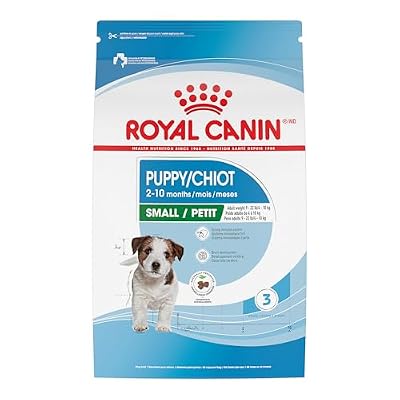
Royal Canin Size Health Nutrition Small Puppy Dry Dog Food, 4 lb Bag
Included for 'Best Dog Food for Puppy Small Breed Dogs' because the listing specifies 4 lb Bag, details this guide uses to compare options.
View on Amazon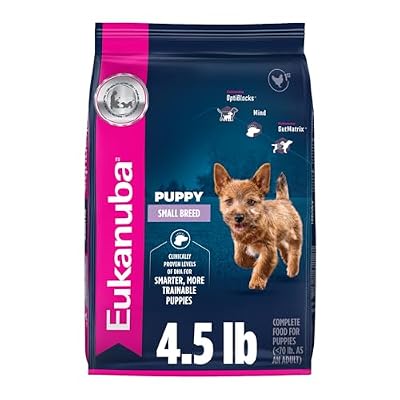
Eukanuba Small Breed Puppy Dry Dog Food, 4.5 lb Bag
Included for 'Best Dog Food for Puppy Small Breed Dogs' because the listing specifies 4.5 lb Bag, details this guide uses to compare options.
View on AmazonSmall stomachs
A small puppy’s stomach cannot hold enough food for the day in one or two meals. More frequent meals keep energy steady and reduce the risk of dips in blood sugar, particularly in the smaller end of this group.
Faster maturity
Most small breeds reach adult size somewhere around 9 to 12 months. That means the switch to adult food happens earlier than for large breeds, and continuing growth-level calories past that point often leads to weight gain.
Small mouths and crowded teeth
Small kibble is easier to pick up and chew. Small breeds are also prone to dental disease, so starting good dental habits early matters.
Feeding schedule by age
See also: How to Pick a Heating Pad for an Arthritic Senior Dog • How to Transition a Picky Cat to a New Food
| Age | Meals per day | Notes |
|---|---|---|
| 8 to 12 weeks | 4 | Moisten kibble if the puppy struggles; keep portions small |
| 3 to 6 months | 3 to 4 | Rapid growth phase; monitor body condition weekly |
| 6 to 9 months | 3 | Growth slows; adjust portions to keep a visible waist |
| 9 to 12 months | 2 to 3 | Start transitioning to adult food when near adult size, as your vet advises |
Portions come from the food’s label guide based on current weight and expected adult weight. These are starting points: adjust by body condition.
What to look for on the label
- Nutritional adequacy statement: the food should be complete and balanced for growth or for all life stages. If an “all life stages” food is used, check it is not intended only for breeds reaching 70 lb or more.
- DHA: an omega-3 fatty acid that supports brain and eye development; many puppy foods include it from fish oil.
- Named animal protein as a leading ingredient.
- Kibble size suited to a small mouth.
- Calorie content per cup or per 100 g, which varies a lot between brands.
Keeping a small-breed puppy lean
Overweight small dogs are very common, and extra weight gained as a puppy is hard to lose later. Aim for a body where you can feel the ribs easily under a thin layer of fat and see a waist from above. Weigh food with a kitchen scale; a heaped cup can be 20 percent more than a level one. Treats and training rewards should stay under about 10 percent of daily calories, so use tiny pieces or part of the daily kibble.
Neutering and calorie needs
Energy requirements often drop after neutering, which in small breeds frequently happens around six months or later. Weigh your puppy regularly afterwards and trim portions if weight climbs faster than expected. Your vet can advise on timing.
FAQ
Can a small-breed puppy eat regular puppy food?
Yes, if it is complete and balanced for growth and the kibble is small enough. Small-breed formulas mainly offer higher calorie density and smaller kibble, which suit many small puppies better.
When should I switch my small-breed puppy to adult food?
Typically between about 9 and 12 months, once your puppy is close to adult size. Transition over 7 to 10 days, and ask your vet if your puppy is at the heavier end of the small-breed range.
Bottom line
The best food for a small-breed puppy is a complete growth formula with small, calorie-dense kibble, DHA and a named animal protein, fed in three to four measured meals a day. Keep your puppy lean, adjust after neutering, and move to adult food around 9 to 12 months, with your vet guiding any questions about growth or weight.
Ready to decide? Our #1 pick for 2026 is the 8 to 12 weeks.
Live price & availability on Amazon.