Our Short List of 3


All 3 Picks at a Glance
| Product | Specs | Action |
|---|---|---|
| 2. Denon DP-400 Semi-Automatic Analog Turntable with Speed Auto Sensor | Check price on Amazon | |
| 3. Fluance RT80 Classic High Fidelity Vinyl Turntable with Audio-Technica AT91 Cartridge | Check price on Amazon | |
| 4. Fluance RT81+ Elite High Fidelity Vinyl Turntable with Audio-Technica VM95E Cartridge | Check price on Amazon |
📅 Last updated:
A semi-automatic hi-fi turntable sits between a fully automatic deck and a manual one. The listener cues the record by hand, and the deck lifts the arm or stops the platter at the end of the side. That combination keeps the ritual of playing vinyl while removing the one moment that damages records and styli: a side left turning in the run-out groove.
This guide compares semi-automatic hi-fi turntables by their end-of-side action, tonearm and cartridge, headshell, phono stage, platter and speeds. Each pick is listed on Amazon US, with features described as the manufacturer lists them.
📋 Table of Contents
- At a Glance
- 1. Fluance RT81 Elite High Fidelity Vinyl Turntable with Audio-Technica AT95E Cartridge
- 2. Denon DP-400 Semi-Automatic Analog Turntable with Speed Auto Sensor
- 3. Fluance RT80 Classic High Fidelity Vinyl Turntable with Audio-Technica AT91 Cartridge
- 4. Fluance RT81+ Elite High Fidelity Vinyl Turntable with Audio-Technica VM95E Cartridge
- How to Choose
- Frequently Asked Questions
- Conclusion
At a Glance
| Product | Key feature | Best for |
|---|---|---|
| Fluance RT81 Elite High Fidelity Vinyl Turntable with Audio-Technica AT95E Cartridge | Semi-automatic with auto-stop, AT95E cartridge and built-in preamp | A first hi-fi deck with an elliptical cartridge |
| Denon DP-400 Semi-Automatic Analog Turntable with Speed Auto Sensor | Semi-automatic with auto lift, speed sensor and 33/45/78 RPM | Semi-automatic play with three speeds |
| Fluance RT80 Classic High Fidelity Vinyl Turntable with Audio-Technica AT91 Cartridge | Semi-automatic with auto-stop, AT91 cartridge and built-in preamp | A straightforward entry point into hi-fi vinyl |
| Fluance RT81+ Elite High Fidelity Vinyl Turntable with Audio-Technica VM95E Cartridge | Semi-automatic with VM95E cartridge, acrylic mat and anti-resonant platter | An upgraded RT81 with a VM95E cartridge |
1. Fluance RT81 Elite High Fidelity Vinyl Turntable with Audio-Technica AT95E Cartridge
See also: Best Box Trailer for Car: How to Pick a Small Enclosed Trailer That Your Car Can Tow • Utility Bed Work Trucks: A Buying Guide (December 2026)
View on Amazon (ASIN: B07PZF7S8G)
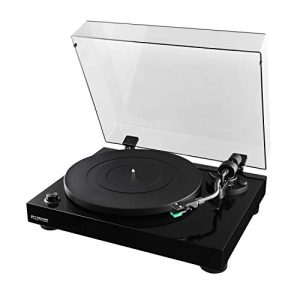
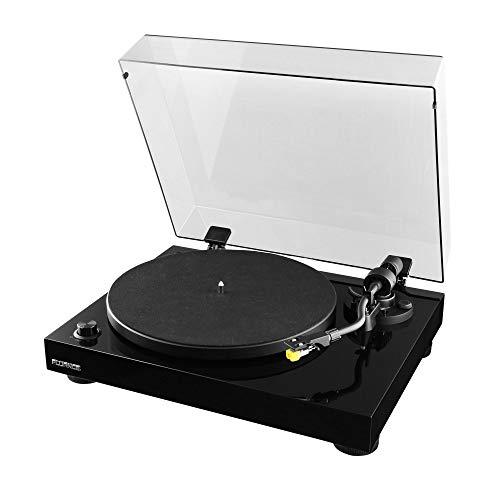
A built-in switchable phono preamplifier connects to powered speakers or to a phono input, and auto-stop switches the platter off at the end of a record. The high-mass MDF plinth, rubber mat and solid-body construction are designed to keep vibration down, and the deck is supplied with a dust cover. The RT81 sits in the semi-automatic group: the listener cues the arm manually, and auto-stop halts the platter when the side ends.
The Fluance RT81 is a belt-drive turntable with an Audio-Technica AT95E cartridge that uses a bonded elliptical stylus. It plays 33 1/3 and 45 RPM records through a balanced aluminum S-type tonearm with an adjustable counterweight, anti-skate control and a cueing lever. The headshell uses a bayonet mount, so cartridge swaps are a twist rather than a wiring job.
Considerations
Strengths: Elliptical AT95E cartridge; adjustable counterweight and anti-skate; removable bayonet headshell; built-in switchable preamp; auto-stop.
Limitations: Auto-stop does not lift or return the tonearm to its rest; there is no Bluetooth or USB output listed.
2. Denon DP-400 Semi-Automatic Analog Turntable with Speed Auto Sensor
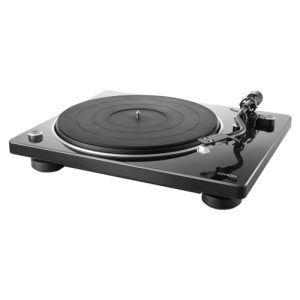
The Denon DP-400 is a semi-automatic belt-drive turntable with a speed auto sensor that maintains accurate rotation at 33 1/3, 45 and 78 RPM. The listener lowers the tonearm manually, and at the end of the side the arm lifts and the motor stops. Its curved S-type tonearm carries a pre-mounted moving-magnet cartridge on a universal headshell.
A weighted belt-driven platter is designed for stable rotation, and a built-in switchable phono equalizer connects to a phono input or a line input. The deck suits collections that span LPs, singles and 78 RPM records, because all three speeds are covered without a separate accessory. The controls stay analog and the signal path stays wired, which fits a dedicated listening setup built around an amplifier and speakers.
Considerations
Strengths: Semi-automatic lift and stop; speed auto sensor; 33/45/78 RPM; universal headshell; switchable phono equalizer.
Limitations: There is no Bluetooth or USB output listed; the listener still cues the arm by hand at the start of each side.
3. Fluance RT80 Classic High Fidelity Vinyl Turntable with Audio-Technica AT91 Cartridge
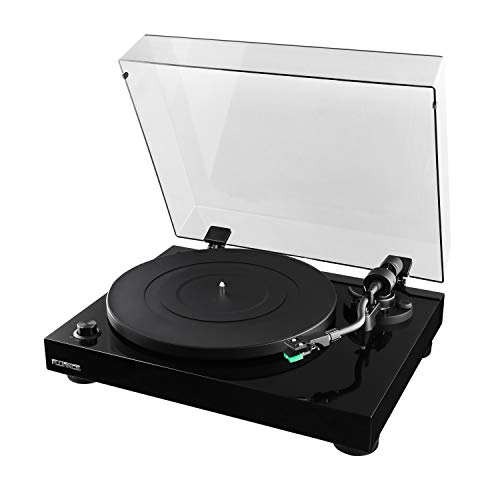
Auto-stop switches the platter off at the end of a record, so the stylus does not keep turning in the run-out groove. The built-in preamplifier can be switched on for powered speakers or a line input, or off for a phono input. A dust cover, RCA cable with ground wire and 45 RPM adapter are included, and the bayonet headshell supports cartridge changes later.
The Fluance RT80 is a belt-drive turntable with an Audio-Technica AT91 cartridge and a built-in phono preamplifier. It plays 33 1/3 and 45 RPM records through a balanced aluminum S-type tonearm with an adjustable counterweight and a cueing lever. The solid engineered wood plinth and aluminum platter with a felt mat give it a conventional hi-fi layout at the entry level of the Fluance range.
Considerations
Strengths: Built-in switchable preamp; adjustable counterweight; removable bayonet headshell; auto-stop; solid wood plinth.
Limitations: The AT91 cartridge is a simpler model than the AT95E and VM95E in the decks above it; auto-stop does not lift or return the arm, and there is no wireless output.
4. Fluance RT81+ Elite High Fidelity Vinyl Turntable with Audio-Technica VM95E Cartridge
The Fluance RT81+ builds on the RT81 with an Audio-Technica AT-VM95E cartridge, an acrylic platter mat and an anti-resonant platter. It is a belt-drive turntable playing 33 1/3 and 45 RPM records, with a balanced aluminum S-type tonearm, adjustable counterweight, anti-skate control and a cueing lever. The bayonet headshell can be removed for cartridge changes.
A built-in switchable phono preamplifier is included, and auto-stop halts the platter at the end of a side. Adjustable isolation feet help level the deck on a shelf or cabinet, and the wooden plinth and dust cover complete a conventional hi-fi presentation. As with the RT81, the listener lowers the arm manually; the automatic function is the stop at the end of the record.
Considerations
Strengths: VM95E cartridge with elliptical stylus; acrylic mat; adjustable isolation feet; removable headshell; built-in switchable preamp.
Limitations: Auto-stop does not return the tonearm; there is no Bluetooth or USB output listed, and the deck needs a wired connection to speakers or an amplifier.
How to Choose
The best semi-automatic hi-fi turntable is the one that cues easily, stops or lifts reliably at the end of a side, and accepts a better cartridge later.
Phono preamplifier
A built-in switchable phono preamplifier connects to powered speakers or a line input, and it can be switched off for a separate phono stage. That switch keeps the deck usable if the amplifier changes later.
Platter and plinth
A heavier platter and a solid MDF plinth help keep rotation steady and vibration down. A rubber or acrylic mat, isolation feet and a dust cover all contribute to a quieter presentation in a normal room.
Speeds
Most collections need 33 1/3 and 45 RPM. A 78 RPM setting is useful only for 78 RPM records, and it usually needs a different stylus, so choose it for the collection rather than for the specification alone.
Connectivity
Most semi-automatic decks in this guide are wired, with RCA output to an amplifier or powered speakers. Bluetooth and USB output appear on some models, so check the listing if wireless listening or digital archiving is part of the plan.
Setup and placement
A semi-automatic deck needs a level surface and room for the dust cover to open. Balance the arm and set tracking force and anti-skate during setup, and keep the deck away from speakers that vibrate the same shelf.
Semi-automatic operation
On a semi-automatic deck the listener cues the arm, and the deck handles the end of the side. Some models lift the arm and stop the motor, while others only stop the platter, so confirm which steps are automatic before choosing.
Frequently Asked Questions
What does semi-automatic mean on a turntable?
Semi-automatic means the listener starts playback by cueing the tonearm manually, and the deck handles the end of the side, either by lifting the arm and stopping the motor or by stopping the platter. The exact action varies by model and is noted for each pick below.
Do I need to balance the tonearm?
Yes, on decks with an adjustable counterweight. Balance the arm, set the tracking force for the supplied cartridge and set anti-skate during setup, following the manual for the model. That setup is part of owning a semi-automatic deck.
Can I use a semi-automatic turntable with powered speakers?
Yes, if the deck has a built-in phono preamplifier. All of the Fluance and Denon picks in this guide list a built-in switchable preamplifier, so they connect to powered speakers or to a line input without extra equipment.
Is a semi-automatic turntable hard to use every day?
No. The daily steps are placing the record, cueing the arm with the lever, and letting the deck handle the end of the side. The setup takes longer than a fully automatic deck, but daily use is straightforward once the arm is balanced.
Conclusion
Confirm the end-of-side action first, then compare the cartridge, the arm adjustment and the phono stage.
As an Amazon Associate, we earn from qualifying purchases.