📅 Last updated:
The best wave maker for most reef tanks in 2026 is the hygger Lite Wave Maker: it is rated for 50–120 gallon aquariums, which covers the majority of mixed-reef systems, it mounts with a magnet instead of suction cups, and it runs on DC power so you can dial flow up or down rather than accepting a single fixed speed. If your tank is a nano in the 15–40 gallon range, the hygger Mini Wave Maker is the better match. If you run a large SPS-dominated system or a tank well past 150 gallons, the JEREPOND 3450 GPH moves the kind of volume a small pump simply cannot. This guide covers seven currently available wave makers and powerheads, from budget two-packs to premium cross-flow units, and explains how to match flow rate, controllability, mounting style, and noise to your aquarium size and coral needs — plus how to keep dead spots from forming behind your rockwork.
📋 Table of Contents
- Top 3 Picks
- Quick Comparison
- How We Chose
- 1. hygger Mini Wave Maker – Best for Nano Reef Tanks
- 2. AQUANEAT 2 Pack Aquarium Circulation Pump – Best for Budget Two-Point Flow
- 3. hygger Lite Wave Maker – Best Overall for Mid-Size Mixed Reefs
- 4. hygger 10W 5/24 Wave Maker – Best for High-Flow Reef Systems
- 5. hygger 18W Adjustable Cross Flow Pump – Best for Wide, Broad Flow
- 6. JEREPOND 3450 GPH Aquarium Wave Maker – Best for Very Large Tanks
- 7. Flexzion Blue Aquarium Wave Maker – Best Budget High-Volume Option
- How to Choose
- Frequently Asked Questions
- The Bottom Line by Situation
Top 3 Picks
Best overall: hygger Lite Wave Maker. The 50–120 gallon rating lands it squarely in the most common reef tank bracket, the magnetic base works through glass without the slow failure of suction cups, and DC adjustability means you can tune turnover as corals grow instead of buying a second pump. It suits mixed-reef keepers who want controllable flow without paying premium prices.
Best budget: hygger Mini Wave Maker. For 15–40 gallon tanks it delivers the two things budget circulation pumps usually get wrong — a magnet mount and genuinely quiet operation. It is the least expensive way to add directional flow to a nano reef without a suction cup popping off at 2 a.m.
Best premium: hygger 18W Adjustable Cross Flow Pump with LED Display Controller. A cross-flow (gyre-style) impeller spreads a wide, laminar sheet of water across the tank rather than a narrow jet, and the LED display controller gives visible, repeatable settings. It is the pick for keepers who want broad, gentle flow across a large footprint.
Quick Comparison
See also: Bad Bunny Fortnite Festival Season 14 Headliner Info • Frozen Corn Dogs Brands Ranked: Best Picks
Every product below appears in a full section further down. Price tiers reflect general market positioning rather than any specific listing price, because retail prices on aquarium gear change constantly.
| Product | Best for | Key specs | Price tier |
|---|---|---|---|
| hygger Mini Wave Maker | Nano tanks, 15–40 gal | Rated 15–40 gal; magnetic mount; quiet operation; saltwater and freshwater; single fixed-speed AC pump | Budget |
| AQUANEAT 2 Pack Circulation Pump | Budget two-point flow, 40–75 gal | 800 GPH each, 1,600 GPH combined; submersible; saltwater and freshwater; two independent units | Budget |
| hygger Lite Wave Maker | Most mid-size mixed reefs, 50–120 gal | Rated 50–120 gal; adjustable flow; magnetic base; DC-driven; saltwater and freshwater | Mid-range |
| hygger 10W 5/24 Wave Maker | High-flow and SPS systems, 50–120 gal | 2,114 GPH; 10 W; rated 50–120 gal; 5/24 flow-cycle designation; saltwater and freshwater | Mid-range |
| hygger 18W Adjustable Cross Flow Pump | Wide, broad flow across large footprints | 18 W; cross-flow impeller; LED display controller; magnetic mount; DC 24 V | Premium |
| JEREPOND 3450 GPH Wave Maker | Very large tanks and high-turnover reefs | 3,450 GPH; DC 24 V; 20 W; adjustable controller; magnetic mounting | Premium |
| Flexzion Blue Aquarium Wave Maker | Budget high-volume flow | 2,200 GPH; submersible circulation pump for fish tanks | Budget |
How We Chose
Selection was based on published specifications, manufacturer documentation, and long-standing conventions in reef keeping rather than any form of physical evaluation — no unit here was purchased, installed, or measured for this article. The first filter was category fit: a product had to be a genuine in-tank circulation device (wave maker or powerhead), not a return pump, canister, or filter, because the two categories solve different problems and mixing them confuses turnover math.
The second filter was specification transparency. Products that state a flow rating, a tank-size range, a wattage, or a mounting method give a buyer something to compare against; products that state none of these were deprioritised. The third was upgrade path — whether the device lets a keeper increase or decrease flow as a reef matures, since a tank that is well-served at 15× turnover on day one often wants 25–30× two years later once stony corals fill in. Finally, we weighted mounting durability and controllability, because the two most common complaints about cheap circulation pumps are suction cups that fail and fixed speeds that cannot be tuned down for soft corals or LPS. The result is a spread of picks across budget, mid-range, and premium tiers so that tank size and coral type — not budget alone — drive the recommendation.
1. hygger Mini Wave Maker – Best for Nano Reef Tanks
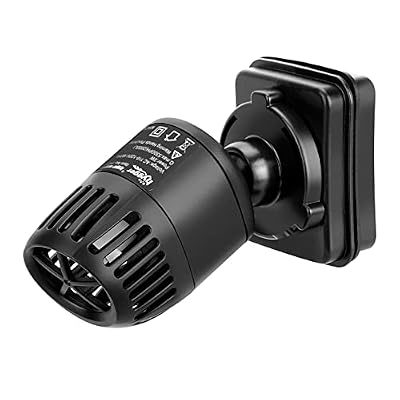
hygger Mini Wave Maker for 15-40 Gallon Aquarium with Magnetic Mount Quiet Powerhead for Saltwater and Freshwater Fish Tank 530 GPH
Included for 'Best Wave Makers and Powerheads for Reef Water Circulation' as a relevant option in this category; details come from the product listing.
View on AmazonThis is the pump to look at first if your aquarium is between 15 and 40 gallons. Nano reefs have a specific circulation problem: a single return nozzle cannot reach behind a rock wall in a small footprint, and full-size wave makers blow the sand bed into dunes and batter soft corals in a tank that small. The hygger Mini Wave Maker is sized for exactly that gap — a compact, submersible circulation pump rated by the manufacturer for 15–40 gallon aquariums and marketed for both saltwater and freshwater use.
Its headline feature is the magnetic mount. Instead of a suction cup that hardens, loses grip, and eventually lets the pump fall onto your coral, the magnet clamps the pump to the glass from both sides. That single design choice is the main reason this unit is worth more than a generic budget powerhead.
Key specs
- Rated tank size: 15–40 gallons
- Mounting: magnetic (internal magnet plus external magnet), no suction cups
- Noise: marketed as quiet operation; DC-class small impeller
- Water types: saltwater and freshwater
- Control: fixed flow — no external speed controller
- Form factor: compact, submersible, single directional outlet
Strengths
For a 20- or 30-gallon nano, the magnet mount alone justifies the budget-tier price. It also runs quietly enough for a bedroom or office tank, which is not a given at this price point — cheap AC powerheads often transmit a hum through the glass because the impeller housing vibrates against the mounting hardware. A small, compact body means it disappears behind rockwork rather than dominating the aquascape, and because it is rated for freshwater too, it works in a planted tank or a quarantine system if you later move it.
Pros
- Magnetic mount is far more reliable than suction cups on glass
- Correctly sized for 15–40 gallon tanks — will not sandblast a nano reef
- Quiet enough for bedrooms and offices
- Works in saltwater and freshwater, so it can be repurposed
- Lowest-cost entry into magnetic mounting in this list
Cons
- No speed controller — flow is whatever the pump delivers
- One unit means one flow direction; you may still need a second pump for the opposite end
- Will not scale to a 55-gallon or larger tank
- Small impellers of this class typically need cleaning more often than larger ones, since a thin film of calcium carbonate slows them noticeably
How it compares
The nearest alternative is the AQUANEAT 2 Pack, also budget tier. The AQUANEAT route gives you two pumps and roughly 1,600 GPH of combined flow, which is more total movement for similar money — but those units rely on classic powerhead mounting and fixed AC speed, and they are better suited to 40–75 gallon tanks where the extra volume helps. If your tank is under 40 gallons, the hygger Mini’s magnet and quieter running matter more than raw flow. If you are setting up a 55-gallon on a tight budget, the two-pack makes more sense.
2. AQUANEAT 2 Pack Aquarium Circulation Pump – Best for Budget Two-Point Flow

AQUANEAT 2 Pack Aquarium Circulation Pump,800 GPH Fish Tank Powerhead, Saltwater Wave Maker, Submersible Water Pump with Suction Cup
Included for 'Best Wave Makers and Powerheads for Reef Water Circulation' because the listing specifies 800 GPH Fish Tank Powerhead and Saltwater Wave Maker, details this guide uses to compare options.
View on AmazonBuying two smaller pumps instead of one large one is one of the most useful habits in reef circulation, and this product bakes that idea into the box. You get two 800 GPH submersible circulation pumps rated for saltwater and freshwater, for a combined 1,600 GPH of movement. Two pumps pointed at each other from opposite ends of the tank create chaotic, alternating flow and eliminate the single-jet problem that leaves one corner of the rockwork stagnant.
This is the pick for a budget-minded build in the 40–75 gallon range, or for a keeper who wants to add flow without committing to a controller-based system. It is also a sensible choice for a fish-only tank with live rock, where you need water movement across the rock but not the violent, variable surge a stony-coral reef demands.
Key specs
- Flow rating: 800 GPH per pump
- Quantity: two pumps, 1,600 GPH combined
- Type: submersible powerhead / circulation pump
- Water types: saltwater and freshwater
- Control: fixed AC speed, no controller
- Mounting: standard powerhead mounting hardware supplied with the pump
Strengths
The value proposition is the quantity. Getting two independently positionable pumps means you can aim one along the back glass and one across the front, which is the cheapest effective way to prevent dead spots behind and between rock structures. It also gives you redundancy: if one pump needs cleaning, the other keeps water moving while you work. For a 55-gallon fish-only-with-live-rock system, 1,600 GPH works out to roughly 29× turnover, which is comfortably in the range most reef keepers target.
Pros
- Two pumps in one purchase — immediate two-point flow
- 1,600 GPH combined is ample for 40–75 gallon tanks
- Redundancy if one unit is removed for cleaning
- Simple fixed-speed operation with nothing to program
- Works in freshwater tanks and mixing stations too
Cons
- No speed control — you cannot dial flow down for LPS or soft corals
- Fixed AC pumps in this class tend to run louder than DC equivalents
- Standard powerhead mounting is less secure long-term than a magnet
- Two pumps means two impellers to clean, not one
- Not the right tool for a nano tank — 800 GPH in a 20-gallon system is far too much
How it compares
Against the hygger Mini Wave Maker, the AQUANEAT pair wins on total flow and on the two-point flow principle, while the hygger wins on mounting security and noise. Against the Flexzion Blue 2200 GPH — the other budget option here — the comparison is about concentration versus spread. A single 2,200 GPH pump puts a lot of energy in one direction; two 800 GPH pumps spread the same general idea across two directions with less risk of blasting a single coral colony. If you have a tank with a central rock structure, two pumps beat one.
3. hygger Lite Wave Maker – Best Overall for Mid-Size Mixed Reefs

hygger Lite Wave Maker For 50-120 Gallons Aquarium Adjustable Circulation Pump with Magnetic Base Fish Tank DC Powerhead for Coral Reef and Freshwater Up to 2114 GPH
Included for 'Best Wave Makers and Powerheads for Reef Water Circulation' as a relevant option in this category; details come from the product listing.
View on AmazonIf you own one tank in the 50–120 gallon range and you want one circulation pump that will still be appropriate in two years, this is the pick. The hygger Lite Wave Maker is rated by the manufacturer for 50–120 gallon aquariums, uses a magnetic base, and — critically — is adjustable. That combination covers the widest set of real-world reef situations in this list.
The adjustability is what earns it the top spot. A tank that is well circulated at moderate turnover when it holds a few soft corals and a couple of fish wants considerably more movement once stony corals grow in and start blocking flow paths. A fixed-speed pump forces you to buy again. A controllable one lets you turn it up.
Key specs
- Rated tank size: 50–120 gallons
- Control: adjustable flow
- Mounting: magnetic base
- Drive: DC-powered, which is what makes speed adjustment practical
- Water types: saltwater and freshwater
- Form factor: submersible circulation pump / wave maker
Strengths
The magnetic base solves the single most common failure point in cheap circulation pumps. DC drive means the speed control is genuine rather than a mechanical restrictor, and DC pumps of this class are generally quieter than AC equivalents because the motor runs at a lower, more controlled speed. The 50–120 gallon range is deliberately broad, which means it works in a 65-gallon cube, a 75-gallon standard, a 90-gallon, or a 120-gallon long without being oversized at the small end or marginal at the large end.
For a mixed reef — soft corals, LPS, and a few stony pieces — this pump plus the return nozzle is usually enough to eliminate the obvious dead spots behind the rockwork. You can also add a second unit later and run them alternately for more chaotic flow, which is the standard upgrade path.
Pros
- Adjustable flow means it grows with the tank instead of being replaced
- Magnetic base holds through glass far more reliably than suction cups
- DC drive runs quieter than fixed AC powerheads in the same class
- Covers the 50–120 gallon range that most reef keepers actually own
- Works in freshwater as well, so it survives a change of direction
Cons
- One pump delivers one flow direction; a large tank with dense rockwork may still want a second unit
- Mid-range pricing sits above the budget two-pack options
- Magnet mounts have a maximum glass thickness — check your tank’s glass or acrylic thickness before ordering
- At the top of its rated range it will not satisfy a heavy SPS system on its own
How it compares
Its closest competitor in this list is the hygger 10W 5/24 Wave Maker, which is rated for the same 50–120 gallon window but is positioned for higher flow — 2,114 GPH at 10 W. The Lite is the better choice if you want to keep soft corals and LPS happy without a wind tunnel, or if you are unsure how much flow your reef can take. The 5/24 is the better choice if you already know you want high turnover, or if you are keeping stony corals that demand it. Both are mid-range, both are hygger, and the deciding question is simply how much flow your livestock tolerates.
4. hygger 10W 5/24 Wave Maker – Best for High-Flow Reef Systems

hygger 10W 5/24 Wave Maker 2114 GPH for 50-120 Gallon Saltwater & Freshwater Fish Tanks,Aquarium Circulation Pump with LCD Controller Powerhead& Magnetic Base
Included for 'Best Wave Makers and Powerheads for Reef Water Circulation' as a relevant option in this category; details come from the product listing.
View on AmazonThis is the same manufacturer’s answer to a different question: how do you move serious water in a 50–120 gallon tank without buying two pumps? The answer is 2,114 GPH from a 10 W pump, marketed for both saltwater and freshwater aquariums and designated “5/24” in the listing name — a flow-scheduling label, and the product listing itself is the authoritative source for exactly what each mode does. Treat that designation as a feature to confirm at purchase rather than an assumption.
The 10 W figure is worth pausing on. Moving roughly 2,100 GPH for ten watts is an efficient design, and efficiency matters in a reef tank because every watt of pump energy eventually becomes heat in the water. In a 90-gallon system with a closed canopy and warm ambient room temperatures, the difference between a 10 W pump and a 40 W pump can be the difference between a stable temperature and a chiller conversation.
Key specs
- Flow rating: 2,114 GPH
- Power draw: 10 W
- Rated tank size: 50–120 gallons
- Designation: “5/24” flow-cycle labelling — confirm mode behaviour in the listing
- Water types: saltwater and freshwater
- Form factor: submersible circulation pump / wave maker
Strengths
The flow-to-wattage ratio is the headline. In a 90-gallon tank, 2,114 GPH works out to roughly 23× turnover from a single device, which is a solid target for a mixed reef with growing stony corals and a respectable figure even for an SPS-dominant system when combined with a return pump. Because it draws only 10 W, you can run it continuously without worrying about heat contribution.
It also gives you headroom. A pump running at partial capacity is generally quieter and lasts longer than one running flat out, and if you pair this with a controller or run it alongside a smaller unit, you have flexibility to shape flow rather than simply blasting the tank.
Pros
- 2,114 GPH from a single unit — enough for high-turnover reefs in its size class
- Only 10 W, so minimal heat added to the water
- Efficient design keeps running costs negligible
- Rated across the 50–120 gallon window, so it fits a wide range of tanks
- Works in freshwater as well as marine systems
Cons
- High flow in the wrong tank will batter soft corals and push sand into dunes
- The “5/24” mode labelling needs confirmation in the listing rather than assumption
- Single directional outlet — a wide tank may still need a second pump for even coverage
- Overkill for anything below about 50 gallons
How it compares
Against the hygger Lite, this is the higher-flow sibling at the same rated tank size and the same price tier. Choose the Lite if you want to start gentle and turn up; choose the 5/24 if you already know your corals want strong, consistent current. Against the Flexzion Blue 2200 GPH — the budget high-flow alternative — the 5/24 is the more efficient and better-documented product, while the Flexzion sits a tier lower in price. If you are running a soft-coral tank in a 60-gallon cube, the Lite is the safer pick; if you are running stony corals in a 100-gallon, the 5/24 is the better match.
5. hygger 18W Adjustable Cross Flow Pump – Best for Wide, Broad Flow
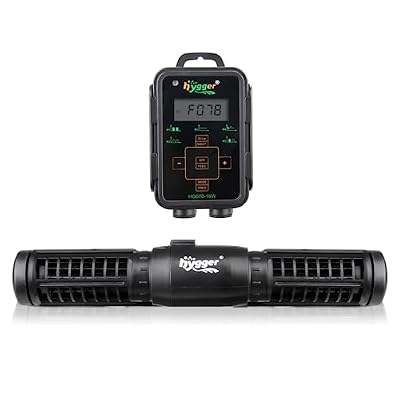
hygger Aquarium Wave Maker, 18W Adjustable Cross Flow Pump with LED Display Controller, Magnetic DC 24V Aquarium Powerhead for Freshwater and Marine Reef Aquariums Up to 135 Gallon
Included for 'Best Wave Makers and Powerheads for Reef Water Circulation' because the listing specifies 18W Adjustable Cross Flow Pump with LED Display Controller, details this guide uses to compare options.
View on AmazonCross-flow pumps — often called gyre pumps — work differently from standard powerheads. Instead of a propeller pushing water out of a round nozzle, a long cylindrical rotor draws water along its length and pushes it out as a wide, laminar sheet. The result is broad flow across the whole tank rather than a narrow jet, and that changes which tanks the pump suits.
The hygger 18W Adjustable Cross Flow Pump is a DC 24 V magnetic-mount unit with an LED display controller. The display matters more than it sounds: with a screen, you can see and repeat a specific setting rather than guessing at a dial position, which makes it much easier to return to a flow pattern after maintenance.
Key specs
- Power draw: 18 W
- Impeller type: cross-flow (gyre-style), producing a wide laminar sheet
- Controller: LED display controller with adjustable settings
- Mounting: magnetic
- Drive: DC 24 V
- Form factor: elongated horizontal body, submersible
Strengths
Broad flow is the right answer for several common situations. A long tank — a 120-gallon long, a 75-gallon, a frag system — has a length problem that a round nozzle cannot solve: a jet loses energy and disperses before it reaches the far end, so you end up with a strong zone and a weak zone. A cross-flow pump pushes a sheet of water the whole way down the tank, which is exactly the pattern that keeps detritus suspended and moving toward the overflow.
The LED display controller makes tuning practical. You can set a speed, observe how corals respond over a week, and adjust without losing your reference point. DC 24 V operation keeps the pump quiet and efficient, and the magnet mount holds the elongated body firmly against the glass — important, because a gyre pump that slips and rotates will spray water at your sand bed.
Pros
- Wide laminar flow covers more of the tank than a narrow jet
- LED display controller makes settings visible and repeatable
- Magnetic mount suits the long, horizontal body shape
- DC 24 V drive runs quietly and efficiently
- Excellent at keeping detritus suspended in long tanks
Cons
- Premium tier pricing
- Cross-flow rotors are longer and can collect debris along their length, so they need regular cleaning
- Less effective in a cube or a tall narrow tank where the length advantage disappears
- Placement is less forgiving than a small round powerhead — a poorly aimed gyre can strip flesh from corals near its output
How it compares
Against the JEREPOND 3450 GPH, the other premium option, the difference is flow character rather than quantity. The JEREPOND moves a very large volume through a more conventional outlet, which suits a big tank that needs raw turnover. The hygger cross-flow moves water as a wide sheet, which suits a long tank that needs even coverage rather than a single powerful current. In a 6-foot tank, the gyre is usually the better tool; in a 4-foot tank with dense rockwork, either works and the choice comes down to whether you prefer broad or concentrated flow.
6. JEREPOND 3450 GPH Aquarium Wave Maker – Best for Very Large Tanks

JEREPOND 3450GPH Aquarium Wave Maker with Adjustable Controller, DC24V 20W Powerhead with Magnetic Mounting, Wavemaker pump for coral reef or fresh water aquarium
Included for 'Best Wave Makers and Powerheads for Reef Water Circulation' because the listing specifies DC24V 20W Powerhead with Magnetic Mounting and Wavemaker pump for coral reef or fresh water aquarium, details this guide uses to compare options.
View on AmazonAt 3,450 GPH, this is the highest-rated flow figure in this list, and it is aimed at keepers with large systems. It is a DC 24 V pump drawing 20 W with an adjustable controller and magnetic mounting — a specification set that puts it firmly in premium territory while keeping the wattage sensible for its output.
The use case is straightforward. Once a tank passes roughly 125–150 gallons, small circulation pumps stop being a solution and start being a rounding error. You need a device that can move enough water to create turnover measured in multiples of the tank volume, and 3,450 GPH does that in a way that a pair of 800 GPH pumps cannot.
Key specs
- Flow rating: 3,450 GPH
- Drive: DC 24 V
- Power draw: 20 W
- Control: adjustable controller
- Mounting: magnetic mounting
- Form factor: submersible wave maker / powerhead
Strengths
For a 150-gallon reef, 3,450 GPH works out to 23× turnover from a single pump — a genuinely useful figure for a mixed reef, and a reasonable baseline for a stony-coral system when combined with a return pump and a second smaller pump. For a 120-gallon SPS-dominant tank, one unit alone delivers close to 29× turnover, which is the range many SPS keepers aim for.
Twenty watts for 3,450 GPH is efficient, and DC 24 V operation with an adjustable controller means you can run it below maximum most of the time. The magnetic mount is essential at this size — a pump this powerful falling off the glass would do real damage to an aquascape.
Pros
- 3,450 GPH is enough to carry a large tank’s turnover on its own
- Adjustable controller lets you dial flow down for acclimation or soft-coral zones
- DC 24 V drive is quiet and efficient at 20 W
- Magnetic mounting holds securely through thick glass
- Gives large-tank keepers a single-pump option instead of three small units
Cons
- Far too much flow for anything under about 100 gallons
- Premium pricing
- A single high-output pump creates one dominant flow pattern; you may still want a second, smaller unit for the opposite end
- Large impellers still accumulate calcium deposits and need periodic cleaning to stay quiet
How it compares
Against the hygger 18W Cross Flow, the choice is about tank geometry and flow style. The JEREPOND delivers a very high volume through a conventional outlet — the right answer for a big tank that needs turnover. The hygger spreads a wide sheet across a long footprint — the right answer when even coverage matters more than peak volume. Against the hygger 10W 5/24, the JEREPOND is the clear step up for tanks above 120 gallons; below that, the 5/24’s 2,114 GPH is usually plenty and costs less.
7. Flexzion Blue Aquarium Wave Maker – Best Budget High-Volume Option

Flexzion Blue Aquarium Wave Maker, 2200 GPH Circulation Pump for Fish Tanks
Included for 'Best Wave Makers and Powerheads for Reef Water Circulation' because the listing specifies 2200 GPH Circulation Pump for Fish Tanks, details this guide uses to compare options.
View on AmazonThis is the highest-flow budget option in the list: a 2,200 GPH submersible circulation pump for fish tanks, priced in the same tier as much smaller units. If your priority is raw flow per unit of spend and you are comfortable without a controller, this is the value play.
It suits a specific buyer: someone setting up a 75–125 gallon tank on a tight budget, or someone who wants a strong secondary pump to supplement a controllable primary. It is not the right choice for a nano tank, and it is not the right choice for a keeper who wants to fine-tune flow for delicate livestock.
Key specs
- Flow rating: 2,200 GPH
- Type: submersible circulation pump / wave maker
- Target use: fish tanks and reef systems requiring high water movement
- Control: fixed speed — no external controller
- Price tier: budget
Strengths
The flow-per-cost ratio is the reason to consider it. In a 100-gallon tank, 2,200 GPH is 22× turnover from one budget-priced device — a figure that would otherwise require a mid-range controllable pump. For a fish-only system with live rock, or a tank where the aquascape is open and the flow pattern does not need to be subtle, that is a lot of movement for the money.
Because it is fixed-speed, there is nothing to program and nothing to fail electronically. That simplicity has real appeal for a quarantine tank, a holding system, or a sump where you want dependable water movement without a controller in the chain.
Pros
- 2,200 GPH at a budget-tier price
- Enough flow for 75–125 gallon tanks from a single unit
- No controller to fail or program — simple fixed operation
- Useful as a secondary pump alongside a controllable primary
- Good fit for fish-only systems and holding tanks
Cons
- No speed control — you cannot dial it down for soft corals or LPS
- Budget fixed-speed pumps typically run louder than DC equivalents
- Mounting hardware is less secure long-term than a magnetic base
- Single directional outlet concentrates flow rather than spreading it
- Too powerful for tanks under roughly 50 gallons
How it compares
Against the AQUANEAT 2 Pack, both are budget tier, but they solve flow differently. The Flexzion concentrates 2,200 GPH in one direction; the AQUANEAT pair spreads 1,600 GPH across two directions. For a tank with a central rock structure and visible dead spots on both sides, two pumps are usually more effective than one stronger pump. Against the hygger 10W 5/24, the Flexzion is cheaper but lacks the efficiency and the documented control features; if the budget stretches, the hygger is the better long-term purchase.
How to Choose
Choosing a wave maker is really four separate decisions: how much flow, how much control, how it attaches, and how loud it is. Get the flow volume right first, because the other three only matter once the pump is the correct size for the tank.
Step 1: Work out your target turnover
Reef keepers measure circulation as turnover — the total pump output divided by the tank’s water volume, expressed as a multiple per hour. Return pumps and in-tank circulation pumps are counted together, but the in-tank pumps do most of the work. In-tank wave makers and powerheads have essentially zero head pressure to overcome, unlike a return pump pushing water up a pipe, so the nameplate GPH figure is a reasonable approximation of what you actually get.
| Tank volume | Soft coral / fish-only target (10–15×) | Mixed reef target (20–25×) | Stony coral target (30×+) |
|---|---|---|---|
| 20 gallons | 200–300 GPH | 400–500 GPH | 600+ GPH |
| 40 gallons | 400–600 GPH | 800–1,000 GPH | 1,200+ GPH |
| 75 gallons | 750–1,125 GPH | 1,500–1,875 GPH | 2,250+ GPH |
| 100 gallons | 1,000–1,500 GPH | 2,000–2,500 GPH | 3,000+ GPH |
| 120 gallons | 1,200–1,800 GPH | 2,400–3,000 GPH | 3,600+ GPH |
| 180 gallons | 1,800–2,700 GPH | 3,600–4,500 GPH | 5,400+ GPH |
Worked example: you have a 75-gallon mixed reef. Target 20× turnover means you want roughly 1,500 GPH of total in-tank movement. Your return pump contributes some of that — say 300 GPH after head loss. That leaves about 1,200 GPH to come from wave makers. The AQUANEAT 2 Pack delivers 1,600 GPH combined, which is slightly above target but fine, since you can aim the pumps so their streams partly oppose each other and lose energy in the collision. Alternatively, a single hygger Lite set to a moderate speed would land close to target with room to increase later.
Second worked example: a 120-gallon SPS-dominant system. Target 30× means 3,600 GPH. One JEREPOND 3450 GPH gets you to about 29× on its own, which is essentially on target. Add a modest return pump and you are comfortably above 30×, with a single device to clean instead of three.
Step 2: Decide how much control you need
Controllability is the feature that separates a pump you keep from a pump you replace. Three levels exist in practice:
- Fixed speed (budget tier). The pump runs at one speed whenever it is plugged in. Fine for fish-only tanks, quarantine systems, and any setup where you already know the flow is appropriate. Cheap, simple, no electronics to fail.
- Adjustable speed (mid-range and premium). A dial or controller lets you reduce or increase output. This is the single most useful feature for a mixed reef, because soft corals and LPS generally want less direct flow than stony corals, and you can place a strong pump and turn it down rather than buying a weaker one.
- Programmable modes and schedules (premium). Controllers with displays and multiple modes let you vary flow through the day, creating surge and lull periods. The benefit is real for stony corals, but the complexity is only worth paying for if you will actually use it.
A practical rule: if your tank is under 40 gallons, fixed speed is often fine because the pump is small and gentle by nature. If your tank is 50 gallons or more and holds any stony coral, buy adjustable. The premium you pay for a controller is usually less than the cost of replacing a fixed-speed pump that turned out to be the wrong strength.
Step 3: Match the mounting style to your tank
Mounting is where cheap pumps fail, and it is worth more attention than most buyers give it.
- Suction cups. The cheapest option. Suction cups hold well on clean glass and poorly on glass with any algae film. They harden over months, lose grip, and eventually release. In a reef tank, a falling pump can crush coral. Suction cups are acceptable for a temporary setup or a quarantine tank, not for a permanent display.
- Magnetic mounts. An internal magnet and an external magnet clamp the pump to the glass. They do not degrade the way suction cups do, they can be repositioned without draining anything, and they hold securely. The trade-off is a maximum glass thickness — most magnetic mounts specify one, and thick rimless glass or acrylic tanks can exceed it. Measure before you buy.
- Clamp or bracket mounts. Common on larger powerheads and some gyre pumps. Secure and adjustable, but they occupy rim space and can be awkward under a tight canopy.
For a permanent reef display, magnetic mounting is the default recommendation. For a tank with unusually thick glass, verify the mount’s rated thickness or plan on a clamp-style alternative.
Step 4: Plan for noise
Wave maker noise has three sources: motor hum, impeller rattle, and vibration transmitted into the glass. DC pumps generally run quieter than AC pumps of the same output because the motor speed is controlled electronically rather than fixed by mains frequency. Magnetic mounts help because the external magnet dampens vibration rather than passing it straight into the panel.
The most common cause of a pump that suddenly gets noisy is not the motor — it is a film of calcium carbonate or a trapped air bubble in the impeller well. A pump that hums after three months of service usually needs cleaning, not replacing. If a pump is noisy from day one, check that the impeller is seated correctly and that the pump is not touching the glass directly at any point other than its mount.
Step 5: Design against dead spots
A dead spot is any area of the tank where water movement is too weak to keep detritus suspended and to deliver oxygen and minerals to coral tissue. They form predictably: behind rock structures, in the shadow directly beneath a large pump, in corners where two flow streams cancel each other out, and along the sand bed in tanks where flow is aimed horizontally above the rockwork.
Prevention is easier than correction, and it comes down to three habits:
- Use two pumps rather than one, even if the total flow is the same. Two streams from opposite ends create chaotic, unpredictable movement that reaches more of the tank than a single stream of equal volume. This is why the AQUANEAT 2 Pack is often a better choice than one stronger pump at the same price.
- Aim across and slightly down, not straight down. A stream directed at the sand bed creates dunes and a bare patch, and the water above the sand stays still. Aim along the tank length, just above the rockwork, so flow travels across the display and pushes detritus toward the overflow.
- Vary the flow through the day if you can. Alternating between pumps, or using a controller with changing modes, prevents the same stagnant zone from persisting indefinitely. Even a simple manual adjustment once a week is better than a pattern that never changes.
A useful test with no equipment: drop a small amount of flake food or a pinch of fine coral food into the tank and watch where the particles travel and where they settle. Anywhere particles drift to and stop is a dead spot. Reposition a pump by a few degrees and repeat until the particles keep moving across the whole footprint.
Step 6: Understand the ownership realities
Wave makers are not maintenance-free, and knowing what wears out first prevents surprise replacements.
- Impellers and shafts wear first. The impeller assembly — magnet, shaft, and bushings — is the consumable part. When a pump becomes noisy or loses flow despite cleaning, the impeller assembly is usually the culprit. Many manufacturers sell these separately, so check availability before buying a brand.
- Calcium and carbonate deposits build on every wetted surface. In a reef tank, deposits accumulate on the impeller well, the shaft, and the inlet grille. The usual fix is a soak in white vinegar or a citric acid solution for a few hours, followed by a soft brush. A rough cleaning interval is every four to eight weeks for a heavily stocked stony-coral tank and every two to three months for a lightly stocked system.
- Never clean with abrasive pads or metal brushes. Scratched impeller wells and shafts run louder and wear faster.
- Magnet mounts need occasional cleaning too. Algae and coralline growth on the internal magnet reduce grip. Wipe the internal magnet and the glass it contacts when you clean the pump.
- Common mistakes: buying one oversized pump instead of two moderate ones; aiming flow directly at a coral colony; running a pump at full speed when it is rated far above the tank’s needs; ignoring a rattle until the impeller is damaged; and forgetting that a pump’s magnet rating is tied to glass thickness.
One more ownership note: electricity cost for these pumps is negligible. A 10 W pump running continuously for a year uses roughly 88 kilowatt-hours, and a 20 W pump roughly 175. Even at premium tier pricing, the purchase price dominates the total cost of ownership, so efficiency should be a tiebreaker between similar pumps rather than the deciding factor.
Frequently Asked Questions
How many wave makers do I need for a reef tank?
Most tanks between 40 and 120 gallons do well with two circulation pumps plus the return outlet. Two pumps create chaotic, opposing flow that reaches more of the rockwork than one pump of the same total output. Tanks under 40 gallons often need only one small pump, and very large tanks above 150 gallons may need two high-output pumps or a high-output pump plus a smaller secondary.
Can I use too much flow in a reef tank?
Yes, and it is more common than under-flowing. Excessive direct flow damages soft corals, prevents LPS polyps from expanding, pushes sand into dunes, and can strip tissue from stony corals placed too close to an outlet. The sign of too much flow is a coral that stays retracted or a sand bed that will not stay level. Reduce speed if your pump is adjustable, or reposition the outlet to aim along the glass rather than at the aquascape.
Are magnetic mounts really better than suction cups?
For permanent displays, yes. Suction cups grip well when new but harden and release over time, and a falling pump can crush coral. Magnets hold through glass, can be repositioned without draining the tank, and do not degrade the same way. The main limitation is glass thickness — most magnetic mounts specify a maximum, and thick glass or acrylic can exceed it, so check the rating before ordering.
How often should I clean a wave maker?
For a heavily stocked stony-coral tank, every four to eight weeks. For a lightly stocked mixed reef, every two to three months. A soak in white vinegar or citric acid solution followed by a soft brush removes the calcium and carbonate film that causes noise and flow loss. Cleaning more often than needed is harmless; cleaning less often is what shortens pump life.
Why is my wave maker suddenly noisy?
Almost always deposits or air. A film of calcium carbonate on the impeller or shaft unbalances it and produces a hum or rattle. Trapped air in the impeller well after a water change produces a similar sound that usually clears within minutes. Clean the impeller assembly and shaft, check that the impeller is seated correctly, and confirm nothing is touching the glass except the mount.
Do I need a DC wave maker, or is AC fine?
AC is fine for fish-only tanks, quarantine systems, and any setup where a fixed flow rate is appropriate. DC is worth the extra cost when you want adjustable speed, quieter running, or programmable modes. In practice, most reef keepers with stony corals end up wanting DC because they need to tune flow as colonies grow.
What is a cross-flow or gyre pump, and do I need one?
A cross-flow pump uses a long cylindrical rotor to push a wide, laminar sheet of water along the tank instead of a narrow jet from a round nozzle. It suits long tanks — four feet and up — where a conventional jet loses energy before reaching the far end. In a cube or a tall narrow tank, the length advantage disappears and a standard powerhead is usually simpler and cheaper.
How do I find dead spots in my tank?
Drop a pinch of fine food or a few flakes into the water and watch where particles travel and where they settle. Anywhere particles stop moving is a dead spot. Reposition a pump a few degrees and repeat until the particles keep circulating across the entire footprint. The predictable problem areas are behind rock structures, directly beneath large pumps, and along the sand bed.
The Bottom Line by Situation
If you have a nano reef between 15 and 40 gallons, buy the hygger Mini Wave Maker — the magnetic mount and quiet running matter more at that size than raw flow. If you are building a 40–75 gallon tank on a tight budget and want flow from two directions, the AQUANEAT 2 Pack gives you the most useful movement per unit of spend. If you own one mid-size tank in the 50–120 gallon range and want a pump that will still be appropriate in two years, the hygger Lite Wave Maker is the best overall choice because its adjustable flow grows with the tank. If you already know your corals want strong, consistent current, step up to the hygger 10W 5/24 for its 2,114 GPH at only 10 W. If you run a long tank and want broad, even coverage rather than a single powerful jet, the hygger 18W Cross Flow with its LED display controller is the pick. If your system is 150 gallons or more, the JEREPOND 3450 GPH delivers the turnover a large tank needs from a single device. And if the budget is the binding constraint and the tank is 75 gallons or larger, the Flexzion Blue 2200 GPH moves serious water for the least money — just accept the fixed speed and plan to clean the impeller regularly.