📅 Last updated:
Hardwood floors require a delicate balance of soft-touch materials and high airflow, especially in homes with cats or dogs where stray kibble, fine dander, and long fur constantly settle into wood grain and plank grooves. Using the wrong cordless vacuum can cause micro-scratches on polyurethane coatings, scatter pet litter across the floor, or choke the intake with hair tangles. To keep timber surfaces gleaming without sacrificing cleaning power, you need to look beyond raw motor wattage and evaluate how a machine handles delicate, non-porous surfaces.
As cordless technology has evolved for 2026, manufacturers offer an overwhelming array of specialized attachments, smart sensors, and suction modes. However, expensive features do not always translate to better performance on hard floors. This guide breaks down the essential mechanical design choices, filtration standards, and battery architectures that truly matter when choosing a cordless vacuum for hardwood floors. By focusing on these core factors, you can select a lightweight unit that simplifies daily cleanup while preserving the natural beauty of your flooring.
As an Amazon Associate we earn from qualifying purchases at no extra cost to you.

📋 Table of Contents
Soft Fluffy Rollers vs. Standard Bristle Bars
When shopping for a hardwood vacuum, the brush head configuration is the single most important component to evaluate. Traditional vacuum cleaner heads rely on stiff nylon bristles designed to agitate carpet fibers. On hard surfaces, these rigid bristles tend to flick heavy particles across the floor rather than pulling them up, and over time, they can leave fine micro-abrasions on soft floor finishes like wax or oil-treated wood.
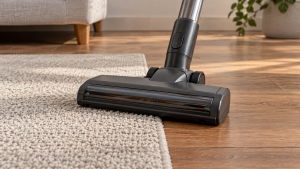
For hardwood flooring, look for primary floor heads equipped with a dense, soft woven nylon roller paired with rows of anti-static carbon fiber filaments. Soft rollers maintain continuous contact with the floor surface, forming a temporary seal that channels vacuum pressure directly around debris. The soft fabric envelopes large particles like stray dry dog food without pushing them forward, while the carbon fiber threads neutralize static charges to scoop up micro-dust and pet dander that usually cling stubbornly to polished timber.
Airflow Efficiency over Raw Vacuum Pressure
See also: Best Digital Thermometer for Newborn: 6 Picks for New Parents • Jurong Bird Park Food
Vacuum manufacturers frequently highlight sealed suction measurements or motor wattage numbers, but high suction alone can actually hinder hardwood cleaning. Excessive suction pressure can cause a motorized cleaner head to seal flat against smooth floorboards, making the machine difficult to push and potentially scratching sensitive sealants. Furthermore, high static suction does not guarantee efficient pickup if air movement is restricted.
Instead of relying strictly on suction metrics, prioritize high airflow, which is measured in cubic feet per minute. Robust airflow creates a sweeping effect that draws dust and pet hair into the intake duct from the sides of the nozzle and between narrow floorboard gaps. A well-designed floor head balances air intake channels with low suction resistance, allowing the machine to capture heavy pet debris without sticking to the floor or placing unnecessary strain on the motor.
Fully Sealed HEPA Filtration for Pet Homes
Hardwood floors highlight microscopic dust, shed dander, and dried mud far more noticeably than carpeted rooms. When you vacuum non-porous surfaces, exhaust air from an inefficiently filtered vacuum blows directly toward the floor, scattering surrounding dust and recirculating microscopic allergens back into your living space. This creates an endless cycle of wiping and re-cleaning surfaces.
To prevent secondary pollution, choose a cordless vacuum featuring a fully sealed filtration system with a post-motor high-efficiency particulate air filter. A fully sealed mechanism ensures that all air drawn into the vacuum passes directly through every filter layer without leaking through seams, latches, or motor housing vents. This traps ultrafine dander and dust mites inside the dustbin, ensuring that exhaust air blown across your clean floorboards is completely free of allergens.
Anti-Tangle Technology and Pet Hair Pickup
Long pet hair poses a significant challenge for motorized floor heads, frequently wrapping tightly around the central spindle. On hard floors, a tangled brush roll loses its ability to maintain contact with the ground and can cause motor overheating or belt failure. Clearing hair wraps by hand with scissors is time-consuming and risks damaging delicate soft roller fabrics.
Look for floor heads specifically designed with integrated comb teeth, arched guide vanes, or dual-spinning rollers. Comb teeth sit inside the brush housing to continuously strip wrapped hair off the roller and direct it straight into the suction path before it can bind. Alternatively, open-ended single-spindle rollers allow hair to slide off naturally into the air channel, preserving cleaning efficiency during heavy daily shedding seasons.
Battery Management and Real-World Runtime
Cordless vacuums rely on lithium-ion battery packs that degrade over time if subjected to high heat or continuous deep discharges. High-power boost modes draw massive amounts of current, reducing battery runtimes to mere minutes and generating excess heat. Fortunately, hardwood floors rarely require maximum suction settings because debris sits on top of the surface rather than embedded deep within carpet fibers.
Opt for models featuring removable, click-in battery systems and intelligent power regulation. Removable batteries allow you to swap in a fresh pack during longer cleaning sessions and simplify future replacements without replacing the whole vacuum unit. Operating your vacuum on medium or eco mode provides ample suction for wood floors while extending runtime to thirty or forty minutes, keeping battery temperatures low and extending total battery lifespan.
Ergonomics, Swivel Articulation, and Clearance
The lightweight nature of cordless stick vacuums makes them ideal for multi-story homes, but poor weight distribution can lead to wrist fatigue. Top-heavy designs place the motor and battery near the handle, making overhead cleaning easy but putting extra strain on your hand during low-level floor cleaning. Models with lower center-of-mass configurations or balanced handle angles reduce physical strain during extended floor sessions.
Maneuverability beneath furniture is equally critical for hardwood care. Dust and fur accumulate rapidly under sofas, sideboards, and bed frames where airflow is limited. Select a unit equipped with a 180-degree swivel steering neck and a lay-flat floor wand profile. A cleaner head height under three inches allows you to reach deep beneath low-clearance furniture without scuffing wooden chair legs or baseboards.
Related Guides
To see which specific models excel in our real-world laboratory testing for suction, delicate floor safety, and pet hair handling, explore our hands-on review of the best cordless vacuums for hardwood floors to find the ideal match for your home.
FAQ
Can stiff bristle brush bars damage hardwood floor finishes?
Yes, traditional stiff bristle bars can cause micro-scratches on delicate polyurethane, wax, or oil finishes over time. Additionally, stiff bristles tend to kick hard particles like pet litter across smooth surfaces rather than sweeping them into the intake path.
How much suction power is necessary for cleaning hardwood floors?
Hardwood floors do not require high static suction because pet hair and debris sit on the floor surface rather than inside deep fibers. High airflow efficiency paired with a soft velvet roller is far more important than extreme vacuum pressure for hard floor pickup.
How frequently should I clean a soft roller vacuum head?
You should inspect and clean your soft roller brush head every two to four weeks depending on shed volume. Most soft rollers can be easily unlatched and washed under cool water, but ensure they are completely dry before reattaching them to avoid trapping moisture near electrical components.
What is the best way to prevent pet hair from tangling in a cordless vacuum?
Choose a vacuum with built-in hair-removal comb teeth or anti-tangle roller geometry. Additionally, vacuuming in eco or normal mode creates steady airflow that pulls long hair directly into the dustbin before it can wrap around the rotating axle.