- Top Pick: TBTeek Cat Toy, Automatic Motion-Activated, 5 Fun Patterns, 4 Speed Modes
- Best Value: YVE LIFE Interactive Cat Toys Laser for Indoor Cats,Automatic Kitten Toys
- Premium Choice: Potaroma Smart Sensor Cat Laser Toys Interactive, Motion Activated Truly Random Trjajectory, Clamp Design, Automatic Chargeable Kitten Toy Indoor Exercise, Cream White
📅 Last updated:
As an Amazon Associate, All Ears Pet Care earns from qualifying purchases. This article contains affiliate links — if you buy through them we may earn a small commission at no extra cost to you. We only recommend products we believe in.

TL;DR: Automatic rotating cat laser toys provide consistent, schedule-based exercise for indoor cats without requiring your constant attention. The best models offer variable speed, multi-pattern rotation, and built-in auto-off timers to prevent overstimulation.
As an Amazon Associate we earn from qualifying purchases at no extra cost to you.


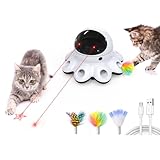


Best Automatic Cat Laser Toy with Rotating Patterns: Keep Your Cat Active All Day
Indoor cats face a hidden health crisis: boredom-driven inactivity that leads to obesity, destructive behavior, and anxiety. The automatic cat laser toy was designed specifically for this problem. Unlike interactive toys that require you to hold a wand, an automatic rotating laser runs scheduled play sessions throughout the day—even when you’re at work, in meetings, or asleep.
The difference between a cheap $8 laser and a quality automatic toy is dramatic: unpredictable rotation patterns, multiple speed settings, obstacle-avoidance sensors, and auto-off timers transform what could be a repetitive light dot into genuine prey simulation that engages your cat’s full hunting sequence.
🛒 Best Price Today on Amazon
Prime members get fast, free shipping on everything above, plus member-only deals. New members get a 30-day free trial — cancel anytime.
📋 Table of Contents
Top Automatic Cat Laser Toys
The best automatic laser toys share one crucial design principle: unpredictability. A laser that moves in a perfectly predictable circle quickly loses a cat’s interest. Random pattern algorithms that vary speed, direction, and arc length mimic the erratic movement of real prey—mice don’t run in circles. When the pattern feels alive and unpredictable, your cat’s hunting drive stays fully engaged.
Key Features That Separate Good from Great
See also: Washable Kitten Bed With Removable Cover: 7 Easy-Wash Picks • Cat House for Outdoor Cats: Insulated Shelters and Straw Bedding
When evaluating automatic cat laser toys, these are the specs that matter most:
- Pattern variety: Look for at least 3–5 distinct movement patterns. Some models offer 10+ algorithmically randomized paths. More variety = longer engagement over time.
- Speed settings: Multiple speed levels let you match intensity to your cat’s energy level and age. Kittens need faster movement; senior cats benefit from slower patterns.
- Auto-off timer: Critical for preventing laser fixation—a real behavioral problem where cats become obsessively anxious after laser play. A 15-minute session with an automatic shut-off is ideal.
- Laser class: Only Class I or Class II lasers (under 1mW) are safe for cat toys. Avoid products that don’t specify laser class or claim high-power output.
- Silent motor: Cats are extremely sensitive to mechanical sound. A noisy motor will spook your cat before the laser session even begins.
- Scheduling capability: Premium models let you set 2–4 daily sessions automatically, ensuring consistent exercise even on your busiest days.
For households where exercise is an ongoing priority, pairing a laser toy with a dedicated physical exercise tool creates a comprehensive fitness routine. See our review of the cat exercise wheel for a high-intensity cardio option that complements laser play sessions.
Automatic Laser Toy Comparison
| Feature | Basic | Mid-Range | Premium |
|---|---|---|---|
| Pattern count | 1–2 circles | 3–5 patterns | 8–12 random patterns |
| Speed settings | 1 fixed | 2–3 speeds | 5+ adjustable |
| Auto-off timer | No | 15 min fixed | 5/10/15/20 min selectable |
| Scheduling | No | No | 2–4 sessions/day |
| Power source | Batteries only | Batteries/USB | USB-C + battery backup |
| Laser safety class | Often unspecified | Class II | Class I (safest) |
| Motor noise | Audible clicking | Low hum | Near-silent |
| App control | No | No | Some models yes |
The Laser Fixation Problem and How to Avoid It
Laser toys are controversial among some veterinary behaviorists because cats can develop a compulsive, anxious fixation on light—chasing reflections, shadows, and spots on the wall long after the laser is off. This happens when cats are never given a satisfying “catch” at the end of the hunt.
The solution is simple: end every laser session by directing the beam to a physical toy—a mouse, crinkle ball, or feather wand—that your cat can pounce on and “catch.” This completes the prey sequence and prevents frustration. Products with automatic shut-off timers help, but the end-session physical toy is non-negotiable for responsible laser play.
Interactive puzzle-based enrichment complements laser play well by engaging a different type of mental stimulation. Our guide on interactive treat dispenser toys covers the enrichment science that applies equally to cats.
Setting Up for Maximum Engagement
Placement matters. Set the toy at ground level on a hard floor—the laser pattern is most engaging when cats can slide, skid, and leap in pursuit. Avoid carpet-only rooms where pouncing is muffled. The optimal play zone is a clear 6–8 foot radius with some furniture the cat can dart behind to simulate ambush behavior.
Position the toy near a wall rather than the center of a room. The laser hitting the baseboards and corners adds a new dimension of unpredictability—suddenly the “prey” disappears into a corner and reappears from an unexpected angle. Experienced cat owners report this wall-corner pattern generates the highest intensity engagement.
If your cat watches birds through the window and you want to enhance that enrichment, check our Furbo Mini 360 pet camera review for interactive two-way audio that lets you trigger play remotely even when you’re not home.
Frequently Asked Questions
Are automatic cat laser toys safe for cats’ eyes?
Yes, when using Class I or Class II lasers (under 1mW output). These are the same power levels used in presentation pointers and are safe for incidental eye exposure. Never purchase a toy that doesn’t specify its laser class, and avoid any product claiming “high power” output. The rotation speed and auto-off timer also reduce cumulative exposure compared to manually-operated lasers.
How long should a cat laser toy session last?
10–15 minutes per session is the sweet spot for most adult cats. Kittens can handle two 10-minute sessions. Sessions longer than 20 minutes increase the risk of laser fixation and obsessive behavior. An auto-off timer is not just a convenience feature—it’s a behavioral health tool. Always end the session with a physical toy your cat can catch.
Will my cat lose interest in an automatic laser toy over time?
Cats will habituate to any stimulus that becomes too predictable. To prevent this, choose a model with multiple randomized patterns and rotate sessions between the laser and other toy types. Taking the toy away for a week and reintroducing it also resets novelty. Some premium models update their pattern algorithms via firmware—look for this feature if long-term engagement is a priority.
Can I use an automatic laser toy for kittens?
Yes, with supervision for kittens under 6 months. At this age, cats are still developing their prey-chase instincts and laser play is highly beneficial for coordination and confidence. Use the slowest speed setting and keep sessions under 10 minutes. Always supervise young kittens during laser play to ensure they’re not becoming anxious or frustrated rather than playfully engaged.
What’s the best surface to use an automatic cat laser toy on?
Hard floors—hardwood, tile, or laminate—give the best experience because they allow the cat to slide on pounces and create the slipping, skidding movement that mimics chasing real prey. The laser dot is also more visible on light-colored hard floors. Avoid thick carpet for primary sessions, though occasional carpet play is fine. Place the unit on a stable, flat surface to prevent the rotation angle from drifting during a session.