📅 Last updated:
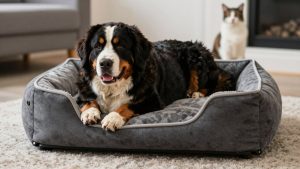
If you live with a Bernese Mountain Dog you already know the tumbleweeds. The breed has a thick double coat, a soft woolly undercoat under a longer, glossy outer coat, that sheds steadily all year and blows heavily twice a year, usually in spring and fall. Without the right brushes that hair ends up on your floor, and the undercoat packs into mats behind the ears, in the “pants” on the back legs, and under the collar. Here are the tools that actually work on Berner coat and how to use them.
📋 Table of Contents
The core Berner brush kit
Undercoat rake
This is the most important tool. An undercoat rake with one or two rows of rounded teeth, about 3/4 inch to 1 inch long, reaches through the outer coat and pulls out loose undercoat. During shedding season it can remove a startling volume of hair in one session.

Self-cleaning Undercoat Rake for Dogs Double Coated Long Hair Grooming Tool
Included for 'Best Dog Grooming Brush for Bernese Mountain Dog' as a relevant option in this category; details come from the product listing.
View on Amazon
Dog Brushes for Grooming Large Dogs, Undercoat Dog Rake Long Hair Pet Comb Pet Grooming Brush with Anti-Slip Handle, Steel Comb for Golden Retriever Husky German Shepherd
Included for 'Best Dog Grooming Brush for Bernese Mountain Dog' because the listing specifies Steel Comb for Golden Retriever Husky German Shepherd, details this guide uses to compare options.
View on Amazon
Max Undercoat Rake for Dogs & Cats, Dog Brush for Shedding, Dematting Comb
Included for 'Best Dog Grooming Brush for Bernese Mountain Dog' because the listing specifies Dog Brush for Shedding and Dematting Comb, details this guide uses to compare options.
View on AmazonSlicker brush
A large slicker brush with fine, bent pins lifts loose hair and works through small tangles. Choose one with flexible pins or a cushioned head, and use light pressure. Pressing hard with a slicker can cause brush burn on the skin.
Pin brush
A long-pin brush smooths the outer coat and finishes the look after raking. It is gentle enough for daily use.
Metal comb
A steel greyhound-style comb with wide and narrow teeth is how you check your work. If the comb glides from skin to tip, the area is done. It is essential for the soft fur behind the ears, where Berners mat most easily.
Deshedding tool, used carefully
Bladed deshedding tools remove lots of undercoat fast, but overuse can cut or thin the outer guard hairs and dull the coat. Use them sparingly during heavy sheds rather than every day.
Brush comparison for Bernese coat
See also: Best Electric Dog Fences for Reliable, Humane Containment • Best Dog Boots for Basset Hound
| Tool | Job on a Berner | How often |
|---|---|---|
| Undercoat rake | Removes loose undercoat | 2 to 3 times a week, daily in a heavy shed |
| Large slicker brush | Lifts loose hair, small tangles | 2 to 3 times a week |
| Pin brush | Smooths and finishes outer coat | After raking or daily |
| Greyhound comb | Finds hidden mats, checks work | Every session |
| Bladed deshedding tool | Fast undercoat removal | Occasionally during a coat blow |
| Mat splitter | Breaks up stubborn mats | As needed, gently |
A brushing routine that works
- Start with a quick pass of the pin brush to find tangles.
- Work in sections with the undercoat rake, lifting the outer coat and raking in the direction of growth, down to the skin.
- Follow with the slicker on the same section.
- Finish with the comb. Pay special attention to behind the ears, under the collar, the armpits, the feathering on the legs, and the thick fur on the back of the thighs.
Plan on 20 to 30 minutes, two or three times a week, and more often during a coat blow. A high-velocity dryer on a cool setting, used outdoors, can blast out massive amounts of loose undercoat before brushing.
Why you should not shave a Berner
It is tempting in summer, but the double coat insulates against both heat and cold and protects the skin from sunburn. Shaving can also lead to patchy or slow regrowth. Keeping the undercoat thoroughly brushed out is what helps a Berner stay cooler. Tidy trimming of the feet, around the ears, and sanitary areas is fine.
What regular brushing tells you
Grooming time is a good time to check your dog. Bernese have a higher risk of certain cancers, including histiocytic sarcoma, so note any new lumps, and check for hot spots, which can develop under dense damp coat. Anything new, growing, or sore is worth showing your vet promptly.
Common mistakes
- Brushing only the top layer. The outer coat looks fine while the undercoat mats against the skin.
- Using a slicker with heavy pressure and causing brush burn.
- Bathing a dog with mats; water tightens them. Brush out first.
- Skipping the ears and pants, the two places Berners mat first.
FAQ
How often should I brush my Bernese Mountain Dog?
Two to three times a week normally, and daily during the heavy spring and fall sheds. Short, frequent sessions are easier on both of you than a marathon once a month.
What is the single best brush for a Berner?
If you buy only one tool, get an undercoat rake. Then add a slicker and a metal comb as soon as you can, because the comb is how you find mats before they become a problem.
Bottom line
The best grooming brushes for a Bernese Mountain Dog are an undercoat rake, a large soft slicker, a pin brush, and a steel comb, used in sections down to the skin two or three times a week. Keep the coat intact rather than shaving, and use brushing time to check for lumps, hot spots, and mats behind the ears.