📅 Last updated:
The best electric dog fences are in-ground systems for the most stable boundary, wireless systems for fast setup and portability, and GPS fences for very large or irregular properties where burying wire is impractical.
📋 Table of Contents
Quick comparison: wireless, in-ground, and GPS fences
| System type | Typical coverage | Installation | Boundary stability | Typical collar runtime | Best for |
|---|---|---|---|---|---|
| Wireless radio | Up to about 3/4 acre in a circular boundary | 15–60 minutes; no digging | Moderate; affected by terrain, buildings, and interference | 1–3 months per replaceable battery, or roughly 1–3 weeks rechargeable | Renters, small open yards, temporary containment |
| In-ground wire | Usually 1/3 acre to several acres; expandable with extra wire | Several hours; trenching or stapling required | High when the wire is installed correctly | 1–3 months replaceable, or roughly 1–3 weeks rechargeable | Permanent yards, shaped boundaries, multiple exclusion areas |
| GPS fence | Several acres to very large properties, depending on model | App-based mapping; no boundary wire | Variable; depends on satellite reception and map accuracy | About 1–3 days for many rechargeable collars | Large rural properties, travel, irregular boundaries |
These are typical market ranges rather than guarantees. Actual coverage, battery life, and boundary precision vary with the system, landscape, collar settings, and how often the dog approaches the boundary.

PetSafe Wireless Pet Containment System, Up to 1/2 Acre
Included for 'Best Electric Dog Fences for Reliable, Humane Containment' because the listing specifies Up to 1/2 Acre, details this guide uses to compare options.
View on Amazon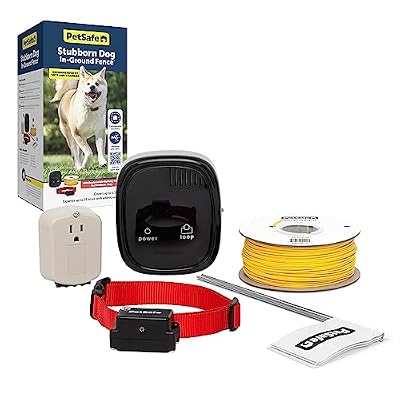
PetSafe Stubborn Dog In-Ground Fence, Up to 1/3 Acre
Included for 'Best Electric Dog Fences for Reliable, Humane Containment' because the listing specifies Up to 1/3 Acre, details this guide uses to compare options.
View on Amazon
PetSafe Basic In-Ground Fence, 2 Dog, Up to 1/3 Acre
Included for 'Best Electric Dog Fences for Reliable, Humane Containment' because the listing specifies 2 Dog and Up to 1/3 Acre, details this guide uses to compare options.
View on AmazonOur picks by situation
See also: Best Dog Boots for Basset Hound • Best Dog Crate for Basset Hound
- Best for the most dependable permanent boundary: a wired in-ground system such as PetSafe or SportDOG’s compatible underground-fence ranges.
- Best for quick installation: a wireless radio system from PetSafe, provided the yard is reasonably open and roughly circular.
- Best for very large or irregular land: a GPS system such as SpotOn or Halo, with careful attention to subscription requirements, reception, and the manufacturer’s supported regions.
- Best for multiple dogs: an expandable in-ground kit with individually adjustable collars, especially when dogs differ substantially in size or temperament.
- Best for frequent travel: a GPS system or portable wireless unit. A permanent wired system is usually inconvenient to move.
- Best budget choice: an in-ground system when you can install the wire yourself. The initial work is greater, but replacement wire is inexpensive compared with buying a new transmitter for a larger property.
Wireless versus in-ground: the important head-to-head differences
Coverage area and boundary shape
Wireless systems create a circular boundary around a central transmitter. That makes them simple, but it also means you cannot neatly follow a property line, protect a garden inside the yard, or include a long side passage without also creating unwanted boundary zones.
In-ground systems use a continuous loop of boundary wire. You can route it around an irregular lot, create exclusion loops around a pool or flower bed, and connect separate sections. The trade-off is that every break, poor splice, or accidental cut can disable part of the boundary.
GPS systems are the most flexible on paper. You draw a digital boundary in an app rather than laying wire. However, a mapped boundary is not a physical fence. Buildings, tree cover, terrain, satellite conditions, and the collar’s positioning can affect how accurately the warning zone is represented.
Boundary stability
For a fixed home yard, in-ground wire usually wins. Once buried or secured, it does not move when furniture, vehicles, or people are nearby. Wireless transmitters are easier to install but can be sensitive to where the transmitter is placed. Keep it indoors or under cover as directed, away from large metal objects and sources of radio interference.
GPS systems need a clear view of the sky and a reliable connection for setup and updates. Before choosing one, check whether the manufacturer supports your country and whether the app requires a recurring subscription.
Collar fit and correction settings
Fit matters more than maximum range. The collar should be snug enough that the contact points maintain consistent contact without being tight. You should normally be able to slide one or two fingers between the strap and the dog’s neck. Check the fit again after the first few minutes of activity and regularly thereafter.
Look for collars with:
- Multiple contact-point or probe lengths for different coat thicknesses
- A lightweight receiver appropriate for the dog’s size
- Adjustable warning tone and static levels
- A tone-only training option
- Automatic safety time-outs
- Water resistance suitable for the dog’s normal outdoor activity
Do not select a high setting simply because it seems more reliable. Begin with the lowest effective level and follow the manufacturer’s training process. The boundary should be taught as a cue, not discovered through repeated corrections. Dogs that are fearful, highly reactive, escape-motivated, or difficult to train may need a different containment plan and advice from a qualified canine behavior professional.
Battery life and collar weight
Replaceable-battery collars can offer long service between changes and are useful when you do not want to remember daily charging. Rechargeable collars reduce disposable-battery waste but require a charging routine. GPS collars generally consume more power because they use location and wireless components, so daily or every-few-days charging is common.
A useful ownership calculation is to compare charging effort with the number of collars. For three rechargeable collars used five days per week, a seven-day battery may require approximately 15 collar-charges per week across the household. If charging is likely to be forgotten, a replaceable-battery system may be the more practical choice even when its advertised features are less advanced.
What to inspect before buying
| Decision criterion | Look for | Warning sign |
|---|---|---|
| Dog size | Manufacturer’s minimum weight and adjustable collar range | A heavy receiver or oversized strap on a small dog |
| Coat | Longer probes or a compatible long-hair accessory | Probes that cannot reach through the coat |
| Property | Expandable wire, suitable GPS coverage, or a large enough wireless radius | Trying to make a circular wireless system fit a narrow or L-shaped yard |
| Weather | Water-resistant or waterproof collar rated for regular outdoor use | Exposed charging ports or a transmitter that must be kept outdoors |
| Maintenance | Replacement wire, probes, straps, batteries, and chargers that are easy to obtain | A proprietary component with no clear replacement path |
Installation and training: a safer setup sequence
- Map the containment area. Mark gates, driveways, roads, ponds, gardens, and places where the dog must not enter. For wired systems, plan a complete loop before digging.
- Check the signal above ground. Connect and test the wire or transmitter before burying anything. This prevents hours of troubleshooting later.
- Install the boundary conservatively. Follow the recommended burial depth, avoid sharp bends where possible, and use waterproof connectors. Photograph the route before covering it.
- Fit the collar and find the warning zone. Use the test method supplied with the system. Do not assume the visible boundary flags exactly match the correction area.
- Train with a leash. Walk toward the flags, reward the dog for turning back at the warning cue, and practice in short sessions. Gradually increase distance and distractions.
- Supervise the first off-leash sessions. Do not leave a newly trained dog alone until it consistently responds to the warning cue and the boundary has been checked in different weather conditions.
Durability and ownership realities
The part most likely to wear first is often the collar strap, followed by contact probes, battery doors, charging covers, and underground-wire connections. Dirt and moisture around the probes can reduce consistent contact, while a loose strap can cause missed warnings. Clean the collar according to its manual, inspect the strap weekly, and remove the collar for rest periods as directed by the manufacturer.
For in-ground systems, keep a small repair kit with compatible wire, waterproof splice connectors, and boundary flags. Avoid ordinary wire nuts or unsealed twists underground. For wireless systems, record the transmitter’s position and settings so they can be restored after a power outage or accidental movement. For GPS systems, keep the app updated and periodically verify the mapped boundary while walking the perimeter.
Every system should be paired with physical identification and ordinary supervision. An electric boundary does not stop another animal from entering, prevent theft, or protect a dog from traffic once it has crossed the line. A secure physical fence may be the better choice near roads, for dogs that rush through boundaries, or wherever reliable containment is critical.
Bottom line
Choose an in-ground system for the best combination of boundary stability, custom layout, and long-term value. Choose wireless when installation speed matters more than shape flexibility. Choose GPS when the property is too large or irregular for wire, but budget for more frequent charging and possible subscription costs. Whichever type you buy, prioritize correct collar fit, adjustable low-level settings, replacement-part availability, and a structured training plan over headline range.