📅 Last updated:
The best dog training collars are humane ones: a well-fitted flat or martingale collar for ID and everyday walks, paired with a front-clip harness or head halter for pulling and a long line for recall. The real training happens with treats, a clicker and consistent rewards, not with shock, prong or choke collars.
If you expected a list of e-collars, you are not alone; many owners feel stuck with a dog who pulls or bolts. This guide covers which humane tools solve those problems, how to fit them, and when to call a professional. Pair it with our guide to teaching loose-leash walking for the training side.
📋 Table of Contents
Our Humane Picks: Harnesses, Collars and Leads That Help
Check current details on each card above. Here is who each category suits.
Front-Clip Harness: Best for Dogs Who Pull
A front-clip harness attaches the lead at the chest. When the dog surges forward, the tension gently turns their body back toward you rather than letting them lean their full weight into the lead. Well-known examples include the PetSafe Easy Walk and the Ruffwear Front Range, which offers both front and back attachment points. Best for: medium and large dogs who pull and owners who want less strain on the neck. Trade-offs: straps across the shoulder can restrict movement, and loose fits chafe. Skip it if your dog already walks nicely; a back-clip harness or flat collar is simpler.
Flat Collar: Best for ID and Everyday Wear
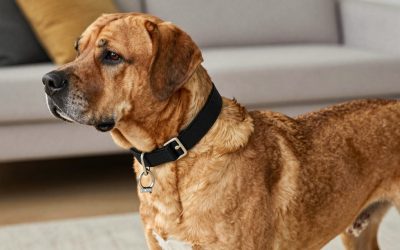
A buckle or quick-release flat collar carries ID and rabies tags. Best for: every dog, all the time they are supervised. Trade-offs: clipping a lead to a flat collar on a strong puller puts pressure on the throat. Skip it as a walking tool if your dog pulls hard or has a history of tracheal or airway issues; use a harness instead and ask your vet.
Martingale Collar: Best for Narrow-Headed Breeds
A martingale has a second, smaller loop that tightens to a set limit when the dog pulls back, so the collar cannot slip over the head. Best for: greyhounds, whippets, salukis and other dogs whose heads are narrower than their necks, plus nervous dogs who back out of collars. Trade-offs: the loop can snag, so it should only be worn on walks. Skip it if a standard collar already stays on securely.
Head Halter: Best for Strong Dogs, With Patience
Head halters such as the PetSafe Gentle Leader and the Halti Headcollar loop over the nose and behind the ears, steering the head the way a halter steers a horse. Best for: strong pullers when a harness is not enough. Trade-offs: they need a slow introduction, and a sudden jerk on the lead can twist the neck, so never use them with a retractable lead. Skip it if you are not willing to spend a week or two conditioning your dog to wear one.
Long Line: Best for Recall Training
A long line is a 15 to 50 foot lead that lets a dog explore while you stay connected. Biothane lines are easy to clean. Best for: dogs learning to come when called in open spaces. Trade-offs: lines can burn hands and tangle legs, so attach to a harness, never a collar, and wear gloves. Skip it if you only walk on busy pavements.
Treat Pouch and Clicker: The Tools That Actually Train
No collar teaches anything by itself. A treat pouch keeps rewards within reach, and a clicker marks the exact moment your dog gets it right. Best for: every owner. Trade-offs: clickers take practice; a consistent “yes” works too. Our beginner’s guide to clicker training covers the basics.
Problem to Humane Tool: Quick Reference
See also: Best Electric Dog Fences for Reliable, Humane Containment • Best Dog Boots for Basset Hound
| Problem | Humane tool | Why it helps | Training focus |
|---|---|---|---|
| Pulling on the lead | Front-clip harness | Redirects forward momentum sideways without neck pressure | Reward walking at your side; stop when the lead goes tight |
| Very strong puller | Head halter (introduced gradually) | Guides the head, and the body follows | Condition the halter with treats before any walks |
| Slipping out of collars | Martingale collar or escape-resistant harness | Limited tightening prevents backing out | Build confidence around triggers that make the dog retreat |
| Poor recall | Long line + high-value treats | Safe freedom while you practice | Short, rewarding recalls; never call to end fun every time |
| Jumping, lunging, barking at dogs | Harness + treat pouch, plus a certified trainer | Keeps the dog secure while you reward calm | Distance, counter-conditioning, professional guidance |
| Everyday ID | Flat collar with tags | Identification if your dog gets lost | None needed; keep contact details current |
What About Shock, Prong and Choke Collars?
We do not recommend or list any shock collar (e-collar), prong collar or choke chain. These tools work by making something unpleasant happen when the dog does the “wrong” thing, and many veterinary and behaviour organisations, including the American Veterinary Society of Animal Behavior and the British Veterinary Association, advise against aversive methods because of the risk of pain, fear and stress.
The bigger problem is what the dog learns. A dog who lunges at other dogs and gets a correction each time can come to associate other dogs with discomfort, which may make reactivity worse rather than better. Choke and prong collars also concentrate pressure on the neck.
Considering them does not make you a bad owner; it usually means you need a better plan. If your dog pulls hard, reacts to people or dogs, or has shown any aggression, the most useful thing you can buy is time with a certified positive-reinforcement trainer or, for serious cases, a veterinary behaviourist. Look for credentials such as CPDT-KA, KPA-CTP or IAABC. Read more in our guide to helping a reactive dog.
How to Choose the Best Dog Training Collar or Harness
Match the tool to the problem
Start with the behaviour, not the gadget. Many owners sensibly own a flat collar, a harness and a long line. For large dogs, prefer metal hardware, padded straps and several adjustment points.
Consider your dog’s body
Brachycephalic breeds such as pugs and French bulldogs should avoid neck pressure, and head halters may not sit well on short muzzles. Sighthounds usually do best in martingales. If your dog has a neck, spine or breathing condition, ask your vet what to use.
Sizing and Fit: The Two-Finger Rule
A tool that fits badly can rub, slip off or pinch. The simplest check is the two-finger rule: you should be able to slide two flat fingers between the collar or strap and your dog’s body, but not much more. Measure with a soft tape and re-check growing puppies often. Our guide to measuring your dog for a harness walks through it.
| Tool | Where to measure | Correct fit | Signs it is wrong |
|---|---|---|---|
| Flat collar | Middle of the neck | Two fingers slide under snugly | Slips over the ears, or leaves hair worn away |
| Martingale collar | Widest part of the head and the neck | When fully tightened, still two fingers of room; loops do not meet | Hardware touches when pulled (too loose) or it presses the throat |
| Front-clip harness | Neck base and widest chest girth | Two fingers under every strap; front ring sits on the breastbone | Ring drifts to one side, rubbing behind the front legs |
| Head halter | Muzzle and behind the ears | Neck strap snug high behind the ears; nose loop can slide to the base of the muzzle but not off | Nose loop rides into the eyes or the dog paws constantly after training |
| Long line | Not applicable | Attached to a harness back ring | Attached to a collar, or handled without gloves |
Safety Rules for Any Training Collar
- Never leave a training collar on an unsupervised dog. Martingales, head halters and harnesses can catch on crates, fences or another dog’s teeth during play. Swap to a flat breakaway collar at home.
- Introduce head halters gradually. Let your dog sniff it for a treat, then place the nose loop on for a second and reward, building up over several short sessions before clipping on a lead.
- Check skin weekly under straps for redness, hair loss or sores, and see your vet if you find any.
- Keep sessions short and upbeat. Five minutes of success beats thirty minutes of frustration. See our puppy training schedule for realistic session lengths.
Under-stimulated dogs pull more, so adding sniff walks and enrichment games for dogs can make training easier.
Frequently Asked Questions
What is the most humane training collar for a dog?
For everyday wear, a properly fitted flat collar is the most humane option because it simply holds ID. For walks, a front-clip harness is usually the kindest choice for pulling, and a martingale suits narrow-headed breeds. The tool matters less than reward-based training, which is what actually changes behaviour.
Do front-clip harnesses really stop pulling?
They reduce the force of pulling and make it easier to manage, but they do not teach a dog to walk nicely on their own. Most dogs improve fastest when the harness is paired with rewards for walking beside you and stopping whenever the lead goes tight. Consistency over several weeks is what produces lasting change.
Are martingale collars the same as choke chains?
No. A choke chain can keep tightening around the neck, while a correctly adjusted martingale closes only to a set limit so it cannot slip over the head. That is why martingales are widely used for greyhounds and other sighthounds. They should still be worn only on supervised walks, never left on at home.
Why do trainers advise against shock and prong collars?
Many veterinary and behaviour organisations advise against them because they rely on discomfort, which risks pain, fear and stress, and can make problems like reactivity or aggression worse. Reward-based methods are effective without those risks. If you are struggling, a certified positive-reinforcement trainer can build a plan for your specific dog.
How long does it take a dog to accept a head halter?
It varies widely. Some dogs accept a head halter within a few days of short, treat-filled sessions, while others need two weeks or more. Go at your dog’s pace, pair every step with rewards, and pause if they paw at their face persistently. If discomfort continues, try a front-clip harness instead and ask your vet.