📅 Last updated:
Grooming a Newfoundland is a serious commitment. The breed has a heavy, water-resistant double coat that sheds moderately all year and “blows” dramatically once or twice a year, when the undercoat comes out in handfuls. Without regular brushing, the undercoat packs down into mats, especially behind the ears, under the legs and around the pants, which can pull the skin and hide hot spots. The right set of tools makes the job faster and kinder for the dog. This guide explains which brushes and combs a Newfoundland needs and how to use them.
📋 Table of Contents
Understanding the Newfoundland coat
The outer coat is coarse, moderately long and slightly oily, designed to shed water. Beneath it is a soft, dense undercoat that insulates. The combination sheds heavily and mats easily where friction occurs: behind the ears, the armpits, the collar area, the back of the thighs and the belly. Most Newfoundlands need thorough brushing two to three times a week, with daily sessions during a coat blow.
The essential tool kit
See also: Best Electric Dog Fences for Reliable, Humane Containment • Best Dog Boots for Basset Hound
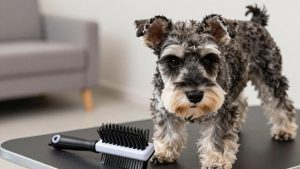
Slicker brush
A large slicker brush with firm pins is the main tool for lifting loose undercoat and working through the outer coat. Use it with a technique called line brushing: part the coat in sections and brush down to the skin from the part, working layer by layer.
Undercoat rake
A rake with long, rounded teeth reaches deep into the undercoat to pull out shedding fur. It is especially valuable during coat blows. Use gentle strokes and avoid digging into the skin.
Steel greyhound comb
A comb with wide and fine teeth is how you check your work. If the comb runs smoothly to the skin, the section is done. If it catches, there is still loose undercoat or a forming mat.
Mat splitter or dematting tool
For mats that have formed, a mat splitter cuts through the mat in strips so it can be combed out. Work slowly and hold the base of the mat to avoid pulling the skin. Large or tight mats close to the skin are best left to a professional groomer or vet.
High-velocity dryer
Not a brush, but a game-changer for Newfie owners. A high-velocity dryer blows out loose undercoat and dries the dense coat after baths or swims, which helps prevent hot spots.
| Tool | Job | How often | Typical price range |
|---|---|---|---|
| Large slicker brush | Line brushing, loose coat | 2-3 times weekly | Check on Amazon |
| Undercoat rake | Remove shedding undercoat | Weekly; daily in coat blow | Check on Amazon |
| Greyhound comb | Check for tangles, finish | Every session | Check on Amazon |
| Mat splitter | Break up small mats | As needed | Check on Amazon |
| High-velocity dryer | Drying, blowing out coat | After baths and swims | Check on Amazon |
Tools to use with care
Bladed deshedding tools can cut and damage the outer guard hairs of a Newfoundland coat if overused, leaving it coarse and less water-resistant. If you use one, keep it for occasional light passes during a coat blow. Avoid shaving a Newfoundland unless your vet advises it for medical reasons: the double coat helps regulate temperature and protects skin from sun, and it may grow back unevenly.
A practical grooming routine
- Start with the high-velocity dryer or a quick rake to remove the worst loose undercoat.
- Line brush with the slicker in sections, from the legs upward.
- Pay extra attention to mat hotspots: behind the ears, the armpits, the neck under the collar, the pants and the tail.
- Comb every section to the skin to confirm it is tangle-free.
- Trim the fur between the pads and tidy the feet with blunt-tipped scissors.
A full session on an adult Newfie often takes 45-60 minutes. Grooming on a sturdy, non-slip mat on the floor, or a low grooming table, is easier on both of you.
Health checks while grooming
Part the coat and look for red, moist patches (hot spots), which can develop quickly under damp, dense fur. Check ears for odor and redness, and wipe the lips and jowl folds, which collect drool. Note any lumps. Anything that looks painful or spreads fast deserves a call to your vet.
FAQ
How often should I brush a Newfoundland?
Two to three times a week, and daily during seasonal coat blows, with extra attention to mat-prone areas.
Should I shave my Newfoundland in summer?
Generally no. The double coat helps with temperature regulation and sun protection. Keep it brushed out and provide shade and cool spaces instead.
Bottom line
A Newfoundland needs a proper grooming kit: a large slicker brush, an undercoat rake, a steel comb, a mat splitter and ideally a high-velocity dryer. Line brush to the skin two or three times a week, focus on friction areas, skip shaving, and use each session to check for hot spots and lumps.