📅 Last updated:
Smart collar battery life regular use depends mostly on the collar type. GPS fence collars run roughly 1 to 2 days (the Halo Collar 5 is rated up to 48 hours), Tractive trackers are rated from 6 to 42 days, and the Fi Series 3+ is rated up to 3 months at low activity. The deciding factor is update frequency: the less often a collar checks its position, the longer it lasts. Updated October 2026.
This page is the reference for numbers by model, claimed versus measured runtime, and what to do when a battery dies early. For a ranked shortlist, see Best GPS Dog Collar Battery Life: Longest-Lasting Picks. Figures below come from manufacturer ratings and named third-party tests, and real runtime varies with update rate, cell signal and temperature.
📋 Table of Contents
- How long does a GPS dog collar battery last? (by collar type)
- Battery life by model
- Which GPS dog collar lasts longest?
- GPS fence and virtual collar battery (Halo, SpotOn, PetSafe Guardian)
- Hunting-dog collars (Garmin, SportDOG, Dogtra): battery and spare packs
- Claimed vs measured battery life
- Why your GPS collar battery dies fast, and when it is failing
- How to extend a GPS dog collar battery
- Budget and lesser-known trackers
- Membership cost vs battery
- Frequently Asked Questions
- Sources we checked
- Related guides
How long does a GPS dog collar battery last? (by collar type)
Three kinds of collar get lumped together under “GPS dog collar”, and they have very different battery lives.
- Cellular trackers (Tractive, Fi): send location over a mobile network and sleep between checks. Days to months per charge.
- GPS fence collars (Halo, SpotOn, PetSafe Guardian): keep GPS running so the boundary is enforced in real time. Hours to a couple of days.
- Hunting-dog radio collars (Garmin, SportDOG, Dogtra): talk to a handheld unit over radio rather than a mobile network. Roughly 1 to 3 days of active use per charge, longer with an extended pack.
Battery life by model
See also: 7 Best Refillable Frozen Dog Treat Toys for Long-Lasting Licks • Best Dog Door Mat for Muddy Paws: Sizing, Materials and Picks by Entryway
| Model | Type | Rated battery | Condition behind the rating |
|---|---|---|---|
| Fi Series 3+ | Cellular (AT&T) + GPS | Up to 3 months | Best case, mostly inside the home Wi-Fi zone. Reviewers report about 1 to 2 months in regular use and roughly 21 hours in Lost Dog Mode. |
| Tractive DOG 6 | Cellular + GPS | Up to 14 days | With Power Saving Zones. Up to 6 days without them. |
| Tractive DOG 6 XL and XL Adventure | Cellular + GPS | Up to 42 days | With Power Saving Zones. Up to 20 days without them. |
| Halo Collar 5 | GPS fence + cellular | Up to 48 hours | GPS stays on, no sleep mode. About 60 minutes to charge. |
| Halo Collar 4 | GPS fence | About 30 hours | Advertised figure, as listed by Outdoor Life. |
| SpotOn Nova | GPS fence | 33+ hours | With tracking on, per Halo’s comparison page. |
| PetSafe Guardian GPS 2.0 | GPS fence | Up to 70 hours | Per Halo’s comparison page; confirm with PetSafe. |
| Garmin Alpha TT 25 | Radio collar | Up to 68 hours | Standard pack; up to 136 hours with the optional extended battery box, per Garmin’s manual. |
| Garmin Alpha T 20 | Radio collar | Up to 68 hours | Treeline Review measured 68 hours on a standard pack. |
| Garmin Alpha 200i handheld | Handheld | Up to 20 hours | Up to 15 hours with inReach satellite messaging on, per Garmin. |
| SportDOG TEK 1.5 | Radio collar + handheld | About 24 hours (collar), 20 hours (handheld) | Per Outdoor Life. |
Whistle trackers are not listed: Tractive acquired the brand and Whistle devices stopped working on August 31, 2025.
Which GPS dog collar lasts longest?
Among cellular trackers, the Tractive DOG 6 XL and XL Adventure carry the longest official rating (up to 42 days), with the Fi Series 3+ rated up to about 3 months at low activity. Fence and hunting collars trade runtime for real-time tracking. The full ranking, with tiers, is on our ranked battery picks page.
Tractive DOG 6

Tractive Smart Dog GPS Tracker | Live Pet Tracker with Virtual Fence | Vital Signs Monitoring of Heart & Respiratory Rate | Bark Monitoring | Dog Collar Attachment (Black)
Included for 'Dog GPS Collar Battery Life: Real Numbers by Model' as a representative home product in this roundup; selection reflects the product set returned for this topic.
View on AmazonTractive DOG 6 – cellular + GPS – up to 14 days with Power Saving Zones (up to 6 days without) – under 2 hours to charge. Power Saving Zones are areas such as home where the tracker updates less often, which is where most of the extra days come from. More in the Tractive tracker review.
Tractive DOG 6 XL

Tractive XL Smart Dog GPS Tracker | Live Pet Tracker with Virtual Fence | Vital Signs Monitoring of Heart & Respiratory Rate | Up to 6-Weeks Battery Life | Dog Collar Attachment (Black)
Included for 'Dog GPS Collar Battery Life: Real Numbers by Model' as a representative home product in this roundup; selection reflects the product set returned for this topic.
View on AmazonTractive DOG 6 XL – cellular + GPS – up to 42 days with Power Saving Zones (up to 20 days without) – up to about 3 hours to charge. The XL Adventure carries the same rating. The larger body suits bigger dogs better than very small ones.
Fi Series 3+

Fi Series 3+ GPS Dog Collar & Tracker, Membership Required, Gray L | GPS tracking collar for dogs with health & behavior monitoring, escape alerts, waterproof, LED, Apple Watch compatible
Included for 'Dog GPS Collar Battery Life: Real Numbers by Model' because the listing is waterproof, which is the attribute this article compares.
View on AmazonFi Series 3+ – AT&T cellular + GPS – up to 3 months at low activity – 47 g tracker. Fi’s rating assumes the collar spends most of its time inside the home Wi-Fi zone. Field results are lower: Treeline Review measured about 10 weeks and Outdoor Life reports 1 to 2 months. Full details in the Fi Series 3 review.
Halo Collar 5
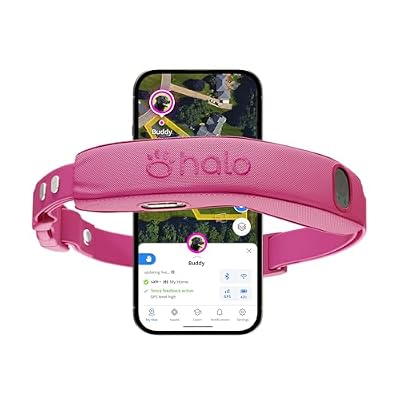
Halo Collar 5 Wireless Dog Fence System, GPS Tracking & Activity Insights
Included for 'Dog GPS Collar Battery Life: Real Numbers by Model' as a representative home product in this roundup; selection reflects the product set returned for this topic.
View on AmazonHalo Collar 5 – GPS fence + cellular – up to 48 hours – about 60 minutes to charge. Halo states the collar runs “AlwaysOn” GPS with no sleep mode so the boundary is enforced in real time, which is why the battery is shorter than a tracker that checks in periodically. Plan on charging it daily or every other day. See the Halo Collar review.
GPS fence and virtual collar battery (Halo, SpotOn, PetSafe Guardian)
Which dog GPS fence has the longest battery life? On published ratings, the PetSafe Guardian GPS 2.0 (up to 70 hours) leads, followed by the Halo Collar 5 (up to 48 hours) and the SpotOn Nova (33+ hours). All three need charging far more often than a Tractive or Fi tracker. If your dog escapes the yard daily, a second charged collar or a nightly charging routine matters more than the last few hours of rating. If the collar dies mid-session the boundary stops working, so check the charge before you let the dog out unsupervised. Compare options in our GPS dog fence roundup.
Hunting-dog collars (Garmin, SportDOG, Dogtra): battery and spare packs
Radio collars are built for long days in the field. Garmin rates the Alpha TT 25 at up to 68 hours and up to 136 hours with the optional extended battery box, while Outdoor Life lists the TT 25 at 25 to 68 hours depending on settings. Dynamic Tracking, which lowers the track-point rate when the dog is stopped, extends runtime. The Alpha 200i handheld is a different story: Garmin lists up to 20 hours, or up to 15 hours with inReach on, so the handheld is often the first thing to run flat.
Garmin Alpha TT 25

Garmin Alpha® TT 25, GPS Dog Tracking & Training Collar | Track Your Dog Up to 9 Miles With a Compatible Handheld (Sold Separately), Tone & Vibration
Included for 'Dog GPS Collar Battery Life: Real Numbers by Model' as a representative home product in this roundup; selection reflects the product set returned for this topic.
View on AmazonGarmin Alpha TT 25 – radio tracking and training collar – up to 68 hours (136 hours with extended battery box) – needs a compatible handheld sold separately. Radio tracking needs no monthly plan; only satellite messaging on inReach models uses one. Confirm handheld and collar compatibility before buying.
SportDOG TEK 1.5 is listed at about 24 hours for the collar and 20 hours for the handheld. For Dogtra, battery ratings differ by model, so read the manual for the exact collar. Aftermarket replacement packs exist for some collars and handhelds, but check the maker’s manual and warranty terms before opening a sealed collar, since the case also provides the waterproof seal.
Claimed vs measured battery life
Treeline Review (updated August 2026) fully charged each device and used it daily until it died. Its results, next to the maker’s claim:
| Collar | Maker claim | Measured |
|---|---|---|
| Tractive DOG 6 | Up to 14 days | About 25 days |
| Tractive DOG 6 XL | Up to 30 days (as listed by Treeline) | About 35 days |
| Fi Series 3+ | Up to 3 months | About 10 weeks |
| Garmin Alpha T 20 | Up to 68 hours | 68 hours on a standard pack |
Outdoor Life (updated February 2026) reports a similar picture for Fi: realistic runtime of 1 to 2 months against the 3-month rating, and about 21 hours in Lost Dog Mode with good cell coverage. It also notes the Halo Collar 5 lands near its 48-hour rating if you charge it nightly. The pattern: cellular trackers can beat a conservative rating, while “up to” ratings that depend on low activity are best treated as a ceiling.
Why your GPS collar battery dies fast, and when it is failing
If a collar drains much faster than its rating, work through these in order.
- Live or Lost Dog mode left on. Fast update modes are the biggest drain on cellular trackers. Switch back to normal mode once the dog is home.
- Weak cell signal. Halo notes that weaker signal areas require more power to transmit. A collar searching for signal at the edge of coverage drains quickly.
- Update rate set too high. A fix every few seconds drains far faster than one every few minutes.
- Cold weather. Cold can shorten runtime on rechargeable cells, so expect fewer days in winter.
- An aging cell. Rechargeable batteries lose capacity over years of charging. If a collar that used to last weeks now needs charging every few days with the same settings, the cell is probably worn. Ask the maker about warranty or replacement.
If the case looks swollen or gets unusually hot while charging, stop charging it and contact the maker. While a collar is charging or being repaired, keep an ID tag on the dog’s regular collar.
How to extend a GPS dog collar battery
- Use a low-power zone around home where the tracker supports one (Tractive Power Saving Zones, a Fi home Wi-Fi zone).
- Set geofence alerts instead of constant live tracking, so the collar only speeds up when the dog leaves the safe area.
- Lower the update interval during low-risk periods such as overnight.
- Keep firmware and the app updated, since makers adjust power management in updates.
- Charge on a fixed schedule, for example when the dog’s walk ends, rather than waiting for a low-battery alert.
Budget and lesser-known trackers
| Tracker | What the maker publishes |
|---|---|
| Life360 Pet GPS Tracker | Lists up to 14 days of battery on the product page. Check the listing for the battery type and the conditions behind that figure. |
| Paw-Alert, Knvieeu, Emacros, Vebiso | No battery rating we could verify from an official source. Treat marketing figures as a ceiling and check the listing for the stated standby and tracking hours. |
For no-fee options, see GPS dog trackers with no subscription and AirTag vs GPS collar. Bluetooth tags such as AirTag run for months but rely on nearby phones and give no live GPS.
Membership cost vs battery
Cellular trackers need a paid membership on top of the hardware, so the true cost is the collar plus every month you keep it active. A longer battery does not change the plan fee, but it does reduce how often the dog is unprotected while the collar is on a charger. Radio systems such as Garmin have no plan for tracking, at the price of a handheld and a shorter runtime. See smart collar membership costs compared for the plan side.
Frequently Asked Questions
How long does the charge last on GPS dog collars?
Fence collars last about 1 to 3 days, Tractive trackers 6 to 42 days, and Fi up to about 3 months at low activity. Live tracking shortens all of them.
Which GPS dog collar has the longest battery life?
Tractive DOG 6 XL and XL Adventure are rated up to 42 days; the Fi Series 3+ up to about 3 months at low activity. Field results for Fi are closer to 1 to 2 months.
Why does my GPS collar battery die so quickly?
Usually live or Lost Dog mode, weak cell signal, a high update rate, cold weather or an aging cell. Lower the update rate first, then check signal and age.
How long does a Halo collar battery last?
The Halo Collar 5 is rated up to 48 hours and takes about 60 minutes to charge. The Collar 4 is listed at about 30 hours. For older generations, check Halo’s support page for your model.
Can you replace the battery in a dog GPS collar?
Some hunting-dog collars and handhelds have aftermarket packs, but most trackers are sealed. Check the maker’s manual and warranty before opening any collar.
What battery does a Life360 dog tracker use?
The maker lists up to 14 days of battery, but the cell type is not stated on the sources we checked. Check the product page or ask Life360 support.
Sources we checked
- Tractive battery page (DOG 6, DOG 6 XL and XL Adventure ratings and charge times)
- Halo Collar GPS collar battery life guide, updated October 12, 2026
- Garmin owner’s manuals for the Alpha TT 25 and Alpha 200i, and Garmin’s Alpha 200i launch announcement
- Treeline Review, GPS dog collar battery life measured vs claimed, updated August 10, 2026
- Outdoor Life, best GPS dog collars, updated February 13, 2026
- Fi product comparison page (Series 3+ battery and weight)
Related guides
- Fi Series 3 GPS dog collar review
- Which Fi tracker to buy
- Halo Collar review
- Waterproof dog GPS trackers
- Garmin dog tracker picks
- Pet tech hub