📅 Last updated:
The best UVB lamp for an aquatic turtle is a linear UVB tube (T5 HO or T8) mounted over the basking spot, plus a separate basking heat lamp. For an aquatic turtle basking light setup, check the manufacturer’s distance chart for your bulb and fixture, because UVB drops quickly with distance and glass or plastic blocks it. Below: picks, 5.0 vs 10.0, distances, and when to replace the bulb. For shell softening or lethargy, see a reptile vet.
Without enough UVB a turtle cannot make the vitamin D3 it needs to use calcium, and the result can be metabolic bone disease, which shows up as a soft or misshapen shell. Diet alone does not replace the lamp, so the UVB tube is the part of the setup not to skimp on. This guide covers aquatic and semi-aquatic turtles such as red-eared sliders, painted turtles and map turtles. Tortoises have different lighting needs, so use a tortoise-specific guide for them.
📋 Table of Contents
- Quick Picks: Turtle UVB Lamps and Basking Lights at a Glance
- Best Turtle UVB Lamps and Basking Lights
- Basking Light vs UVB Light: What Is the Difference?
- UVB Lamp Types for Aquatic Turtles Compared
- How Far Should the UVB Bulb Be From the Basking Spot?
- 5.0 vs 10.0: Which UVB Strength for an Aquatic Turtle?
- Glass, Plastic and Mesh Lids Block UVB
- Setting Up a Complete Basking Station
- Should Turtles Have Lights Off at Night? Day-Night Cycle
- When to Replace a Turtle UVB Bulb
- Waterproof and Splash-Proof Basking Lights for Turtle Tanks
- Does a Turtle UVB Light Cause Algae?
- Buying UVB and Basking Lights in a Pet Store
- Frequently Asked Questions
- Related Turtle and Reptile Guides
- Sources We Checked
Quick Picks: Turtle UVB Lamps and Basking Lights at a Glance
| Need | Pick | Type |
|---|---|---|
| Best UVB tube for most tanks | Zoo Med ReptiSun 10.0 T5 HO | T5 HO tube, needs a T5 HO fixture |
| Fixture plus tube in one | Zoo Med ReptiSun T5 HO Terrarium Hood with 10.0 bulb | T5 HO hood and lamp |
| Milder strength, same fixture type | Zoo Med ReptiSun 5.0 T5 HO | T5 HO tube |
| Budget or low-clearance tank | Zoo Med ReptiSun 5.0 T8 | T8 tube, needs a T8 fixture |
| Alternative brand | Arcadia T5 UVB kit, 36 in, 6% | T5 tube and fixture kit |
| Small-tank starter kit | Zoo Med Aquatic Turtle UVB and Heat Lighting Kit | Dome, halogen and compact UVB bulb |
| One bulb for UVB and heat | Zoo Med PowerSun UV | Mercury vapor |
| Splash-proof basking heat | Zoo Med Repti Tuff Splashproof Halogen | Halogen heat bulb, no UVB |
Best Turtle UVB Lamps and Basking Lights
See also: Best Litter for Bunnies in 2026: 7 Safe, Low-Dust Picks for Odor and Comfort • Litter Box Dimensions for Small Bathroom Size Guide With Measurements (2026)
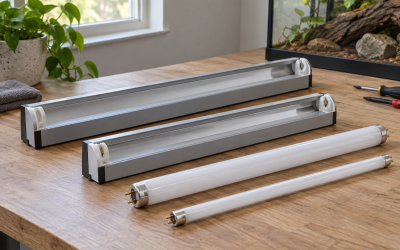
Match the tube to the fixture before you buy: a T5 HO lamp needs a T5 HO fixture and a T8 lamp needs a T8 fixture. Check each listing for the length and wattage that fit your tank.
1. Zoo Med ReptiSun 10.0 T5 HO UVB Lamp

Zoo Med 24 Watt T5 HO ReptiSun 10.0 UVB Lamp, 2pk
Included for 'Best Turtle UVB Lamps & Basking Lights for Tanks' as a representative home product in this roundup; selection reflects the product set returned for this topic.
View on AmazonTop pick tube – T5 HO – 10.0 label – 24 W (22 in) – T5 HO fixture only – follow the package distance chart. Best for: most aquatic turtle tanks where the lamp sits higher above the basking spot. Watch out: it gives almost no heat, so it needs a separate basking bulb.
2. Zoo Med ReptiSun T5 HO Terrarium Hood with 10.0 Bulb

Zoo Med ReptiSun T5 HO Terrarium Hood with 10.0 Bulb (24in)
Included for 'Best Turtle UVB Lamps & Basking Lights for Tanks' as a representative home product in this roundup; selection reflects the product set returned for this topic.
View on AmazonFixture and tube together – T5 HO hood – 10.0 bulb included – 24 in – removes the fixture-fit guesswork. Best for: a first T5 HO setup. Watch out: check that the hood length fits your tank top.
3. Zoo Med ReptiSun 5.0 T5 HO UVB Lamp

Zoo Med REPTISUN T5 HO 5.0 UVB LAMP 24W, 2pk
Included for 'Best Turtle UVB Lamps & Basking Lights for Tanks' as a representative home product in this roundup; selection reflects the product set returned for this topic.
View on AmazonMilder tube – T5 HO – 5.0 label – 24 W – T5 HO fixture only – mounts closer than the 10.0. Best for: tanks where the lamp can sit nearer the basking spot. Watch out: the 5.0 is not the same as a T8 5.0, so do not swap them between fixtures.
4. Zoo Med ReptiSun 5.0 T8 UVB Lamp

Zoo Med ReptiSun T8 5.0 UVB Lamp, 15 Watts
Included for 'Best Turtle UVB Lamps & Basking Lights for Tanks' as a representative home product in this roundup; selection reflects the product set returned for this topic.
View on AmazonBudget tube – T8 – 5.0 label – 15 W – T8 fixture only – mount it closer to the basking spot than a T5 HO. Best for: small, low tanks. Watch out: its UVB falls off faster with distance, so tall tops are a poor fit.
5. Arcadia T5 UVB Reptile Light Fixture Kit, 36 in, 6% UVB

Arcadia T5 UVB Reptile Light Fixture Kit 36" Long 39 Watts 6% UVB Forest – Complete UVB Light for Reptiles, Turtles, Snake, Bearded Dragon Lamp, Long Lasting Easy to Use Professional Lighting
Included for 'Best Turtle UVB Lamps & Basking Lights for Tanks' as a representative home product in this roundup; selection reflects the product set returned for this topic.
View on AmazonAlternative brand – T5 tube plus fixture – 39 W – 36 in – 6% UVB output – follow the Arcadia distance chart. Best for: long tanks where one tube can cover the whole basking zone. Watch out: a 36 in kit is too long for small tops.
6. Zoo Med Aquatic Turtle UVB and Heat Lighting Kit

Zoo Med Aquatic Turtle UVB & Heat Lighting Kit | Heat Lighting Kit
Included for 'Best Turtle UVB Lamps & Basking Lights for Tanks' as a representative home product in this roundup; selection reflects the product set returned for this topic.
View on AmazonAll-in-one starter – dome fixture – 50 W splash-proof halogen basking bulb – 13 W compact ReptiSun 5.0. Best for: small tanks and first-time keepers. Watch out: a compact UVB bulb covers a small area and a linear tube is preferred for coverage, so plan to move up as the turtle grows.
7. Zoo Med PowerSun UV Mercury Vapor Bulb

Zoo Med PowerSun UV Bulb 80 Watt
Included for 'Best Turtle UVB Lamps & Basking Lights for Tanks' as a representative home product in this roundup; selection reflects the product set returned for this topic.
View on AmazonSingle-bulb option – mercury vapor – 80 W – gives UVB and heat from one bulb – needs a ceramic-socket dome and a set distance per the maker. Best for: larger setups and experienced keepers. Watch out: it runs hot, so follow the maker’s mounting and safety notes.
8. Zoo Med Repti Tuff Splashproof Halogen Lamp

Zoo Med Repti Tuff Splashproof Halogen 50 Watt
Included for 'Best Turtle UVB Lamps & Basking Lights for Tanks' as a representative home product in this roundup; selection reflects the product set returned for this topic.
View on AmazonBasking heat – 50 W halogen – splash-proof – gives no UVB, so it always pairs with a UVB tube. Best for: warming the basking platform of an aquatic turtle tank. Watch out: pick the wattage that gets the basking surface to the temperature your turtle species needs.
Basking Light vs UVB Light: What Is the Difference?
A basking light gives heat and visible light so the turtle can warm up and digest. A UVB light gives the ultraviolet band the turtle needs to make vitamin D3. Most tubes give UVB with little heat, and most basking bulbs give heat with no UVB, so a turtle tank normally needs both over the same dry spot. Mercury vapor bulbs are the main exception because they give both. Many clip-on “UVA UVB heat lamp” bundles are primarily heat lamps; unless the maker lists a UVB output and a distance chart, treat them as heat only and keep a reptile UVB tube in the plan.
UVB Lamp Types for Aquatic Turtles Compared
| Lamp type | UVB spread | Heat | Fixture | Replace | Best for |
|---|---|---|---|---|---|
| T8 tube (ReptiSun 5.0) | Even, shorter reach | Low | T8 fixture | Per maker, commonly 6 to 12 months | Small, low tanks and budgets |
| T5 HO tube (ReptiSun 10.0 or 5.0) | Even, longest reach of the tubes | Low | T5 HO fixture only | Per maker, commonly 6 to 12 months | Most aquatic turtle tanks |
| Mercury vapor (PowerSun) | Intense, smaller area | High | Ceramic socket, dome | Per maker | Larger setups, one-bulb UVB and heat |
| Compact (coil) fluorescent | Concentrated, small area | Low | Screw-in dome | Per maker, commonly 6 to 12 months | Small tanks only; tube preferred |
The Merck Veterinary Manual describes fluorescent tubes as giving low heat and a fairly uniform UVB gradient, compact fluorescent bulbs as a more intensive gradient on a small area, and mercury vapor bulbs as an intensive gradient on a smaller area with heat and intense light. For the tube comparison in depth, read T5 vs T8 UVB for aquatic turtles.
How Far Should the UVB Bulb Be From the Basking Spot?
Follow the distance chart on your bulb’s package; there is no single number for every tube. As a published example for red-eared sliders under an open-top T5 HO fixture, ReptiFiles lists about 11 to 13 inches from the lamp for a 5.0 tube and 17 to 21 inches for a 10.0 tube, aiming for a UV index of 3.0 to 4.0 at the basking surface. A T8 tube is weaker and normally sits closer than a T5 HO. Measure from the lamp to the basking surface, not the tank height. Mesh cuts UVB, and glass and most plastics block it, so keep those out of the light path or check the maker’s guidance for mesh lids.
5.0 vs 10.0: Which UVB Strength for an Aquatic Turtle?
The 5.0 and 10.0 labels describe how strong the tube is, and published turtle advice differs. Some keepers choose a 5.0 and a shorter distance; others choose a 10.0 and a longer distance, as in the ReptiFiles ranges above. Because distance changes the dose, the label alone does not decide it. Pick the strength, set the distance from the package chart, and if possible confirm with a UV index meter.
Glass, Plastic and Mesh Lids Block UVB
Glass and most plastics block UVB, and fine mesh reduces it. A tank glass lid, a plastic light diffuser or a window pane between the lamp and the turtle can leave a bright tube delivering little or no usable UVB. The same goes for sunlight through a window: it warms, but the glass filters out the UVB.
Setting Up a Complete Basking Station
UVB and heat are separate jobs. The UVB tube gives little heat, so add a basking spotlight or splash-proof halogen aimed at the platform and place the tube over the same dry area so the turtle gets both at once. Care sheets commonly give a basking surface of about 85 to 95 degrees F depending on species, so check a species care sheet and confirm with a thermometer. Keep the platform dry and easy to climb onto; see best turtle docks for basking and reptile heat lamps.
Should Turtles Have Lights Off at Night? Day-Night Cycle
Yes. Keep a normal day and night cycle on a timer: about 12 hours of light for the UVB and basking lamps (published sources range from 10 to 13 hours, with ReptiFiles giving 11 to 13) and darkness at night. Do not reverse the cycle or leave lights on around the clock, because turtles need a dark period to rest. A single outlet timer on both lamps keeps it consistent.
When to Replace a Turtle UVB Bulb
Replace the tube on the maker’s schedule, commonly every 6 to 12 months depending on tube type and brand. The Merck Veterinary Manual says UVB bulbs should in general be replaced about once a year, while a care sheet made with the Madison Area Herpetological Society says every 6 months. A tube keeps glowing after its UVB has faded and you cannot see the loss, so write the install date on the fixture and replace on time. A UV index meter is the only way to check output.
Waterproof and Splash-Proof Basking Lights for Turtle Tanks
Basking bulbs sit close to the tank, so a splash can hit a hot bulb. Splash-proof halogen bulbs such as the Zoo Med Repti Tuff are made for aquatic turtle tanks, and a dome with a solid mount keeps cords and sockets away from water. Whatever you pick, plug the lights into a timer and keep the plug and cord above any splash zone. Check the maker’s wattage limit for your dome.
Does a Turtle UVB Light Cause Algae?
Care sources disagree, and the evidence is mostly keeper experience. Algae grows on light plus nutrients in the water, so bright light of any kind helps it, and direct sunlight on the tank is a common cause of green water. A UVB tube over a dry basking area is generally not blamed as the main driver, and a turtle still needs it. To limit algae, keep the tank out of direct sun, put lights on a timer, improve filtration, and do regular water changes. See turtle filters for aquatic turtle tanks.
Buying UVB and Basking Lights in a Pet Store
Bring the length of your fixture and note whether it is T5 HO or T8, because the tubes do not swap. Read the package for the distance chart, the strength label and the replacement advice. For brands, stick with established reptile lighting makers such as Zoo Med, Arcadia and Exo Terra, and ask staff whether the bulb gives UVB or only a UVA daylight glow.
Frequently Asked Questions
Can I use one lamp for UVB and heat?
Only mercury vapor lamps do both. With tubes or compact bulbs you need a separate basking heat bulb, since those give little heat.
How far should my UVB bulb be from the basking spot?
Follow the package distance chart. As an example, ReptiFiles lists about 11 to 13 inches for a 5.0 T5 HO and 17 to 21 inches for a 10.0 T5 HO over an open top.
Does a screen lid block UVB?
Mesh reduces the UVB that gets through, and glass and most plastics block it. Follow the maker’s guidance for mesh and keep the tube over an open area where you can.
Is a 10.0 UVB too strong for a turtle?
It depends on distance. A 10.0 at the longer distance in its chart is used for sliders; closer than the chart allows is too strong. Use the chart or a meter.
Can I use a regular fluorescent tube instead of a reptile UVB bulb?
No. Standard household and grow-light tubes are not made to give reptile-grade UVB. Buy a bulb the maker rates for reptile UVB, from a reptile lighting brand.
How do I know if my turtle has metabolic bone disease?
A soft or deformed shell, lethargy, poor appetite and swollen limbs are warning signs. See an exotics veterinarian promptly; this guide covers prevention, not diagnosis or treatment.
Do outdoor turtles need a UVB lamp?
Unfiltered sunlight gives UVB, so outdoor turtles in suitable weather usually do not. Indoors, window glass blocks UVB, so a sunny window is not a substitute for the lamp.
Do tortoises and turtles use the same lamp?
Not necessarily. Tortoises have different lighting needs, so check a tortoise-specific guide and the maker’s chart before using a turtle setup for one.
Related Turtle and Reptile Guides
Choosing between tubes? Read T5 vs T8 UVB for aquatic turtles. For other lighting pages see best reptile UVB lighting kits, how to choose reptile UVB lighting kits, reptile basking lights and turtle basking docks. For the tank itself, see turtle filters.
Sources We Checked
- Merck Veterinary Manual, Nutrition in Reptiles (UVB and metabolic bone disease, bulb types, replacement about once a year)
- ReptiFiles, Red-Eared Slider UVB Lighting (T5 HO distances, UV index target, 11 to 13 hours of light)
- Zoo Med product pages for ReptiSun T5 HO and the Aquatic Turtle UVB and Heat Lighting Kit (fixture fit, kit contents)
- Zilla painted turtle care sheet, made with the Madison Area Herpetological Society (12 hours of light a day, replace bulbs every 6 months)
Recommendations are based on manufacturer specifications and the sources above; this guide is not based on our own testing. UVB advice varies by source and species, so follow the maker’s chart and ask an exotics veterinarian about your turtle.