📅 Last updated:
Crating an English Mastiff is a challenge of scale. Adult Mastiffs stand 27-33 in at the shoulder and weigh 120-230 lb, which means many “extra large” crates are simply too small. A crate that forces a Mastiff to crouch or lie curled is uncomfortable and can aggravate joints already prone to problems. Yet a properly sized crate is a helpful tool for house-training, managing a clumsy adolescent and restricting activity after surgery. This guide explains how to choose and set up a crate for a Mastiff.
📋 Table of Contents
Do Mastiffs need crates?
Many adult Mastiffs are calm and do not need to be crated daily. A crate is most useful for house-training puppies, preventing destructive chewing in adolescents, keeping a dog safe during travel and restricting movement after orthopedic surgery. If you plan to use a crate long-term, buy one sized for an adult Mastiff and use a divider for the puppy stage.
Sizing a crate for a Mastiff
See also: Best Electric Dog Fences for Reliable, Humane Containment • Best Dog Boots for Basset Hound
The crate should allow the adult dog to stand without its head touching the top, turn around and lie flat on its side. Measure your Mastiff from nose to base of tail and add 4-6 in for length. Measure from the floor to the top of the head while standing and add 3-4 in for height. Most adult Mastiffs need a 54 in giant crate, and some large males need even bigger options, such as a custom kennel or a secure pen.
| Mastiff | Weight | Crate length | Minimum interior height |
|---|---|---|---|
| Puppy, 8-12 weeks | 15-35 lb | Giant crate with divider at about 30 in | – |
| Puppy, 4-6 months | 50-100 lb | Divider moved to 42-48 in | – |
| Adult female | 120-170 lb | 54 in | About 36-40 in |
| Adult male | 160-230 lb | 54 in or custom giant kennel | About 40-45 in |
Types of crates for a Mastiff
Giant wire crate
A heavy-gauge 54 in wire crate with a divider is the most practical option. It offers good ventilation, which is essential for a heat-sensitive breed, and lets the dog see its surroundings. Look for multiple doors, secure latches and a sturdy tray. Giant wire crates are heavy and take up a lot of floor space, so plan where it will go.
Heavy-duty steel crate
For Mastiffs that chew, push on doors or have separation anxiety, a welded steel crate offers more security. These are expensive and very heavy, so most owners only buy one if a wire crate proves inadequate.
Exercise pen or dog room
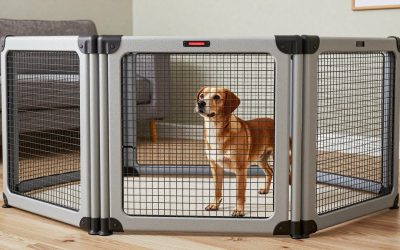
For large adults, a sturdy exercise pen or a dog-safe room can be more comfortable than a crate, especially for long periods. Make sure panels are tall and strong enough that the dog cannot push them over.
Setting up the crate
Place the crate in a cool, quiet area where the dog can still see and hear the family. Avoid sunny windows, heaters and fireplaces. Mastiffs are prone to calluses and pressure sores from lying on hard surfaces, so add a thick, supportive crate pad or orthopedic mat. Choose one with a waterproof liner or washable cover, since Mastiffs drool. In warm weather, a cooling mat can help.
Crate training a Mastiff puppy
Start early while your Mastiff is still small. Make the crate a positive place with meals and treats inside, and increase time gradually. Use the divider to keep the space small during house-training, moving it as the puppy grows. Never use the crate as punishment. Puppies need frequent bathroom breaks, roughly one hour per month of age during the day.
Crates for surgery recovery
Mastiffs are prone to orthopedic issues such as cruciate ligament tears and dysplasia, which may require surgery and weeks of restricted movement. A crate the dog already accepts makes recovery much easier. Many owners crate-train early specifically with this in mind.
FAQ
What size crate does an English Mastiff need?
Most adult Mastiffs need a 54 in giant crate with an interior height of about 36-45 in. Very large males may need a custom kennel or an exercise pen.
Is it cruel to crate a Mastiff?
Not when the crate is the right size and used appropriately. It should be a comfortable, safe resting place, not a place for punishment or extended confinement. Many Mastiffs happily nap in open crates.
Bottom line
The best crate for a Mastiff is a heavy-gauge, 54 in giant wire crate with a divider, secure latches and good ventilation, or a custom kennel or pen for very large males. Add a thick, waterproof, supportive pad, keep the crate in a cool, quiet spot and introduce it early. Used well, a crate helps with training and makes recovery from surgery far easier.