Our Short List of 3
- Brand: Aqueon
- Model: 100106353
- Format: Slow-dissolving feeder block with embedded food
- Pack contents: 4 blocks

- Brand: API
- Item number: 71A
- Format: Pyramid-shaped dissolving block with embedded pellets
- Size: 1.2 oz, single pyramid
- Brand: Penn-Plax
- Model: PBV14N
- Format: Fish-shaped, time-release dissolving blocks
- Pack contents: 2 blocks, 2.2 oz total
All 4 Picks at a Glance
| Product | Specs | Action |
|---|---|---|
| 2. Aqueon 7 Day Vacation Feeder |
| Check price on Amazon |
| 3. API Vacation Pyramid Fish Feeder 14-Day |
| Check price on Amazon |
| 4. Penn-Plax Pro Balance 14-Day Vacation Feeding Blocks |
| Check price on Amazon |
 5. Zoo Med Betta Banquet Blocks |
| Check price on Amazon |
📅 Last updated:
Going away for a week or two leaves aquarium keepers with a short list of options: recruit a neighbor and risk heavy-handed feeding, install an automatic feeder, or drop in a slow-release block and hope the water stays clean. This guide covers the third option only — consumable vacation blocks and gel feeders that sit in the tank and release food over days. Battery-powered automatic feeders are a separate device category, covered elsewhere on this site, and every pick below needs no power, no timer, and no programming.

An honest point belongs at the top. Most healthy adult aquarium fish in a mature, stable tank tolerate a week without any food at all better than they tolerate a dissolving block fouling the water while nobody is home to notice. Plaster-based blocks are the main concern: as the calcium sulfate binder dissolves, it can cloud the water and push hardness and pH upward, and any ignored food keeps breaking down toward ammonia. A feeder block is a tool for longer trips and for fish that genuinely need regular meals, not a default for every weekend away.
That is why the only honest test of any product below is a trial run while the keeper is still home — the same block, in the same tank, for the same number of days — followed by a water test and a partial water change. A block that clouds the water on day three at home will do the same on day three of a trip.
Disclosure: As an Amazon Associate, I earn from qualifying purchases.
📋 Table of Contents
- How to Choose a Vacation Feeder Block
- 1. Tetra Vacation Tropical Slow Release Feeder
- 2. Aqueon 7 Day Vacation Feeder
- 3. API Vacation Pyramid Fish Feeder 14-Day
- 4. Penn-Plax Pro Balance 14-Day Vacation Feeding Blocks
- 5. Zoo Med Betta Banquet Blocks
- Comparison Table
- Frequently Asked Questions
- Conclusion
How to Choose a Vacation Feeder Block
Match the block to the trip length. Weekend, seven-day, and fourteen-day blocks dissolve at different rates by design. A fourteen-day block dropped in for a four-day trip leaves most of its binder and food load in the water for no benefit. Buy the shortest duration that covers the trip, with a small margin.
Choose gel or plaster deliberately. Gel blocks, represented here by the Tetra pick, do not dissolve on their own; food is released only as fish nibble, and leftover gel can be lifted out on return. Dissolving blocks soften continuously whether the fish are eating or not, which makes them simpler but far less forgiving of warm water or a trip that runs long.
Size the block to the fish, not the glass. Maker guidance is written in fish counts — one pyramid for five to ten fish, one gel block for a small community, one mini block for a single betta. A block sized for ten fish in a tank holding three is three times the intended food and binder load. When a tank falls between sizes, the smaller block is the safer error.
Respect sensitive setups. Soft-water tanks, shrimp colonies, fry tanks, and newly cycled aquariums have the least margin for anything that shifts chemistry or adds decaying food. For a short trip, those setups are often better served by a pre-portioned feeding from a trusted person, or by no block at all.
Run the trial, then prepare the tank. A week or two before travel, do a partial water change, add the block, and watch it for the full intended duration, noting how much remains and what ammonia and nitrite read at the end. Before the real trip, repeat the water change and feed normally the day before departure.
1. Tetra Vacation Tropical Slow Release Feeder
See also: Best Automatic Transmission Floor Shifter: Ratchet, Gated and Detent Shifters Compared • Best Automatic Floor Shifter for Truck: Tall, Tough Picks for Pickups and Bench Seats
The Tetra Vacation block stands apart from this category because it contains no plaster at all. It is a firm gel block built around whole daphnia, and it does not disintegrate in water — food is released only as fish graze the block down. That removes the classic vacation-block failure mode: no binder steadily dissolving into the water column for two weeks. Tetra also states the block can be left in the tank when normal feeding resumes, so a trip that ends early creates no cleanup problem.
Specs
- Brand: Tetra
- Model: 77150
- Format: Gel slow-release block, plaster-free
- Weight: 1.06 oz
- Feeding duration: Up to 14 days per block
- Key ingredient: Whole daphnia in a ProCare gel formula
- Water type: Freshwater only
- Release method: Food released as fish nibble; block does not dissolve on its own
Because the block rests on the substrate, surface-oriented fish may take time to find it. The maker’s tip is to break off a small piece before dropping the block in, then release that piece directly above where the block settles, so the fish connect the location with food. Large, hungry fish such as loaches or big cichlids may justify a second block. For freshwater community tanks heading toward a two-week trip, this pick asks the least of the water.
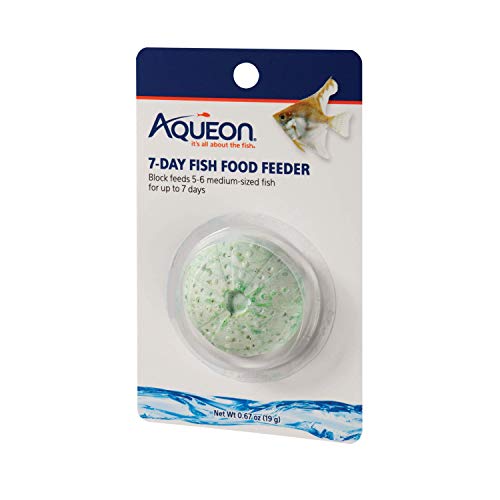
2. Aqueon 7 Day Vacation Feeder
- Brand: Aqueon
- Model: 100106353
- Format: Slow-dissolving feeder block with embedded food
- Pack contents: 4 blocks
Aqueon’s feeder takes the opposite approach to duration: instead of one long block, the pack holds four separate blocks, each intended to cover up to seven days. That portioning suits the way trips actually happen — one block for one week away, a spare for the next trip, and an easy way to feed two tanks at once without cutting a larger block into pieces. Each block rests in the tank and dissolves gradually, releasing its embedded food as it softens.
As a dissolving block, it carries the standard cautions from the top of this guide: it softens whether or not the fish keep up with it, so the trial run matters, and a partial water change on return day is part of the routine. Within those limits, it is the most flexible option here for trips closer to a week than to two, and for households with more than one tank to cover.
3. API Vacation Pyramid Fish Feeder 14-Day
- Brand: API
- Item number: 71A
- Format: Pyramid-shaped dissolving block with embedded pellets
- Size: 1.2 oz, single pyramid
The API pyramid is the long-running classic of this category: a pyramid-shaped block with food pellets embedded throughout, formulated to dissolve slowly over up to fourteen days. Maker guidance sizes one pyramid for five to ten fish, a natural fit for a standard community tank rather than a nano setup. The shape sits stably on gravel and presents a broad surface for grazing fish as it softens.
That water guidance hints at the pyramid’s main trait: dissolution speed is not fixed. Warm, alkaline water softens it faster; cool or acidic water slows it down, and a block can outlast the trip it was bought for. Neither outcome is visible in advance, which is precisely what the trial run is for. Tanks near the maker’s stated temperature and pH window get the most predictable performance.
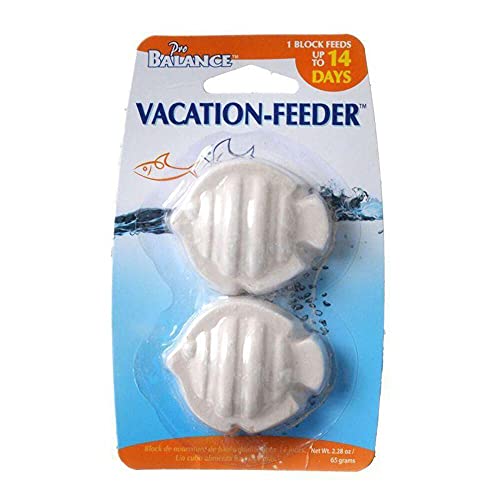
4. Penn-Plax Pro Balance 14-Day Vacation Feeding Blocks
- Brand: Penn-Plax
- Model: PBV14N
- Format: Fish-shaped, time-release dissolving blocks
- Pack contents: 2 blocks, 2.2 oz total
Penn-Plax molds its Pro Balance vacation food into fish-shaped blocks, two to a card, with each block intended to cover up to fourteen days. The two-block card is the practical detail: one block handles the trip on the calendar, and the second stays sealed for the next one, so a single purchase covers two separate absences. The fish shape is not decoration alone — it gives grazing fish edges and surfaces to work on as the block softens.
This is a conventional dissolving block, used with the same discipline as the Aqueon and API picks. One block releases the same total material whether three fish or ten are eating, so lightly stocked setups get proportionally more dissolved binder per fish. The trial run shows how a given tank handles that load, and the return-day water change closes the loop.
5. Zoo Med Betta Banquet Blocks
- Brand: Zoo Med
- Format: Small time-release feeding blocks
- Pack contents: 6 cards, set of 2
- Target fish: Bettas and small tropical fish
Bettas create a specific vacation problem: a single fish, often in a small volume of water, where a community-sized block would release far more food and binder than the setup can absorb. Zoo Med’s Betta Banquet blocks are portioned for exactly that case — small time-release blocks sized for one betta, sold in multi-card packs so one card covers one trip and the rest stay sealed.
Small volumes cut both ways. There is less water to dilute anything the block releases, so the trial-run advice matters more here than for any other pick — and an unfiltered bowl is the weakest candidate for any vacation block at all. In a filtered betta tank of a few gallons, though, a portioned block tested in advance is a sensible way to cover a week away.
Comparison Table
| Product | Format | Duration (maker guidance) | Pack | Best for |
|---|---|---|---|---|
| Tetra Vacation Tropical Slow Release Feeder | Gel block, plaster-free | Up to 14 days | 1 block | Freshwater community tanks, longer trips |
| Aqueon 7 Day Vacation Feeder | Dissolving block | Up to 7 days per block | 4 blocks | Week-long trips, multiple tanks |
| API Vacation Pyramid Fish Feeder 14-Day | Dissolving pyramid block | Up to 14 days | 1 pyramid | Community tanks of 5 to 10 fish |
| Penn-Plax Pro Balance 14-Day | Dissolving fish-shaped blocks | Up to 14 days per block | 2 blocks | Two trips from one purchase |
| Zoo Med Betta Banquet Blocks | Small time-release blocks | Up to 7 days per block | 6 cards, set of 2 | Single betta setups |
Frequently Asked Questions
Can healthy fish really go a week without food?
For most healthy adult fish in a mature tank, yes. A week without food is a normal fast by wild standards, and the water stays exactly as clean as the day the keeper left. Fry, growing juveniles, and fish that are already thin are the exceptions, and trips past ten days change the balance — which is where a tested block earns its place.
Do vacation blocks cloud the water?
Dissolving blocks can. Their calcium sulfate binder clouds water as it softens and can push hardness and pH upward, and food released faster than fish eat it decays toward ammonia. Gel blocks avoid the binder problem because they do not dissolve on their own, but no format excuses skipping the trial.
How should a feeder block be tested before a trip?
Run a full rehearsal one or two weeks ahead: partial water change, block in, then the same number of days the trip will last. Watch for clouding, check how much of the block remains, and test ammonia and nitrite at the end. If the water suffers during the rehearsal, change the format or make a different plan — before the trip, not during it.
What should happen when the keeper returns home?
Remove any leftover block material, test the water, and do a partial water change — the API guidance for its pyramid suggests a change of about a quarter of the volume. Resume normal feeding lightly on the first day back rather than offering a large compensating meal, and watch the tank for a day or two before returning to the full routine.
Conclusion
The right vacation block depends on the trip and the tank. The Tetra gel block is the cleanest option for freshwater community tanks and longer trips, because it releases food only when fish graze it. The Aqueon four-pack suits week-long absences and multi-tank homes, the API pyramid covers a standard community tank for up to two weeks, the Penn-Plax card covers two trips, and the Zoo Med blocks solve the single-betta problem at the right scale. Every one of them should be rehearsed at home first — and for a trip of only a few days, the most honest recommendation here is that healthy adult fish usually need no block at all.