📅 Last updated:
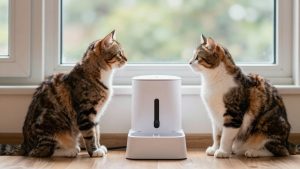
Automatic feeders are a lifesaver for busy cat owners, but if you have more than one cat a practical question comes up fast: can two cats share a single automatic feeder? The short answer is that they can physically eat from one, but it usually causes problems, because the faster or greedier cat tends to eat both portions. Here is when sharing works, when it fails, and the setups that actually keep multi-cat feeding fair.
📋 Table of Contents
- The Short Answer
- When Sharing a Feeder Works — and When It Doesn't
- Better Setups for Multi-Cat Feeding
- Best Feeders for Multiple Cats
- Tips for Fair Multi-Cat Feeding
- What to Look For in a Multi-Cat Feeder
- Automatic Feeders and Wet vs Dry Food
- The Bottom Line on Feeding Multiple Cats
- Frequently Asked Questions
The Short Answer
A basic single-bowl automatic feeder dispenses one portion at each scheduled time, and whichever cat gets there first can eat most or all of it. That is fine if your cats are relaxed, similar in size and appetite, and free-fed, but it breaks down the moment one cat needs portion control, is on a prescription diet, or simply bullies the other away from the bowl. For most multi-cat homes, a single shared feeder is a compromise rather than a proper solution.
When Sharing a Feeder Works — and When It Doesn’t
See also: Washable Kitten Bed With Removable Cover: 7 Easy-Wash Picks • Cat House for Outdoor Cats: Insulated Shelters and Straw Bedding
Sharing can work if both cats eat at a similar pace, neither is overweight or on a special diet, and there is no food guarding. It does not work when one cat is dominant, when cats need different amounts or different foods, or when a vet has prescribed measured portions. Free-feeding two cats from one bowl also makes it impossible to know how much each cat is actually eating, which matters because a drop in appetite is often the first sign of illness.
Better Setups for Multi-Cat Feeding
Dual-Tray or Two-Bowl Feeders
The simplest fix is a feeder built for two cats, with separate compartments that dispense a set portion to each bowl. The PETLIBRO dual-tray feeder is designed exactly for this, giving each cat its own controlled portion on the same schedule.
Microchip-Activated Feeders
The most reliable solution for cats on different diets is a microchip- or tag-activated feeder that only opens for the correct cat, so one cat physically cannot eat the other’s food. These cost more but are the gold standard when portion or diet control is essential.
Two Separate Feeders in Different Spots
Alternatively, give each cat its own feeder in a different room or corner. Running two units such as the PetSafe Smart Feed or the WOPET feeder lets you tailor each cat’s schedule and portion, and reduces competition at mealtimes.
Best Feeders for Multiple Cats
| Feeder | Best For | Typical Price |
|---|---|---|
| PETLIBRO Dual-Tray Feeder | Two cats, one unit, separate portions | Check on Amazon |
| PetSafe Smart Feed | App control, one per cat | Check on Amazon |
| WOPET Automatic Cat Feeder | Budget, reliable single feeder | Check on Amazon |
Prices are approximate and change frequently; check the live listing for current pricing.
Tips for Fair Multi-Cat Feeding
Feed measured portions rather than free-feeding, space feeders apart to reduce guarding, and watch each cat’s weight and appetite so you notice problems early. If one cat consistently steals food, a dual-tray or microchip feeder is worth the investment. Keeping mealtimes calm and separated is the key to healthy weights across a multi-cat household.
What to Look For in a Multi-Cat Feeder
When choosing a feeder for more than one cat, prioritise accurate portion control, a hopper large enough for your household, and easy cleaning so stale food does not build up. App scheduling lets you set different meal times, a jam-resistant dispensing mechanism prevents missed meals, and a battery backup keeps it running through power cuts. For homes where one cat needs a special diet, selective (microchip) access is the feature that matters most, since it is the only way to guarantee each cat eats only its own food.
Automatic Feeders and Wet vs Dry Food
Most automatic feeders are designed for dry kibble, which stores well in the hopper. If your cats eat wet food, look for a feeder with sealed, refrigerated, or ice-pack compartments designed to keep portions fresh, and expect to clean it more often. Many multi-cat households use an automatic dry feeder for scheduled meals and serve wet food separately by hand, which sidesteps the freshness challenge while still automating most feeds.
The Bottom Line on Feeding Multiple Cats
A single basic feeder shared by two cats almost always leads to uneven eating, so match the setup to your cats: a dual-tray feeder for two cats with similar diets, a microchip feeder when diets differ, or two separate feeders to remove competition entirely. Feed measured portions, watch each cat’s weight, and you will keep both cats healthy without the daily guesswork of a shared bowl.
Frequently Asked Questions
Can two cats share one automatic feeder?
They can eat from one, but it usually means the faster or more dominant cat eats both portions, which is a problem for weight and diet control. A dual-tray feeder, a microchip-activated feeder, or two separate feeders is a fairer solution for two cats.
How do I feed two cats on different diets?
Use a microchip- or tag-activated feeder that only opens for the correct cat, or give each cat its own feeder in a separate location on its own schedule. This prevents one cat from eating the other’s food, which is essential when one is on a prescription or weight-control diet.
Do automatic feeders work for multiple cats?
Yes, if you choose the right type. Dual-tray feeders portion food for two cats from one unit, and running one feeder per cat works well too. A single-bowl feeder shared by multiple cats is the setup most likely to cause uneven eating.
How do I stop one cat eating the other’s food?
The most reliable method is a microchip-activated feeder that opens only for the matched cat. Feeding measured portions, spacing bowls apart, and supervising early mealtimes also help. If bullying persists, separate feeding areas or a selective feeder solves it.
Is it better to free-feed or portion-feed multiple cats?
Portion-feeding is generally better for multiple cats because it lets you control each cat’s intake and spot appetite changes that signal illness. Free-feeding from a shared bowl makes it impossible to know how much each cat eats and often leads to one cat overeating.