- Top Pick: ANDOLL HOME Automatic Cat Feeder, 4L Cat Food Dispenser with 10s Voice Recorder, Pet Feeder up to 8 Meals per Day, Timed Dog Feeder with Dry Food Sealed Ring
- Best Value: Automatic Cat Feeder, 3L Cat Food Dispenser with Anti-Jam Design, Over 180-day Battery Life, 1-6 Meals Per Day with Stainless Steel Cat Bowl, Keep Dry Food Fresh, Timed Pet Feeder Also for Small Dog
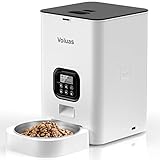
- Premium Choice: VOLUAS Automatic Cat Feeder, 4L Timed Dry Food Dispenser for Cats & Dogs
📅 Last updated:
Buying an automatic pet feeder is less about choosing the biggest hopper or the most buttons. The right model must dispense a consistent amount, fit your pet’s eating habits, stay sanitary, and keep working when you are away. In 2026, inexpensive feeders can offer scheduling, voice recording, battery backup, and portion control, but specifications are not always presented in the same way.
The most common mistake is confusing “meals” with “portions.” A meal may contain one portion or several portion units, depending on the feeder. Another mistake is buying by hopper capacity alone. A 4-liter feeder may be perfectly adequate for one cat, while a large dog may need an 8-liter unit and a wider tray. Buyers also overlook kibble size, battery requirements, cleaning access, and whether the dispenser can still operate during a Wi-Fi outage.
As an Amazon Associate we earn from qualifying purchases at no extra cost to you.



📋 Table of Contents
Decide These 3 Things First
- How much food does your pet need per day? Start with the daily amount recommended by your veterinarian or printed on the food package. Divide that total among the number of meals you want. For example, a cat eating 2.5 ounces per day across four meals needs about 0.625 ounce per meal, though the feeder’s portion units may not correspond exactly to ounces.
- What kind of food will you dispense? Most automatic feeders are designed for dry kibble. Check the stated kibble range, because some narrow chutes struggle with pieces larger than 0.5 inch. Automatic feeders generally do not replace refrigeration for wet food unless they use sealed, chilled compartments.
- How much supervision is realistic? If you are home daily, a simple timer with a 3- to 4-liter hopper may be enough. If the feeder will cover weekends or travel, prioritize jam alerts, a low-food indicator, a backup battery, a secure lid, and a bowl that is easy to inspect and clean.
Size and Capacity
See also: How to Remove Litter Box Odor Buildup (2026): Step-by-Step • How to Fix a Jammed Automatic Feeder (2026): Step-by-Step
Capacity should match both the animal and the number of days between refills. A 3-liter hopper commonly suits one cat or a small dog for several days, while a 4-liter model offers more breathing room without taking over a countertop. Large-dog feeders may hold 8 liters or roughly 34 cups, but a bigger hopper is useful only if the machine can dispense the required amount accurately.
Measure the available floor area before ordering. Many compact feeders occupy approximately 8 by 8 inches, while larger models can approach 12 by 12 inches. Allow at least 3 inches of clearance around the unit so the lid can open and the power cord is not sharply bent. A narrow base may be easy to fit but easier for a determined pet to tip.
Consider bowl height as well. A bowl positioned 3 to 6 inches above the floor can be more comfortable for some pets, but large or older animals may prefer a raised stand. The tray should be wide enough for the pet’s muzzle; a 5- to 7-inch diameter bowl is often more practical for cats than a deep, narrow dish.
Material and Food Safety
The food-contact components deserve more attention than the exterior finish. Stainless steel bowls are durable, resist odor retention, and are usually easier to sanitize than soft plastic. Look for a removable bowl that can be washed separately. If plastic touches the food, choose thick, smooth plastic with no deep seams where grease and crumbs can collect.
Do not assume that a “stainless steel bowl” means the entire food path is stainless steel. In many feeders, kibble still travels through a plastic hopper and rotating dispensing wheel. That is not automatically a problem, but the channel should be accessible with a dry brush or damp cloth. Avoid soaking the motor housing unless the instructions specifically allow it.
A gasket or sealed ring around the hopper lid can slow exposure to humidity. It will not make kibble airtight, and it cannot prevent spoilage indefinitely. Store food in a cool, dry place, clean the hopper before changing food, and avoid filling the container beyond the manufacturer’s maximum line.
Construction and Tip Resistance
Construction quality often determines whether a feeder remains useful after the novelty wears off. Look for a stable base, a lid that locks or twists firmly, and a dispensing chute that does not leave an easy paw-accessible opening. A feeder weighing about 3 to 6 pounds is generally more reassuring than an ultralight model, especially for larger cats and small dogs that push with their noses.
Check the relationship between hopper height and base width. A tall, narrow feeder may hold plenty of food but be more vulnerable to tipping. Rubber feet help prevent sliding on hard floors, while a weighted base is preferable for persistent pets. Place the unit against a wall when possible, but do not block the bowl or create a corner where food can accumulate.
For multi-pet homes, construction cannot solve every problem. A standard timed feeder may dispense one shared meal, not identify which pet eats it. If one animal needs prescription food or strict portion control, consider a microchip-access feeder rather than relying on separate bowls.
Comfort and Dispensing Performance
Portion control is the central feature in an automatic feeder buying guide with portions. Read the manual before comparing claims such as “up to 50 portions.” One portion might be a few teaspoons, while another machine’s portion could be closer to a tablespoon. The practical question is whether the smallest available increment lets you reach your pet’s daily target without large swings.
Choose a feeder with at least four scheduled meals per day if your pet benefits from smaller, frequent servings. Some models offer one to six meals daily, while others offer up to eight. A useful schedule might be breakfast, lunch, dinner, and a small overnight serving. Confirm whether each meal can contain multiple portion units and whether the schedule repeats automatically every day.
Anti-jam mechanisms are valuable, but they are not magic. Kibble can bridge across a chute when it is oily, irregularly shaped, or too large. A dispensing wheel with a wide opening and a removable food path is easier to clear. If the feeder uses an app, verify that the core schedule is stored locally; a Wi-Fi interruption should not cancel feeding.
Voice recording is a convenience feature, not a performance feature. A 10-second message may help call a pet to the bowl, but it does not compensate for inconsistent portions or a difficult-to-clean tray. Battery operation is useful during outages, but check whether batteries are primary power, backup power, or the only power source.
Price Tiers
Budget feeders typically cost about $25 to $40. In this range, expect a 3- to 4-liter hopper, basic timer controls, dry-food dispensing, and one bowl. For example, models priced around $29.99 to $32.29 may include a voice recorder, one to eight scheduled meals, a stainless steel bowl, or a long claimed battery life. Treat advertised battery duration as a best-case estimate because usage, battery type, and dispensing frequency affect it.
Midrange models usually cost $40 to $75. They may offer a larger hopper, a stronger dispensing mechanism, clearer controls, backup power, better lid seals, and more useful alerts. A 4-liter timed feeder around $41.79 may be a reasonable choice for a single pet if its portion increments match the food you use.
Premium and large-capacity models commonly begin around $75 and can exceed $150. The higher price may reflect app control, cameras, two-way audio, stainless food paths, custom schedules, or access control rather than dramatically better portion accuracy. Large 8-liter units around $55.98 show that capacity alone does not make a feeder premium. Pay for the feature that solves your actual problem.
Warranty and Support
A one-year limited warranty is a sensible minimum for an electronic feeder. Confirm what it covers: motor failure, display problems, power adapters, and battery compartments may be treated differently. A warranty that excludes clogs caused by normal kibble may still be reasonable, but the manufacturer should provide clear cleaning and troubleshooting instructions.
Look for a company with a stated contact method, accessible replacement parts, and a return window of at least 30 days. Replacement bowls and power adapters are especially useful because they are more likely to wear or disappear than the main housing. Keep the receipt, packaging, and model number until the feeder has completed several weeks of reliable schedules.
Delivery and Assembly
Most automatic feeders require little assembly: attach the bowl, install batteries if needed, and connect the power adapter. Allow 10 to 20 minutes for setup, plus time to test portions. Before loading food, run at least 10 dispensing cycles into a measuring cup. Weigh the output with a kitchen scale if portion accuracy matters.
Check the package dimensions and shipping weight if delivery access is limited. A compact feeder may weigh 3 to 5 pounds, while a large-capacity model can be closer to 8 pounds. Inspect the hopper, chute, tray, and power cord immediately. Do not use a unit with a cracked food container or a loose adapter.
Spec Checklist
| Spec | Budget | Mid | Premium |
|---|---|---|---|
| Typical price | $25–$40 | $40–$75 | $75–$150+ |
| Hopper capacity | 3–4 liters | 4–6 liters | 6–8+ liters or specialty compartments |
| Meals per day | 1–6 | 1–8 | Custom schedules; often 6–12 events |
| Portion adjustment | Basic portion units | Multiple units per meal | Fine increments, app scheduling, or pet-specific access |
| Bowl | Plastic or stainless insert | Removable stainless bowl preferred | Wide stainless bowl and replaceable parts |
| Power | Plug-in; battery backup varies | Plug-in plus backup batteries | Backup power, alerts, and app monitoring |
| Warranty target | 6–12 months | At least 12 months | 12–24 months or stronger support |
Red Flags
- “Portion” is advertised without a stated volume, weight, or adjustable increment.
- The manufacturer does not specify the maximum kibble diameter.
- The lid is loose, the base is very light, or the bowl can be pulled out by the pet.
- The food chute cannot be opened or brushed clean.
- Battery life is stated without naming the battery type or explaining backup behavior.
- The feeder requires Wi-Fi for basic scheduled dispensing.
- There is no clear warranty, return policy, manual, or replacement-bowl availability.
- A large hopper is promoted as a substitute for portion testing.
FAQ
How many portions should an automatic feeder dispense?
Choose the smallest increment that lets you divide the recommended daily food amount sensibly. If your cat needs 2.5 ounces daily, four meals of about 0.625 ounce may be appropriate, but you must test what the machine’s portion unit actually delivers. Use a scale rather than assuming one portion equals one ounce.
Is a 3-liter or 4-liter feeder better for one cat?
Either can work. A 3-liter hopper is compact and usually sufficient for several days of dry food for one cat. A 4-liter model reduces refill frequency and may be preferable if the cat eats more, the kibble is bulky, or you travel for longer periods. Capacity does not improve accuracy by itself.
Are automatic feeders safe during a power outage?
Only if the model has a functioning battery backup or operates on batteries. Confirm that the backup powers scheduled dispensing rather than only the display. Test it by unplugging the feeder for a full scheduled cycle, and replace batteries on the manufacturer’s recommended schedule.
Can one automatic feeder feed two pets?
It can dispense a shared meal, but it cannot guarantee equal access. One pet may eat faster or block the other. For different diets, weight-management needs, or medication-related feeding, use separate feeders or a model with individual pet identification.
Ready to decide? Our #1 pick for 2026 is the Typical price.
Live price & availability on Amazon.