- Top Pick: Apasiri Tough Dog Toys for Aggressive Chewers: Beef Flavored Long Lasting Dog Bones for Large Dogs, Indestructible Dog Chew Toys to Keep Them Busy, Large Dog Toys for Medium & Large Breed, Red
- Best Value: SIHRMIU 2 Pack Dog Chew Toys for Aggressive Chewers,Boredom and Stimulating Best Dog Toys for Medium/Large Breed,Tough Almost Indestructible Dog Bones for Teeth Cleaning and Training
- Premium Choice: WinTour Tough Dog Toys for Aggressive Chewers, Indestructible Dog Chew Toys
📅 Last updated:
📋 Table of Contents
The Short Answer
For a strong chewer, choose a dog toy that is at least 4 to 6 inches longer than the width of the dog’s mouth when closed, and large enough that it cannot be swallowed or wedged behind the back teeth. As a general starting point, small dogs usually need a toy measuring 4 to 5 inches (10 to 13 cm), medium dogs need 5 to 7 inches (13 to 18 cm), large dogs need 7 to 9 inches (18 to 23 cm), and extra-large dogs may need 9 to 12 inches (23 to 30 cm).
Weight matters as much as length. A toy that feels appropriately sized but is very light may be easy for a powerful dog to break apart or carry into an unsafe position. For dogs between 40 and 70 pounds, look for a dense rubber or nylon toy weighing roughly 8 to 16 ounces. Dogs over 70 pounds may need a toy weighing 12 to 24 ounces, depending on the shape and material.
As an Amazon Associate we earn from qualifying purchases at no extra cost to you.



These measurements are starting points, not guarantees. A strong chewer should always be supervised with a new toy. Remove it when it develops deep grooves, sharp edges, loose pieces, cracks, or a missing section. Product descriptions that use terms such as “tough” or “indestructible” should not replace regular inspection.
Standard Sizes
See also: How to Remove Litter Box Odor Buildup (2026): Step-by-Step • How to Fix a Jammed Automatic Feeder (2026): Step-by-Step
The table below matches common chew-toy dimensions with dog size, approximate weight, and suitable uses. Measure the actual toy rather than relying only on a package label such as “large.” A long bone and a thick ring can have the same length but offer very different bite resistance.
| Size | Typical toy dimensions | Metric dimensions | Suggested dog weight | Typical toy weight | Best for |
|---|---|---|---|---|---|
| Small | 4–5 in. long × 1.5–2 in. wide | 10–13 cm × 4–5 cm | Up to 20 lb | 3–6 oz (85–170 g) | Small breeds with compact jaws |
| Medium | 5–7 in. long × 2–2.5 in. wide | 13–18 cm × 5–6.5 cm | 20–45 lb | 6–12 oz (170–340 g) | Terriers, spaniels, and medium mixed breeds |
| Large | 7–9 in. long × 2.5–3.25 in. wide | 18–23 cm × 6.5–8.3 cm | 45–75 lb | 10–18 oz (285–510 g) | Powerful chewers and large breeds |
| Extra-large | 9–12 in. long × 3–4 in. wide | 23–30 cm × 7.5–10 cm | 75–120 lb | 16–30 oz (455–850 g) | Very large dogs and dogs with wide jaws |
For a strong chewer, choose the upper end of the recommended range when your dog falls between sizes. For example, a 42-pound dog that destroys medium toys may be better matched with a 7-inch large toy than a 5-inch medium toy. Avoid sizing up so far that your dog cannot comfortably grip, carry, or chew the toy.
Nylon bones, dense rubber shapes, and thick synthetic chew toys are common choices. Nylon toys are often rigid and long-lasting, but they can be too hard for some dogs. A simple check is to press the surface with a fingernail. If there is no slight give at all, ask your veterinarian whether the material is suitable for your dog’s teeth. Hard objects can cause dental injuries, particularly in dogs that bite down with full force.
How to Measure Your Space
- Measure your dog’s mouth width. With your dog relaxed, measure across the mouth at the widest point, generally from the outside of one cheek to the other. Do not force the mouth open.
- Measure the jaw opening. Estimate the distance between the upper and lower canine teeth when the mouth is naturally open. A toy should be too large to fit completely through this opening.
- Measure the dog’s body weight. Use a household scale or a recent veterinary record. Weight helps narrow the size category, but jaw width and chewing style should decide between two options.
- Measure the toy’s thickest section. For a bone, check the center and both ends. For a ring or bar, measure the outside diameter and the thickness of the material, not just its overall length.
- Check the grip area. Your dog should be able to hold the toy without its teeth touching the floor, furniture, or your hand. A toy that is too short can create a bite or finger hazard during interactive play.
- Leave room for wear. If the toy is already close to the minimum safe size, choose a larger replacement. Chewing can reduce the length, width, or thickness over time.
By Room or Use Case
Living Room Chewing
For supervised chewing on a rug or dog bed, choose a toy with rounded ends and a manageable weight. A 5- to 7-inch toy is a practical choice for many medium dogs, while large dogs often need 7 to 9 inches. Avoid small pieces, thin discs, and toys that can roll under a sofa and encourage your dog to push or bite at an awkward angle. Place the toy on a washable mat if flavored or treat-filled products may leave residue.
Crate and Quiet-Time Use
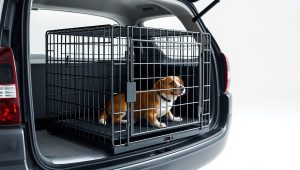
Crate toys should be large enough not to fit through the crate door bars or become lodged between the dog and the side wall. A single, solid piece is usually easier to inspect than a toy with detachable caps or several small components. Measure the crate’s floor area before selecting an oversized toy; the dog should still be able to turn around, lie down, and stretch out. Do not leave a newly introduced chew toy in the crate until you have observed how your dog uses it.
Outdoor and Yard Play
Outdoor toys should be easy to see in grass and large enough not to disappear in soil or leaves. Bright red, orange, or blue toys are generally easier for people to locate than brown or green toys. For fetch, choose a ball or ring at least 2.5 inches (6.4 cm) in diameter for many medium and large dogs, and larger than that for dogs with wide jaws. A chew bone designed for stationary chewing may not be suitable for high-speed fetching, so use the toy only for its intended purpose.
Road Trips and Travel
Travel toys need to fit securely in a carrier without reducing ventilation or resting against the dog’s face. A 4- to 6-inch toy works for many smaller dogs; medium and large dogs may use a 6- to 9-inch toy if the carrier has enough room. Bring a backup rather than allowing a damaged toy to remain in use. Store chews in a sealed container because flavored nylon and rubber toys can attract dirt, moisture, and insects.
Training and Enrichment
For food-stuffable toys, select a size that holds enough food to occupy the dog without making the item too heavy to carry. The opening should be large enough for cleaning, but not so large that treats fall out immediately. A strong chewer may need a thick-walled 5- to 7-inch toy rather than a thin treat dispenser. If your dog bites through the opening or removes chunks, discontinue use.
Common Sizing Mistakes
- Choosing by breed name alone: Two dogs of the same breed can have very different jaw widths and chewing habits.
- Buying a toy that is too small: If the dog can fit the entire toy behind the front teeth, the risk of swallowing or choking increases.
- Assuming heavier always means safer: Weight helps, but an extremely hard toy can still damage teeth.
- Ignoring thickness: A 9-inch toy with a thin center may be less suitable than a shorter toy with a thick, rounded body.
- Using puppy-size toys for adult chewers: Growing dogs may outgrow their first toy quickly, especially during the transition to adult teeth.
- Keeping a damaged toy: Replace a toy when pieces break off, regardless of how much life appears to remain.
- Expecting one toy to fit every activity: Chewing, fetching, crate time, and tugging place different demands on shape and size.
As a price reference, tough chew toys in the examples supplied for this guide range from about $9 to $15, including products listed at $9.47, $11.99, $12.99, and $14.99. Price does not establish durability or safety. Compare the listed dimensions, material, and recommended dog size, then inspect the toy after each session. This approach remains useful when shopping in 2026, when product names and package claims may change but fit and supervision remain the key considerations.
FAQ
What size toy is best for a 50-pound strong chewer?
Start with a large toy measuring about 7 to 9 inches long and 2.5 to 3.25 inches wide. Choose the larger or thicker option if your dog destroys medium toys, but confirm that the toy cannot fit completely into the mouth. A 10- to 18-ounce toy may provide a better starting point than a lightweight model.
Can a strong chewer use a toy labeled “large”?
Yes, but the label is only a general category. Check the actual length, width, thickness, and material. One manufacturer’s large toy may measure 6 inches, while another’s may measure 9 inches. Match the measurements to your dog’s mouth and weight rather than relying on the word “large.”
Is a hard nylon toy safe for aggressive chewers?
It may be appropriate for some dogs, but hard nylon can chip or contribute to tooth damage. Avoid any toy that is sharper than your dog’s teeth, shows splintering, or has become rough and jagged. Ask your veterinarian about suitable materials if your dog has worn, fractured, or sensitive teeth.
How often should I replace a strong-chewer toy?
There is no universal replacement schedule. Inspect the toy before every use and replace it immediately when it has cracks, sharp edges, loose pieces, deep punctures, or substantial size loss. A toy may last several weeks or months, while a powerful chewer may damage it during the first session.
Ready to decide? Our #1 pick for 2026 is the Small.
Live price & availability on Amazon.