Our Short List of 3

- Tank range: 60–100 gallons
- Outlets: 2
- Power: 4.8 W
- Model: 77855

- Tank range: 10–100 gallons, as published
- Outlets: 2
- Output: 2–5 L/min, manually adjustable
- Pressure: 18 kPa
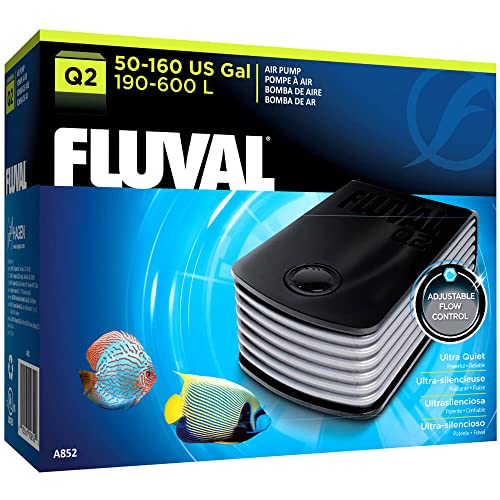
- Tank range: 50–160 gallons
- Outlets: 1
- Output: 60 GPH (240 LPH)
- Maximum pressure: 3.4 psi
All 5 Picks at a Glance
| Product | Specs | Action |
|---|---|---|
| 1. Tetra Whisper 100 (77855) |
| Check price on Amazon |
| 2. HITOP Dual Outlet Aquarium Air Pump (204) |
| Check price on Amazon |
| 3. Fluval Q2 Air Pump (A852) |
| Check price on Amazon |
 4. Aqueon QuietFlow Air Pump 100 |
| Check price on Amazon |
 5. Tetra Whisper AP150 Deep Water Air Pump |
| Check price on Amazon |
📅 Last updated:
Disclosure: As an Amazon Associate, I earn from qualifying purchases.
Best Aquarium Air Pumps for Sponge Filters and Air Stones
An air pump deserves a skeptical start: most tanks with a working filter do not strictly need one. Oxygen enters the water at the surface, and it is surface agitation — a filter return breaking the surface film — that does the oxygenating, not the bubbles themselves. A bubble column is mostly a way of moving water upward and stirring the surface from below.
Air pumps still sell in large numbers because bubbles power a whole class of useful equipment. Sponge filters, box filters and undergravel filters run on air. Air stones drive quarantine tubs and breeding setups where a powered filter is too strong. Backup aeration during a power cut needs a pump too.
This guide covers the general job: standard home aquariums, sponge filtration, multiple air-driven devices and deep tanks — not near-silent pumps for a nano tank beside a bed, which is a narrower problem. The five pumps below span single-outlet basics, an adjustable dual-outlet kit and one deep-water specialist.
📋 Table of Contents
How to Choose an Aquarium Air Pump
Start with the job, not the gallon label
Tank-size labels on air pumps are the loosest numbers in the hobby. A pump marked for 100 gallons may struggle in a tall 40-gallon tank, because what actually limits a pump is depth and back pressure: every extra inch of water above the air stone pushes back against the diaphragm. Match the pump to the deepest device it will drive and to the number of devices, and treat the gallon figure as a rough ceiling.
Count outlets, then plan the plumbing
One outlet per device is the clean arrangement. Two outlets cover the common pairing of a sponge filter plus an air stone, or two sponge filters in one tank. Beyond two devices, run a single strong outlet into a gang valve — a manifold that splits one line into several, each with its own tap — rather than daisy-chaining splitters, which starves the furthest device. Two outlets feeding one line? Join them with a T-connector for steadier flow.
Understand where the noise actually comes from
Almost nobody is kept awake by an air pump motor. The buzz that carries across a room is vibration transferred from the pump body into the shelf or cabinet it touches, which then acts like a sounding board. That is why placement fixes outperform shopping: set the pump on a folded towel or foam pad, keep the airline off hard surfaces, hang it from a hook if the cabinet hums, and never let the body touch the tank glass.
Fit a check valve, every time
A check valve is a small one-way fitting in the airline, and it is the cheapest insurance in the hobby. When a pump stops — a power cut, a tripped breaker, a plug knocked loose — water can siphon back down the airline toward the pump. If the pump sits below the waterline, that siphon can drain a serious amount of tank water onto the floor and wreck the pump on the way. A check valve closes against the backflow. Only a pump mounted above the waterline makes it optional.
Flow control and spare air
Adjustable output sounds like a luxury until a pump overdrives a small sponge filter and turns a fry tank into a jacuzzi. A knob on the pump is the tidy solution; with a fixed-output pump, fit an inline control valve, and bleed excess air off through a spare valve rather than throttling the line hard shut, which strains the diaphragm and shortens its life.
Comparison Table
See also: Best Automatic Transmission Floor Shifter: Ratchet, Gated and Detent Shifters Compared • Best Automatic Floor Shifter for Truck: Tall, Tough Picks for Pickups and Bench Seats
| Product | Tank fit | Outlets | Output | Flow control |
|---|---|---|---|---|
| Tetra Whisper 100 (77855) | 60–100 gallons | 2 | Sized by tank range | None on pump |
| HITOP Dual Outlet (204) | 10–100 gallons | 2 | 2–5 L/min | Manual knob |
| Fluval Q2 (A852) | 50–160 gallons | 1 | 60 GPH (240 LPH) | Knob on pump |
| Aqueon QuietFlow 100 | Up to 100 gallons | 1, vertical | No published figure | None on pump |
| Tetra Whisper AP150 | Deep tanks, typically 90–180 gallons | 1 | 2.5 L/min | None on pump |
The 5 Best Aquarium Air Pumps
1. Tetra Whisper 100 (77855)
- Tank range: 60–100 gallons
- Outlets: 2
- Power: 4.8 W
- Model: 77855
The Whisper 100 is the default answer for a mid-to-large tank that needs air on two lines. The domed housing and internal sound-dampening chambers smooth the pulses each diaphragm stroke produces, so airflow arrives steadily instead of in buzzes, and the wide footprint keeps the unit planted.
Two outlets run a pair of sponge filters, a sponge filter plus an air stone, or air to two smaller tanks, in the 60 to 100 gallon range at ordinary depths; for a tall tank, the deep-water model further down is the better tool. Nothing else comes in the box: tubing, stones and the essential check valve are separate purchases.
View the Tetra Whisper 100 on Amazon
2. HITOP Dual Outlet Aquarium Air Pump (204)
- Tank range: 10–100 gallons, as published
- Outlets: 2
- Output: 2–5 L/min, manually adjustable
- Pressure: 18 kPa
The HITOP dual outlet pump is the kit purchase of this group: two air stones, two airline tubes, two check valves, a T-connector and a spare intake filter cotton all arrive with the pump, so a two-device setup can be plumbed the day it lands. Having the check valves in the box removes the most commonly forgotten item from the list.
Output adjusts by hand with a knob, across a published 2 to 5 liters per minute, against 18 kPa of pressure. Manual adjustment is deliberate: no electronic control board to fail, and the maker argues the simpler mechanism lasts longer. The stated 10 to 100 gallon range is optimistic at the deep end — treat it as a small-to-mid tank pump with headroom.
View the HITOP Dual Outlet Air Pump on Amazon
3. Fluval Q2 Air Pump (A852)
- Tank range: 50–160 gallons
- Outlets: 1
- Output: 60 GPH (240 LPH)
- Maximum pressure: 3.4 psi
The Q2 is Fluval’s pressure pick for large and deep aquariums, and its specification sheet is unusually honest reading: 60 gallons per hour of output, a maximum pressure of 3.4 psi, and a stated fit for tanks from 50 to 160 gallons. Pressure is what matters in a deep tank, and 3.4 psi keeps a sponge filter working where smaller pumps fade to a trickle.
A single outlet feeds that pressure to one line, and a flow-control knob built into the pump dials output down without extra valves. The double-walled housing carries an engineered baffle chamber, and the swing-arm and diaphragm assembly is shared across the Q series, so repair modules are a standard part. Fluval publishes a noise figure of 45 dB at one meter for the series — a test-room number; placement on a soft surface still does more for a quiet room than the gap between two published figures. Airline, stones and a check valve are separate purchases.
4. Aqueon QuietFlow Air Pump 100
- Tank range: up to 100 gallons
- Outlets: 1, vertical
- Output: no published figure
- Check valve: integrated and replaceable
The QuietFlow 100 builds the safety fitting into the pump itself: a check valve is integrated into the unit and is replaceable, removing the most dangerous omission in air pump setup. The diaphragm and dust filter pad are replaceable too, and Aqueon sells repair kits for the line, so the pump can be maintained rather than discarded when the diaphragm tires.
The single outlet points upward, keeping the airline from kinking where it leaves the pump — a mundane detail that prevents a real failure mode, since a kinked line starves the device and strains the diaphragm. A wide rubber base absorbs vibration at the contact point.
The honest gap in this pump’s paperwork is output: Aqueon publishes no airflow figure for the line, so there is no number to set against the Fluval or the HITOP. The 100 is the largest of three sizes, for tanks up to 100 gallons at ordinary depths, feeding one line — for keepers who value the built-in check valve and serviceable parts. Tubing and an air stone are sold separately.
View the Aqueon QuietFlow Air Pump 100 on Amazon
5. Tetra Whisper AP150 Deep Water Air Pump
- Tank fit: deep tanks, typically 90–180 gallons
- Outlets: 1, intended for use with a gang valve
- Output: 2.5 L/min
- Devices: up to 10 air-driven accessories, as published
The AP150 belongs to Tetra’s DeepWater series, a different line from the standard Whisper domes above, built for pressure over distance. Tetra positions it for tanks as tall as eight feet and, in typical home terms, aquariums of roughly 90 to 180 gallons up to about 24 inches deep. Its single outlet is meant to feed a gang valve: Tetra states it can run up to ten air-driven accessories from that one line.
Published output is 2.5 liters per minute, which reads modestly until depth enters the picture — the AP150’s job is to keep delivering that flow against deep-water back pressure, where general-purpose pumps lose their stream. A bank of sponge filters on a breeding rack or a large display with several stones is the use case; a single small tank is not.
View the Tetra Whisper AP150 on Amazon
Frequently Asked Questions
Do I need an air pump if my tank already has a filter?
Usually not for oxygen. A filter return that ripples the surface does the gas exchange work on its own, and bubbles add little directly. An air pump earns its place when something runs on air — a sponge filter, a box filter, an air stone in a quarantine tub — or as backup aeration for a heavily stocked tank in hot weather or a power cut, when surface movement stops.
Why is my air pump louder than the one in the shop?
Because the shelf is part of the instrument. Vibration travels into whatever the pump sits on, and a hollow cabinet or thin shelf amplifies it like a drum. Move the pump onto a folded towel or foam pad, keep it from touching the tank or wall, keep the airline off hard surfaces, and try hanging it from a hook. Most loud pumps are placement problems, not defective pumps.
Where does the check valve go, and which way round?
In the airline, between the pump and the tank, with the arrow on the valve body pointing toward the tank — air flows to the aquarium, water cannot flow back. It matters most when the pump sits below the waterline, which is most shelves under most tanks.
What happens to an air-driven setup in a power cut?
The pump stops, the bubbles stop, and two risks begin. The slow one is oxygen: a stocked tank with no surface movement loses oxygen over hours, faster in warm water. The fast one is the siphon — water creeping back down the airline toward a pump below the waterline, which a check valve prevents outright. When power returns, a healthy pump restarts; one that took on water may not.
Conclusion
Buy the pump for the devices it will drive and the depth it will push against, not for the gallon figure on the box. For a standard mid-to-large tank on two lines, the Tetra Whisper 100 is the settled, serviceable default. The HITOP kit suits a first sponge filter setup that should arrive complete, check valves included. Deep and large tanks split two ways: the Fluval Q2 for one strong, adjustable line, and the Tetra AP150 when one pump must feed many devices through a gang valve. The Aqueon QuietFlow 100 is the pick for a single line where the built-in, replaceable check valve simplifies ownership.