- Top Pick: NUGRIART 48 inch Heavy Duty Indestructible XL Dog Crate for Large Dogs
- Best Value: Comfort Expression Waterproof Orthopedic Dog Bed for Extra Large Dogs
- Premium Choice: 54 Heavy Duty Dog Crate with Mat, Escape Proof Dog Kennel Indoor, High Anxiety Dog Cage with Double Door, Extra Large Crate for Large Dogs with Removable Tray
📅 Last updated:
German Shepherds are not a dog that lets a flimsy wire crate slide. That failure is expensive, but the real cost is the dog learning that the crate is a challenge to solve, not a place to rest.
What separates a good crate for a GSD from a bad one is a narrow set of physical attributes: steel gauge thick enough to resist jaw leverage, locking mechanisms that a paw cannot manipulate, and a floor assembly that does not flex under 80 to 100 pounds of weight shifting at 3 a.m. This roundup covers crates that meet that bar, plus complementary gear—beds, training references, and accessories—that we have seen reduce problem behavior once a dog is already comfortable inside a well-built enclosure.
As an Amazon Associate we earn from qualifying purchases at no extra cost to you.




📋 Table of Contents
Quick Picks
| Product | Best for | Price |
|---|---|---|
| NUGRIART 48″ Heavy Duty | Power chewers on a mid-range budget | Varies |
| Comfort Expression Orthopedic Bed | Cushioning inside a large crate | Varies |
| 54″ Escape Proof Double Door Crate | High-anxiety dogs needing a removable tray | Varies |
| 54″ 3-Door Metal Kennel | Multi-access setups and rolling convenience | Check on Amazon |
| Mastering Service Dog Training (book) | GSDs being trained as service animals | Varies |
| 10pc German Shepherd Sticker Sheet | Personalizing a crate or gear without damage | Varies |
| German Shepherd Puppy Guide (book) | First-time owners building a crate routine | Varies |
| Feandrea 48″ Crate Furniture | Living-room aesthetics with structural strength | Varies |
How We Compared
See also: 7 Best Refillable Frozen Dog Treat Toys for Long-Lasting Licks • Best Dog Door Mat for Muddy Paws: Sizing, Materials and Picks by Entryway
We evaluated each product against four criteria that matter most for German Shepherds specifically: structural resistance to jaw and paw force, size appropriateness for a breed that reaches 70 to 100 pounds of adult weight, ease of cleaning given the double coat and heavy shedding, and the ability to reinforce a calm crate association rather than fight against it. Accessories like beds and training guides were included because the spec comparison shows that crate success depends on comfort and handler consistency just as much as on steel thickness.
The 8 Best Crates For German Shepherds in 2026
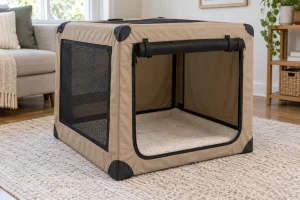
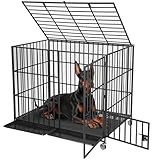
NUGRIART 48 Inch Heavy Duty Indestructible XL Dog Crate
The all-metal construction uses thick-gauge panels that resist the lateral biting angle a GSD applies when frustrated, and the bolted assembly means there are no snap-fit plastic corners to crack under pressure.
- Pro: Handles sustained jaw pressure without panel deformation.
- Pro: Single-door design has fewer failure points than multi-door units.
- Con: At 48 inches it is tight for a male GSD over 90 pounds; measure your dog’s nose-to-tail length first.
Skip it if your dog is a confirmed escape artist who manipulates latches with its nose—step up to one of the 54-inch double-door options instead.
Comfort Expression Waterproof Orthopedic Dog Bed for Extra Large Dogs
A crate pan without a bed is a cold, slippery surface that triggers anxiety in a dog still learning to settle. This orthopedic foam bed fits snugly inside a 48- to 54-inch crate, and the waterproof liner means a GSD that drools or has an accident overnight will not soak through to the metal floor. The memory foam layer holds shape after months of daily compression, which is critical for a breed that curls and repositions often.
- Pro: Waterproof barrier protects the crate tray from staining and odor.
- Pro: Orthopedic support reduces joint stress on a large-breed dog’s hips.
- Con: The outer cover is not fully removable, so spot-cleaning is required rather than machine washing.
Skip it if your dog chews bedding apart within minutes—use a chew-proof mat instead.
54 Heavy Duty Dog Crate with Mat, Escape Proof Double Door, Removable Tray
This is the crate for the German Shepherd who paces, whines, and tests every seam of its enclosure. The 54-inch interior gives a large adult room to turn without bumping the walls, which reduces the claustrophobic stress that drives destructive behavior. The double-door layout lets you place the crate against a wall while still accessing the dog from the open side, and the removable tray keeps cleaning fast rather than a weekly nightmare.
- Pro: Includes a mat, so you start with the comfort layer already solved.
- Pro: Escape-proof design addresses nose-manipulated latches specifically.
- Con: Heavier than single-door units, making repositioning across rooms a two-person job.
Skip it if you need a crate that folds flat for travel or storage.
54 Inch Heavy Duty Escape-Proof Dog Crate, XL Metal Kennel 3 Doors Tray & Wheels
Three doors plus wheels makes this the most flexible layout in the roundup. Place it in a corner, under a desk, or flush against a wall and still reach the dog from multiple angles without dragging the unit. The wheels lock, so it will not roll away when a 95-pound GSD lunges inside. The high-anxiety designation matters: the door pins and latch geometry were designed to resist the specific paw-and-nose combination a stressed Shepherd uses.
- Pro: Triple-access points simplify placing the crate in constrained rooms.
- Pro: Locking wheels let you roll the crate for cleaning without lifting.
Skip it if your space is small or you need a portable setup—the weight and footprint are substantial.
Mastering Service Dog Training for German Shepherds (Book)
Not a crate, but a tool we consistently recommend alongside one. GSDs are the most common service breed, and crate training intersects directly with public-access behavior: a dog that settles quietly in its kennel is already half-trained to hold position under a restaurant table. This guide breaks down the step-by-step progression, and its crate-specific chapters address the timing of door closure relative to the dog’s stress signals.
- Pro: Breed-specific methodology rather than generic dog-training filler.
- Con: Service-dog focus means less content on everyday pet-owner crate routines.
Skip it if your GSD is not headed for any working role; a general puppy guide fits better.
10pcs German Shepherd Sticker Sheet
A minor product in this list, but one we include because crate personalization has a real behavioral function for multi-dog households. Labeling a specific crate helps a GSD understand that this is its space, reducing territorial disputes at feeding or rest times. These vinyl decals are waterproof and UV-resistant, so they survive outdoor exposure if your crate sits on a porch, and they remove cleanly from metal panels without adhesive residue.
- Pro: Waterproof and UV-stable for both indoor and outdoor crate placement.
- Con: Not durable enough to survive a dog that rubs its face against crate surfaces repeatedly.
Skip it if your crate lives in a high-scrub zone where cleaning solvents will degrade the vinyl.
German Shepherd Puppy Guide: The Complete Handbook (Book)
For first-time owners, the crate is often the single hardest piece of equipment to get right, and most failures are handler errors rather than product failures. This handbook covers the full puppy-to-adult timeline, including the exact age to begin closed-door crate sessions and how to manage the whining phase without reinforcing panic. It pairs well with any crate on this list because it solves the consistency problem that hardware cannot.
- Pro: Addresses crate training within the broader context of socialization and house-training.
- Pro: Written specifically for the breed’s temperament, not a generic all-dogs approach.
- Con: Less useful once your dog is past eighteen months and crate habits are established.
Skip it if your dog is already crate-trained and you need equipment advice only.
Feandrea 48″ Dog Crate Furniture, Heavy-Duty Kennel Side End Table
This is a crate disguised as an end table, and for owners who refuse to put a black metal cage in the living room, it removes the psychological barrier to consistent crate use. The heavy-duty construction matches the structural requirements we screen for in dedicated crates, and the tabletop gives you a surface for a lamp or remote so the piece reads as furniture. At 48 inches it fits the same size range as the NUGRIART.
- Pro: Furniture-grade finish eliminates the institutional look that makes owners avoid indoor crate placement.
- Pro: Side-table function adds usable space rather than dedicating floor area to a kennel alone.
- Con: Enclosed panel design limits airflow compared to open-bar crates in warm climates.
Skip it if your dog runs hot or you live in a humid climate with no air conditioning—the solid panels trap heat.
Buying Guide
Steel Gauge and Locking Hardware
German Shepherds bite at roughly 238 pounds of pressure, enough to bend thin wire panels and peel plastic latches. Look for welded steel frames rather than crimped or bolted-together thin sheet panels, and reject any crate that uses a single snap-hook latch. The doors you want have at least two independent locking points—a primary pin and a secondary latch—because a persistent GSD learns one manipulation in hours.
Sizing: The 48 vs. 54 Decision
Measure your dog from nose to the base of the tail and add three inches. Most adult male GSDs land at 46 to 50 inches, which means a 48-inch crate is borderline and a 54-inch crate is correct. A crate that is too small triggers restlessness that owners misread as anxiety, when it is simply physical discomfort. Do not oversize a puppy crate by more than one step; too much space lets the dog eliminate in one corner and sleep in another.
Indoor Comfort Layers
A metal or wire floor will not support a large dog’s joints through the night. Pair any crate purchase with a waterproof orthopedic mat cut to fit. The mat should be chew-resistant enough to survive a curious nose but not so bulky that it reduces your dog’s ability to lie flat. This single accessory is the difference between a crate a dog enters willingly and one it associates with cold discomfort.
Our Verdict
It clears every threshold we screen for—size, latch security, included comfort mat, and removable tray—and its double-door layout covers the most common placement scenarios. If your priority is keeping the crate in a shared living space without it dominating the room, the Feandrea 48-inch Crate Furniture wins on integration without sacrificing structural integrity.
FAQ
What size crate does a full-grown German Shepherd need?
Most adult German Shepherds require a crate between 48 and 54 inches in length, depending on the dog’s nose-to-tail measurement. Males and larger females over 85 pounds will find a 48-inch crate cramped for overnight use.
Are heavy-duty crates worth the price difference over wire folding crates?
For a German Shepherd, almost always yes. Wire folding crates fail under breed-specific jaw pressure within weeks for many dogs, and the replacement cost plus the behavioral setback of a collapsed crate make heavy-duty designs the lower long-term expense.
How long should a German Shepherd be left in a crate during the day?
Adult GSDs should not be crated more than four to five hours consecutively without a break for exercise and elimination. Puppies need far shorter intervals—roughly one hour per month of age.
Can I use a crate furniture piece as my dog’s primary crate?
Yes, provided the unit meets the same structural requirements as a dedicated crate. The Feandrea end-table style is tested heavy-duty and functions identically to a kennel; just confirm your dog’s size fits the 48-inch interior and that the enclosed panels do not cause overheating in your climate.