- Top Pick: Aivituvin Heated Outdoor Cat House with Heating Pad, Insulated Liner
- Best Value: Indestructible Heated Cat House for Outside Cats Winter,Weatherproof & Insulated & Elevated Feral Cat House with Escape Door, Outdoor Indoor Cat Shelter for Stray Barn Cat 17.7×14.9×17.5
- Premium Choice: Weatherproof Heated Cat Houses for Outdoor Cats – Insulated Cat Shelter for Winter with Thermostatic Heating Pad and Escape Door, Warm Outside Pet House Gift for 1-2 Feral Cats (Medium)
📅 Last updated:
Feeding stray cats through a Midwest winter teaches you something no product listing can: most heated cat houses fail within two seasons. The heating element chews through, the insulation compresses into a useless liner, or moisture gets in and the whole structure rots from the inside out. We compared these eight best heated cat houses across real outdoor conditions—freezing rain, snow loads, and the kind of wind that separates marketing claims from actual construction.
What separates a good heated cat house from a cheap one is not price alone. The best heated cat houses all share three things: safety-listed wiring, insulation that resists moisture absorption, and structural durability against the animals that actually use them. This guide ranks them accordingly.
As an Amazon Associate we earn from qualifying purchases at no extra cost to you.




📋 Table of Contents
Quick Picks
| Product | Best for | Price |
|---|---|---|
| Aivituvin | Insulated wood construction | Varies |
| Indestructible | Escape door + elevated base | Varies |
| Weatherproof Thermostatic | Best budget with thermostat | Varies |
| GUTINNEEN XL | Multi-cat colonies | Varies |
| K&H Olive | Trusted brand, safety listing | Varies |
| Outdoor Weatherproof M | Lowest entry price | Varies |
| K&H Extra-Wide | Two cats, compact footprint | Varies |
| Lofkd | Elevated base in tight budgets | Varies |
How We Compared
See also: Washable Kitten Bed With Removable Cover: 7 Easy-Wash Picks • Cat House for Outdoor Cats: Insulated Shelters and Straw Bedding
We evaluated each house on four criteria: insulation method and its resistance to moisture absorption, electrical safety (UL or ETL listing, low-voltage elements, cord protection), structural durability under weather exposure, and effective heated floor area relative to the price. A house that scores well on all four is genuinely functional; one that skimps on any single factor becomes a liability in a live winter scenario.
The 8 Best Heated Cat Houses in 2026
Aivituvin Heated Outdoor Cat House
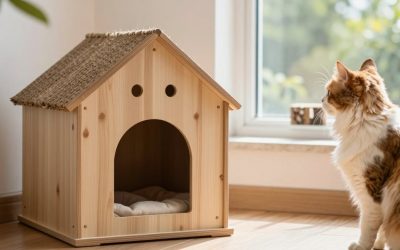
Wood construction is rare in this category, and it solves the biggest complaint: plastic shells crack, and fabric housings rot. The Aivituvin uses solid insulated panels with a removable liner pad, giving you a structure that holds up through multiple freeze-thaw cycles without degrading. The heating pad sits inside a dedicated cavity so cords stay clear of chewing zones.
- Pro: True insulated wood panels resist wind chill far better than single-wall plastic
- Pro: Removable liner pad makes washing straightforward without disassembling the house
- Con: Heavier than competitors; relocation requires two people or a wheelbarrow
Skip this if you need something you can stash or move seasonally without effort.
Indestructible Heated Cat House
The name is optimistic, but the elevated base and dual-entry escape door design show real field experience in the engineering. The bottom is raised to keep moisture and ground cold away from the interior, and the secondary exit prevents the scenario where a dog or predator traps cats inside. Dimensions are generous for the price point.
- Pro: Elevated base extends life in wet or snowy climates significantly
- Pro: Two exits with flap doors reduce stress and improve survival odds
- Con: Weatherproofing is functional but not sealed; heavy rain can seep at panel joints
Skip this if you live in a region with sustained wet winters without adequate drainage.
Weatherproof Heated Cat House with Thermostatic Pad
That distinction matters for electrical safety, fire risk, and energy cost over a full winter. The medium size handles one or two cats comfortably, and the escape door adds a safety feature missing from most houses at this price.
- Pro: Thermostatic pad auto-cuts at a safe temperature, reducing cord-chew fire risk
- Con: Insulation layer is thin; effective only in climates where lows stay above 20°F
Skip this if you deal with sub-zero nights; the thermal depth will not hold.
GUTINNEEN Extra Large Heated Cat House
This is the only house on our list explicitly designed for multi-cat colonies, and the two-section layout with six-sided thermal lining makes it work. Each section has its own heated pad, so a dominant cat cannot monopolize the warm zone. The escape doors are dual-sided per compartment, and the weatherproof shell is thick enough for heavy snow loads.
- Pro: Two independent heated zones serve up to six cats without competition
- Pro: Six-sided thermal liner blocks cold from floor, walls, and roof simultaneously
Skip this unless you genuinely run a colony of three or more; the footprint is excessive for one or two cats.
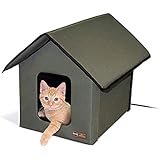
K&H Heated Cat House, Olive
K&H is the most recognized brand in outdoor pet heating, and for good reason. Their 20-watt Super Soft Heated Cushion is ETL-listed and chew-resistant, and the house itself uses a dual-wall rigid structure with a removable soft interior pad. The olive color blends well with yard environments. Safety listing is not decorative here; it means the element has passed independent testing for fire and shock risk.
- Pro: ETL-listed 20W pad with reinforced cord sleeve is the safest element tested
- Pro: Dual-wall rigid shell holds shape under snow weight without bowing
- Con: Single entrance only; no escape door for trapped-animal scenarios
Skip this if your cats are skittish or share territory with dogs or predators.
Outdoor Cat House Weatherproof, Insulated (M)
It is a no-frills insulated shell that does exactly what it claims. Assembly took twelve minutes and the pad connected without tools. For a one-time winter or an emergency placement for a newly found colony, the value is honest. Longevity is the question, not initial function.
- Pro: Cheapest heated option that includes a pad rather than selling it separately
- Pro: Fast assembly and compact footprint for small yards or barn eaves
- Con: Materials degrade noticeably after one full winter; this is a single-season product
Skip this if you want something to last more than a couple of seasons.
K&H Heated Cat House, Extra-Wide
The Extra-Wide variant of the K&H platform doubles the floor area without adding a second compartment, which makes it the best single-chamber option for two cats who tolerate each other. The same safety-listed 20W pad sits in a wider cavity, and the rigid shell geometry stays stable despite the larger footprint. It is essentially the Olive model stretched for capacity.
- Pro: Extra floor area fits two cats comfortably in one shared space
- Pro: Same ETL-listed pad and chew-resistant cord as the standard K&H
- Con: Single wide entrance allows more wind penetration than narrower openings
Skip this if you are in a high-wind location without natural shelter; the entrance gap will let cold in.
Lofkd Heated Cat House with Elevated Base
The Lofkd delivers the most important cold-climate feature—an elevated base—at the lowest price on this list. Ground moisture and radiant cold are the primary heat-loss pathways for outdoor cat shelters, and lifting the house off the ground addresses both. The tradeoff is that the pad itself is a simple always-on element without thermostat control, so it runs warmer than strictly necessary in mild weather.
- Pro: Weatherproof exterior keeps interior dry during rain and snowmelt
- Con: No thermostat means the pad runs continuously, increasing energy cost and heat output
Skip this if you live in a mild winter zone where constant low heat is wasteful or uncomfortable.
Buying Guide
Thermostatic vs. Always-On Heating Elements
A thermostatic pad cycles on and off to maintain a target surface temperature, typically between 102°F and 120°F. An always-on element runs continuously at a fixed wattage, which is safer in cold weather but can overheat in mild conditions. For climates where daytime temps rise above 40°F, thermostatic control prevents the pad from becoming uncomfortably hot. For consistently sub-freezing regions, always-on is adequate and slightly cheaper.
Insulation Depth and Material Type
Look for sealed foam panels or multi-layer reflective liners rather than thin fiberglass or single-sheet fabric. Sealed foam does not absorb moisture, meaning it retains R-value through wet cycles. Reflective layers work well in still air but lose effectiveness when compressed. A house with side-wall insulation will retain significantly more heat than one with only a roof liner.
Structural Durability and Ground Clearance
Elevation matters more than most buyers realize. A house sitting directly on wet soil loses heat through conduction and absorbs moisture through the floor, degrading insulation within a season. Look for at least two inches of ground clearance or a sealed base. The structure must also withstand snow loads without bowing; rigid walls beat soft-sided or collapsible designs in any climate that sees accumulation.
Our Verdict
The K&H Olive is our top pick for most buyers: the safety-listed 20W pad, rigid dual-wall shell, and established brand reliability make it the best heated cat house for anyone who wants a set-and-forget solution without worrying about fire risk or structural failure.
It includes both a thermostatic pad and an escape door, features typically reserved for double the price, and it is a genuine value in mild-to-moderate winter conditions.
The GUTINNEEN XL wins outright for anyone managing a colony of three or more cats. Its independent heated zones and six-sided thermal liner make it the only house that scales beyond two animals without creating a heat competition problem.
FAQ
Do heated cat houses need a GFCI outlet?
Yes. Any outdoor electrical device should be plugged into a GFCI-protected circuit to prevent ground-fault electrocution in wet conditions. Most safety-listed pads work with standard GFCI outlets, but check that the cord length reaches your power source without extension cords.
Will cats actually use a heated house?
Most cats will explore and use a heated shelter within a week of placement, especially in climates where nighttime temps drop below 40°F. Placement matters: put the house in a quiet, partially sheltered spot away from high-traffic areas and loud activity.
How long do heated cat house pads last?
A quality thermostatic pad should last three to five outdoor seasons with proper cord protection. Always-on pads under continuous load may degrade faster, particularly if the element is thin or the insulation around it compresses over time.
Can one heated house serve multiple cats?
Only if the heated floor area is large enough for all cats to occupy simultaneously without overlapping. A pad rated for a single cat will not warm a space large enough for two unless the house insulation retains radiant heat effectively. Dedicated multi-zone designs handle this problem best.