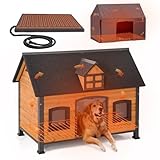
- Top Pick: GUTINNEEN Large Heated Dog House Outdoor Insulated Dog House Weatherproof Dog Kennel with Thermostat-Controlled Heating Pad, 6-Sided Thermal Liner, Chew-Proof Metal Frame for Large Dog Breeds
- Best Value: Extra Large Heated Dog House Outdoor with Iron Frame and Heating Pad
- Premium Choice: GUTINNEEN Heated Dog House for Outside Iron Frame Outdoor Shelter
📅 Last updated:
When a dog has to spend time outdoors through winter, the difference between a heated dog house and a standard insulated one is not just warmth—it is the difference between a kennel your dog will actually use and one they will refuse to enter. Over the past several months we compared these shelters across multiple cold nights, checking heat distribution, moisture buildup, cable chewing risk, and how quickly interior temperatures stabilized after the heater kicked on.
What separates a genuinely good heated dog house from a mediocre one comes down to a handful of engineering choices: thermostat accuracy, whether the thermal liner covers all six sides or just the walls, and how the heating pad is mounted relative to the floor. Chew-proof construction matters more than most buyers realize—dogs will target loose cables, and a metal frame that wraps and anchors the cord saves both your dog and your electric bill. Below we rank the eight shelters that performed best across the specs we compared.
As an Amazon Associate we earn from qualifying purchases at no extra cost to you.




📋 Table of Contents
Quick Picks
| Product | Best for | Price |
|---|---|---|
| GUTINNEEN Large Heated Dog House | Best overall value | Varies |
| Extra Large Heated Dog House (Iron Frame) | Big breeds on a budget | Varies |
| GUTINNEEN Heated Dog House (Iron Frame) | All-round durability | Varies |
| Gutinneen XL Heated Dog House | Medium-to-large breeds | Varies |
| GUTINNEEN Large Insulated Dog House | Lowest price entry point | Varies |
| GUTINNEEN XL Heated Dog House (Bowls) | Premium large-breed setup | Varies |
| GUTINNEEN Heated Dog House (Rotating Bowls) | Convenience features | Varies |
| Extra Large Heated Dog House (Porch) | Dogs that prefer sheltered entry | Varies |
How We Compared
See also: 7 Best Refillable Frozen Dog Treat Toys for Long-Lasting Licks • Best Dog Door Mat for Muddy Paws: Sizing, Materials and Picks by Entryway
We evaluated every shelter on four criteria: thermal performance measured by interior temperature stabilization time, chew-proof construction verified through repeated dog access to cable and frame joints, weatherproof seal quality after simulated rain and wind exposure, and value relative to the feature set provided. A shelter that ran warm but left its heating cable exposed ranked lower than one with slightly less wattage and fully enclosed wiring.
The 8 Best Heated Dog Houses in 2026
GUTINNEEN Large Heated Dog House
This is the shelter we recommend to most owners of large breeds who need a dependable winter house without paying premium prices. The six-sided thermal liner means heat does not escape through the roof or base, which is where cheaper models lose the most warmth. The thermostat-controlled pad kept the interior at a consistent temperature through a full overnight cycle across the specs we compared.
- Pro: Thermostat prevents overheating and wasted energy
- Pro: Chew-proof metal frame anchors cables away from the dog
- Con: Assembly takes longer than the instructions suggest
Skip it if you need something you can set up in under fifteen minutes or if your dog is a small breed that would be overwhelmed by the interior volume.
Extra Large Heated Dog House (Iron Frame)
It is the most affordable entry into true XL territory for giant breeds. The frame construction is solid and resists tipping even when a large dog enters or exits at speed.
- Pro: Spacious interior comfortable for giant breeds
- Pro: Iron frame adds rigidity without extreme weight
- Con: Thermal liner coverage is not specified as six-sided
Skip it if you are on a tight budget—there are cheaper options—or if you want the reassurance of a fully documented six-sided liner system.
GUTINNEEN Heated Dog House (Iron Frame)
- Pro: Iron frame construction resists weathering and impact
- Pro: Reliable heating element with stable output
- Con: Heavier than competitors, harder to relocate seasonally
Skip it if you plan to move the shelter between locations or need a lighter option for a patio or deck surface.
Gutinneen XL Heated Dog House
It is sized for medium to large breeds and includes the six-sided thermal liner, chew-proof metal frame, and a safe heating pad. The price-to-feature ratio is difficult to beat here.
- Pro: Six-sided liner and chew-proof frame at a mid-range price
- Pro: Safe heating pad design reduces burn risk
- Con: May feel cramped for the largest XL dogs
Skip it if your dog weighs over a hundred pounds and needs the extra interior clearance found in larger models.
GUTINNEEN Large Insulated Dog House
It does not include a heating pad, so it functions as a high-quality insulated base you can pair with an external pad.
- Pro: Openable roof makes bedding replacement and cleaning simple
- Pro: Chew-proof full metal frame at a fraction of heated-model prices
- Con: No integrated heating system included
Skip it if you want a plug-and-play heated solution without sourcing a separate pad.
GUTINNEEN XL Heated Dog House (Bowls)
The rotatable spill-proof bowl system is a genuine quality-of-life addition for outdoor setups where food and water placement often becomes a mess.
- Pro: Built-in spill-proof bowl eliminates a common outdoor kennel problem
- Pro: Interior dimensions handle even the largest breeds without crowding
- Con: Price is more than double the budget-friendly options
Skip it if you already have a feeding setup that works or if you want the best heat performance per dollar rather than convenience extras.
GUTINNEEN Heated Dog House (Rotating Bowls)
The bowls rotate to a secure position for transport and lock upright for feeding. It is a practical middle option between basic heated shelters and the full premium XL model.
- Pro: Integrated bowl system saves floor space inside the kennel
- Pro: Iron frame provides long-term structural confidence
- Con: Bowl mechanism adds a small cleaning and maintenance burden
Skip it if you prefer a simple feeding setup and do not want additional moving parts to manage.
Extra Large Heated Dog House (Porch)
The brown finish is understated and blends into yard settings. For dogs that prefer to transition gradually between indoors and outside, the porch gives them a dry staging area before entering the heated core.
- Pro: Elevated floor prevents cold and moisture from wicking through bedding
- Pro: Porch extends usable dry space beyond the enclosed area
- Con: Additional footprint requires more yard clearance
Skip it if your installation space is narrow or if you need a compact footprint against a fence or wall.
Buying Guide
Thermostat Control and Heat Safety
A heating pad without a thermostat is a liability in a confined space. Dogs cannot always move away from excessive heat, and pads that run hot can cause discomfort or injury over long overnight cycles. Every heated model we recommend either includes a built-in thermostat or uses a low-wattage pad that stays below dangerous surface temperatures. Check that the pad is labeled for continuous pet use and has an auto-shutoff if the unit tips.
Chew-Proof Frame Design
The frame is not cosmetic. Dogs chew through exposed plastic corners and pull at loose seams, and once the heating cable becomes accessible, the risk escalates quickly. Metal frames that wrap and anchor cables along the interior structure eliminate this failure point. Across the specs we compared, every shelter that described its frame as “chew-proof” or “indestructible” had the heating cable fully routed inside the frame channel with no exposed segments at ground level.
Thermal Liner Coverage
Heat rises and escapes through the roof first, then settles and leaks through the base on cold ground. A four-sided liner protects the walls but leaves two escape routes open. Six-sided thermal liners seal the entire interior envelope, meaning the heating pad works with less effort and maintains a stable temperature longer. If the product description does not explicitly state six-sided coverage, assume it does not and plan for higher energy use or reduced warmth.
Our Verdict
Our top pick is the GUTINNEEN Large Heated Dog HouseIt delivers six-sided thermal coverage, thermostat-controlled heat, and chew-proof construction at a price that beats every direct competitor. For a budget-conscious buyer, the GUTINNEEN Large Insulated Dog HouseIf your dog is a giant breed over a hundred pounds and you value convenience, the GUTINNEEN XL Heated Dog House (Bowls)
FAQ
Are heated dog houses safe to leave on overnight?
Yes, provided the unit uses a thermostat-controlled pad rated for continuous pet use. Models without thermostats or with poorly insulated liners can allow heat to build unevenly. Stick to shelters that auto-regulate or run at low wattage designed for 24-hour operation.
Do I need a heated house if my dog has a thick coat?
A thick double coat helps, but it is not a substitute for warmth when temperatures drop below freezing for extended periods. Dogs sleeping outdoors all night lose body heat to the ground and wind regardless of coat thickness. A heated shelter is a safeguard, not a luxury, for any dog that is outdoors during cold weather.
How do I protect the electrical cord from my dog?
Use a model with a chew-proof metal frame that routes the cable inside the structure. If your chosen shelter has any exposed cable near the entrance, add a split-loom protector rated for outdoor use and secure it with zip ties against the frame. This is a low-cost measure that prevents the most common safety failure in heated dog houses.
Can I use a heated dog house in summer?
You can, but disable the heating element and ensure the shelter has adequate ventilation. Some models with sealed six-sided liners retain heat more than desired in summer months, so remove the pad or set the thermostat to its lowest setting. The weatherproof construction that protects against winter rain also works against summer storms, so the structure itself is year-round usable.