📅 Last updated:
Choosing between an automatic feeder and a timed feeder is less about whether either one can release food on schedule. Both are designed to make feeding more consistent. The real decision is how much control, capacity, and convenience you want—and how much hardware you are willing to maintain.
A basic timed feeder may open a compartment at a preset hour, making it useful for one or two meals and short absences. An automatic feeder typically stores dry food in a hopper, dispenses measured portions, and may offer multiple schedules, a backup battery, a low-food alert, or a voice recording. In everyday shopping, the terms overlap, so check the feature list rather than relying on the product name. For this guide, “timed feeder” means a simpler schedule-based unit, while “automatic feeder” means a programmable dispenser with more feeding controls.
As an Amazon Associate we earn from qualifying purchases at no extra cost to you.

That distinction matters in 2026, especially for homes with cats that wake people early, dogs that eat too quickly, or owners who work irregular hours. The best choice is the one that fits your pet’s food, your room, and your tolerance for refilling and cleaning.
📋 Table of Contents
Quick answer: Our top pick in 2026 is the Comfort — our #1 rated choice. See the full ranked comparison, alternatives and buying advice below.
Quick Verdict
Choose an automatic feeder if you want several meals per day, consistent portions, a larger dry-food reservoir, or useful extras such as a voice call, slow-feeding schedule, or battery backup. It is usually the better long-term choice for one or more pets that eat dry food on a regular routine.
Choose a timed feeder if you need a straightforward way to delay a meal, feed one or two portions, or keep the purchase price and footprint low. Timed models are often easier to understand and clean, but many do not measure food as precisely and may not hold enough food for a long trip.
Neither type replaces supervision. Wet food may spoil in a room-temperature dispenser, some pets can pry open lids, and a feeder cannot reliably manage a pet’s health needs without veterinary guidance.
Side by Side
See also: How to Remove Litter Box Odor Buildup (2026): Step-by-Step • How to Fix a Jammed Automatic Feeder (2026): Step-by-Step
| Factor | Automatic Feeder | Timed Feeder |
|---|---|---|
| Comfort | More control over portions and multiple meals; often includes a call or alert feature | Simple scheduled release with fewer adjustments |
| Durability | More moving parts, so the motor and dispensing mechanism need care | Fewer electronics or mechanisms in many models; battery doors and hinges still wear |
| Typical price range | About $25–$150 for home models; advanced app models can cost more | About $15–$70, depending on capacity and number of compartments |
| Maintenance | Requires cleaning the bowl, hopper, chute, and portion wheel or auger | Usually has fewer food-contact parts and a simpler wash routine |
| Space needed | Commonly about 8–12 inches wide and 10–16 inches deep | Often about 9–14 inches wide and 9–14 inches deep, depending on compartments |
| Look | Taller, appliance-like shape; usually 12–18 inches high | Lower-profile and easier to hide beneath a console or shelf |
| Resale | Better appeal when clean, complete, and compatible with common kibble sizes | Less technology to become outdated, but basic models have lower resale prices |
| Best for | Several daily meals, portion control, and owners away from home for long workdays | Occasional schedule changes, simple routines, and small spaces |
| Power | Often uses a wall adapter, with some models accepting three or four backup batteries | Usually battery-powered; typical consumption is low, but battery life varies |
Where Automatic Feeder Wins
The biggest advantage is repeatability. A hopper-style automatic feeder can divide a daily ration into four, six, or even eight meals, depending on the model. That can help a cat that begs between meals or a dog that needs smaller portions. A unit such as the ANDOLL HOME Automatic Cat Feeder has a 4-liter capacity, up to eight meals per day, and a 10-second voice recorder. Features like those are more useful when a pet follows a routine every day rather than only when an owner is traveling.
Portion programming is another advantage, although “portion” is not a universal measurement. One feeder’s portion may be roughly 1/8 cup while another’s is different, and kibble shape changes the amount released. Weigh the food with a kitchen scale during setup if calorie control matters. Automatic dispensing is more consistent than filling a bowl by eye, but it is not automatically medically precise.
Capacity also favors an automatic feeder. A 4-liter hopper may hold several days of dry food for a cat, though the actual duration depends on kibble density and the number of meals. A medium dog may empty that capacity much faster. The larger reservoir reduces daily refills and can be practical for a home office, a busy household, or a pet sitter’s routine.
Automatic models can also offer a sealed ring or gasket around the food compartment, helping limit exposure to air and household dust. They do not make kibble fresh indefinitely, and the hopper still needs regular washing and drying. Look for a removable bowl and food-contact parts rather than assuming every component is dishwasher-safe.
Finally, some automatic feeders provide reassurance during a normal workday. A low-food indicator, jam warning, scheduled voice message, or battery backup can be worthwhile when a pet depends on a particular feeding time. These conveniences add electronics and possible failure points, so test the schedule before trusting the unit during an overnight absence.
Where Timed Feeder Wins
A timed feeder is often the better value when your needs are narrow. If you want breakfast to open at 6 a.m. instead of 4 a.m., a simple programmed compartment may solve the problem without a tall hopper, Wi-Fi setup, or portion menu. It is also a practical backup for a pet that already eats measured food from a regular bowl.
Simplicity can improve reliability. Fewer motors, sensors, and settings mean fewer parts to troubleshoot. Many timed feeders run on batteries and continue working if a household outlet is occupied or temporarily unavailable. Before buying, confirm how the clock behaves after a battery change and whether the lid locks securely against curious paws.
These feeders also tend to suit smaller rooms. A low unit that is approximately 10 inches wide and 12 inches deep can fit beside a cabinet, while a hopper model may be tall enough to crowd a narrow feeding station. A lower center of gravity can be helpful for pets that push or paw at their bowls.
The trade-off is limited capacity and control. A rotating tray may hold only two to six meals, and each compartment may accept a fixed amount. Some units work best with dry food only; moist food can require ice packs or a refrigerated design. A timed feeder is not necessarily a good solution for free-feeding, two pets sharing one bowl, or a dog that needs carefully divided portions.
Cost Over 5 Years
Purchase price is only part of the calculation. Basic timed feeders commonly cost $15–$40, while more substantial versions with several compartments often reach $50–$70. Automatic hopper feeders generally range from $25–$100 for everyday models and approximately $100–$150 for units with connected controls or more elaborate monitoring.
For a realistic comparison, consider a $35 timed feeder and a $45 automatic feeder. Over five years, the purchase difference is only $10. Add two or three sets of replacement batteries per year at roughly $8–$20 annually, and either option may spend another $40–$100 on power. A wall-powered automatic feeder can reduce battery use, but keeping backup batteries available is sensible. Replacement bowls, seals, or a worn dispensing part may add $10–$40 during ownership.
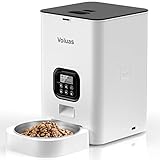
As a current price reference, the ANDOLL HOME 4L feeder is listed at $26.34, while the VOLUAS 4L Timed Dry Food Dispenser is listed at $41.79. Those prices show why labels can be misleading: a product called “timed” may cost more than an entry-level automatic model. Compare capacity, portion settings, power options, and washable parts before treating price as a quality ranking.
The least expensive option may cost more if it causes overfeeding, jams frequently, or requires replacement after a short period. Conversely, paying for app controls you will never use does not improve value. A durable bowl, a secure lid, clear programming, and easy cleaning usually matter more than a long feature list.
Which One for Your Home
Small apartment
Choose a timed feeder if you need one delayed meal and have limited counter or floor space. Its lower profile can leave more room around a compact feeding mat. Choose an automatic feeder if the pet needs several small meals, but measure the available area first. Allow at least a few inches around the unit for opening the lid and removing the hopper.
Family with kids or pets
An automatic feeder is usually the stronger choice for a busy family because it can create a consistent schedule despite changing morning routines. Select a model with a locking lid, a stable base, and a bowl that cannot be easily dragged away. If two pets eat at different speeds, one shared feeder may not solve the problem; separate feeding stations or microchip-controlled equipment may be more appropriate.
Rental
Both types work well because they require no installation. A battery-powered timed feeder is the least disruptive choice for a temporary home. If you buy an automatic feeder, choose a neutral design, avoid drilling for cable management, and keep the cord secured along the wall so it does not become a chewing hazard.
Long-term home
Invest in an automatic feeder when you expect to use it daily for years. Prioritize replaceable bowls, accessible customer support, a backup power option, and a hopper large enough for your pet’s routine. A timed feeder remains the better choice if your schedule is simple and you prefer fewer electronic components to maintain.
FAQ
Is an automatic feeder the same as a timed feeder?
Not always. A timed feeder releases food at scheduled times, while an automatic feeder generally adds a storage hopper, portion control, and sometimes alerts or voice recording. Product names overlap, so inspect the capacity, schedule limits, and dispensing method.
Can an automatic feeder dispense wet food?
Most hopper-style automatic feeders are intended for dry kibble. Wet food requires a tray system designed for moisture control, often with an ice pack or refrigeration. Never assume a standard dry-food dispenser will keep wet food safe.
How often should an automatic feeder be cleaned?
Wipe the bowl every day or every few days, depending on the food and your pet. Empty and clean the hopper and dispensing chute at least monthly, or sooner if oil from the kibble builds up. Parts should be completely dry before refilling.
Will a feeder prevent overfeeding?
It can make portions more consistent, but only if you program the right amount and account for treats. Verify the released quantity with a scale, especially when changing kibble. A feeder also cannot stop a determined pet from accessing another animal’s food.
Ready to decide? Our #1 pick for 2026 is the Comfort.
Live price & availability on Amazon.