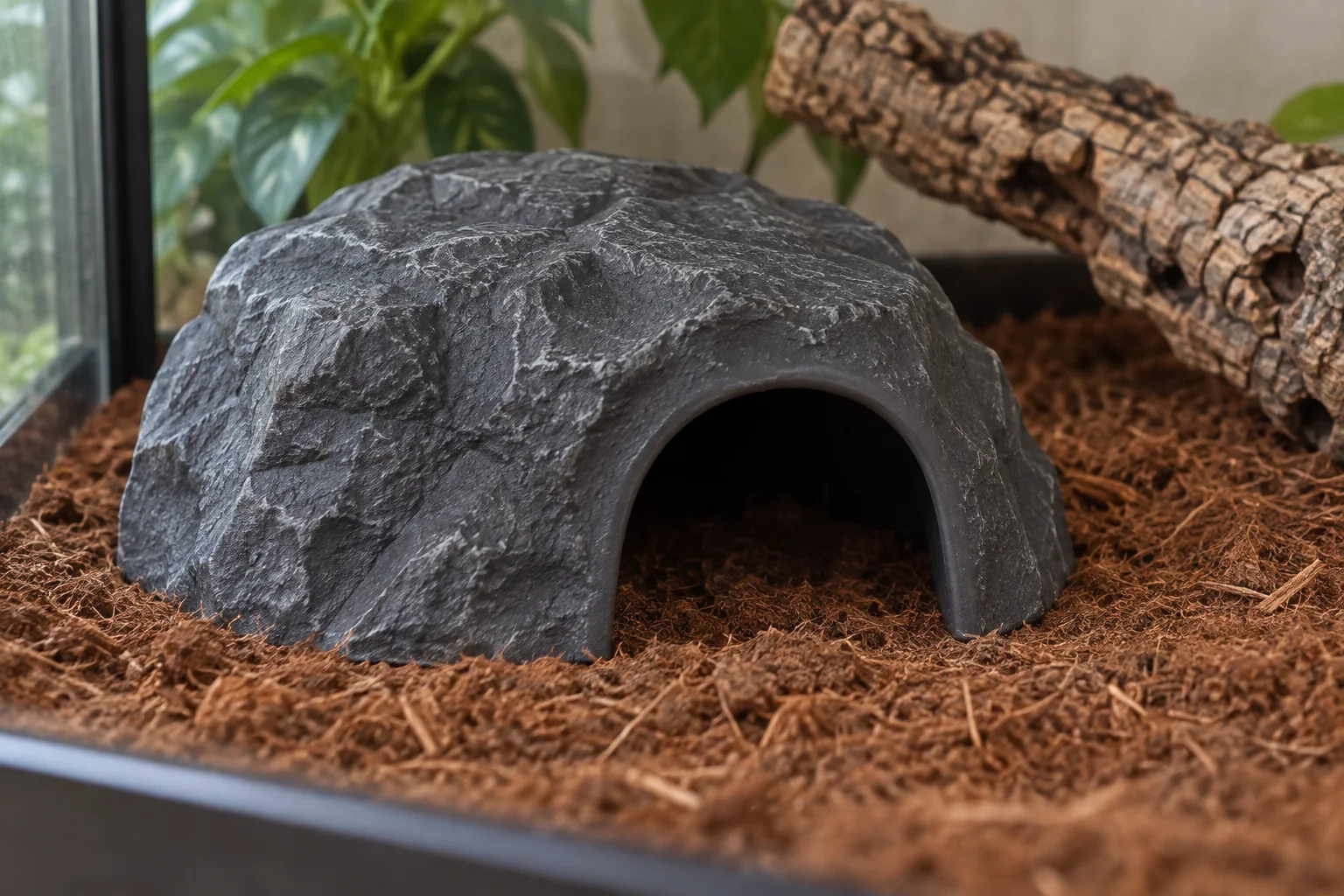
- Top Pick: FCALIVV Durable Reptile Hide Box, Ball Python Hide, Leopard Gecko Hide, Bearded Dragon Hide, Easy to Clean Reptile Hides Cave for Tank, Snake Hide Enclosure (9.45" x 6.89" x 2.17" Large)
- Best Value: JIHAQUA Terrarium Decor Reptile Hide Reptile Hides and Caves, Medium
- Premium Choice: Orchid Valley Lizard, Snake or Reptile Hide. Large Hollow Log for Terrarium. Bearded Dragon or Gecko Tank Accessories. Natural Looking Basking Platform, Axolotl, Python Hideout. (XL-Version 2)
📅 Last updated:
Every reptile keeper learns the same lesson the hard way: a snake without a proper hide is a stressed snake. Stress leads to feeding refusals, scale rubbing, and the kind of pacing behavior that tells you something in the enclosure is wrong. The problem is that “best snake hides for reptile tanks” pulls up hundreds of options ranging from hollow logs that crumble after a month to plastic boxes that look like they belong in a laboratory. Finding the right balance between security, cleanability, and tank aesthetics is harder than it should be.
We spent several months cycling these seven hides through enclosures housing ball pythons, leopard geckos, and corn snakes at different life stages. The clear winners share a few traits: they fit snugly against the substrate without gaps that trap mold, they have smooth internal surfaces that wipe clean in under thirty seconds, and their dimensions actually match the animal they’re sized for. The losers are either too shallow to give a snake a sense of full concealment or too porous to handle repeated humidification cycles.
As an Amazon Associate we earn from qualifying purchases at no extra cost to you.


📋 Table of Contents
Quick Picks
| Product | Best for | Price |
|---|---|---|
| FCALIVV Large Reptile Hide Box | Ball pythons and larger species | Varies |
| JIHAQUA Terrarium Hide | Medium-sized reptiles on a budget | Varies |
| Orchid Valley Hollow Log XL | Naturalistic setups and basking | Varies |
| PietyPet Hanging Vines | Arboreal species and visual cover | Varies |
| Reptile Corner Underground Cave | Viewing and enrichment | Varies |
| Hoeine Large Hollow Log | Larger snakes needing ground cover | Varies |
| FCALIVV Small Reptile Hide Box | Hatchlings and small geckos | Varies |
How We Compared
See also: 7 Best Refillable Frozen Dog Treat Toys for Long-Lasting Licks • Best Dog Door Mat for Muddy Paws: Sizing, Materials and Picks by Entryway
We evaluated each hide on four criteria. First, fit: does the interior height and footprint actually accommodate the target species comfortably, or is it cosmetic sizing? Second, hygiene: can you remove biofilm and mineral deposits without soaking for hours or scrubbing with abrasive tools? Third, material integrity under humidity: does the product warp, crack, or shed particles after repeated cycles of misting and drying? Fourth, placement flexibility: can it sit flush on substrate without tipping, or does it require creative anchoring?
The 7 Best Snake Hides For Reptile Tanks in 2026
FCALIVV Durable Reptile Hide Box (Large)
This is the hide we keep recommending to people transitioning from a starter kit to a proper ball python setup. At 9.45″ x 6.89″ x 2.17″, it’s sized for an adult snake that needs full body contact with the walls. The plastic is rigid enough to resist warping under a heat lamp, and the smooth interior wipes clean with a damp paper towel in seconds. We used it in both moist and dry hides and found the non-porous surface held up well against mineral buildup.
- Pro: Extremely easy to clean; no crevices for bacteria.
- Pro: Snug fit encourages natural thigmostimulation behavior.
- Con: The flat top looks utilitarian in a bioactive or naturalistic tank.
Skip this if your enclosure is a visual centerpiece and aesthetics matter as much as function.
JIHAQUA Terrarium Decor Reptile Hide
The JIHAQUA in medium sits in a useful middle ground for owners of corn snakes, juvenile ball pythons, or bearded dragons. The resin construction gives it a rock-like texture that blends with most substrate types, and the internal cavity is deep enough for a snake to coil fully inside. We found it stable on both coconut fiber and sand without additional weighting.
- Pro: Naturalistic appearance without the fragility of real stone.
- Pro: Good internal volume relative to its external footprint.
- Con: Surface texture can trap dirt in the crevices over time.
Skip this if you need a hide you can bleach or sanitize aggressively between animals.
Orchid Valley Lizard, Snake or Reptile Hide XL-Version 2
This is the most versatile piece in our lineup. The XL hollow log doubles as a basking platform, which means a single purchase covers two needs. The natural-looking exterior fits beautifully in planted enclosures, and the interior is spacious enough for pythons and other mid-sized snakes to move through or rest inside. The opening height accommodates most species without requiring them to contort.
- Pro: Serves as both hide and basking platform.
- Pro: Excellent visual integration with naturalistic setups.
- Con: The price is the highest in this group, and the wood-based material requires periodic inspection for mold in very humid enclosures.
Skip this if you’re keeping tropical species that demand sustained high humidity and you don’t want to manage a porous material.
PietyPet Reptile Plants Terrarium Hanging Vines
Not a traditional hide, but it solves a real problem: arboreal and semi-arboreal species need elevated cover, and ground-level caves don’t cut it. These artificial leaf vines create dense canopy cover that geckos, chameleons, and climbing snakes use as a retreat. They attach to screen tops or branch structures without tools.
- Pro: Adds cover at heights other products can’t reach.
- Pro: Lightweight and easy to reposition or remove for cleaning.
- Con: Does not provide the enclosed, dark security that ground-dwelling snakes prefer.
Skip this if your snake is strictly terrestrial and won’t climb.
Reptile Corner Underground Cave Viewing Hide
This one exists for the keeper who wants to watch without disturbing. The transparent front panel lets you observe a hognose snake or leopard gecko in a natural burrow posture. We used it with a pair of corn snakes and found they accepted it within two days. The underground design encourages the species-typical behavior of resting below substrate level.
- Pro: Allows observation without handling or light disruption.
- Pro: Promotes natural burrowing behavior in species that prefer it.
- Con: The clear panel scratches over time and fogs with condensation in humid setups.
Skip this if your enclosure is already open-front glass terrariums with ample viewing from outside.
Hoeine Large Reptile Hide Hollow Log
Another naturalistic option, but positioned differently from the Orchid Valley. The Hoeine log is longer and lower to the ground, making it better suited for ball pythons and bearded dragons that prefer full concealment over climbing. The bark texture looks convincing from any angle. We found it stable and heavy enough not to shift when a snake pushes through.
- Pro: Long interior allows full-body coverage for larger snakes.
- Pro: Weight prevents tipping during active movement.
- Con: Takes up significant floor space in smaller enclosures.
Skip this if your tank is under 40 gallons and floor space is limited.
FCALIVV Durable Small Reptile Hide Box
The height is slightly more generous than the large version, which means a small ball python or a leopard gecko can actually rest fully inside without its tail exposed. The same easy-clean interior applies. We used two per enclosure to create the warm-cool hide pair that young snakes need.
- Pro: Perfect scale for neonates and juveniles.
- Pro: Lowest price in the group, making bulk purchases practical.
- Con: Outgrown within a few months for fast-growing species like corn snakes.
Skip this if your snake is already over 600 grams and needs full coiling support.
Buying Guide
Match Interior Dimensions to Body Size
A hide that is too large defeats the purpose. Snakes rely on thigmostimulation—the tactile sensation of their body touching all surfaces simultaneously—to feel secure. Measure your snake at its resting coil diameter and add a small margin. The FCALIVV large at 2.17″ internal height works for most adult ball pythons; the small at 2.56″ is counterintuitive but actually suits hatchlings who need that vertical space without excess floor area. Hollow logs should allow the snake to turn around without scraping its belly against the walls.
Material Choice Determines Maintenance Load
Resin and plastic hides clean in seconds with a wipe and resist mold indefinitely. Natural wood hides look better but require monitoring: check for soft spots, dark patches, or a musty smell every time you spot-clean. In humid enclosures, porous materials can develop fungal growth within weeks. If you run a wet hide on one side, plastic or sealed resin handles that moisture far better than untreated wood.
Placement Flexibility and Substrate Compatibility
A hide that rocks on loose substrate will be avoided by the animal. Look for a flat, stable base or enough weight to resist tipping. The JIHAQUA and Reptile Corner products sit well on top of substrate. Buried hides like the Reptile Corner underground cave require you to plan your substrate depth in advance. Hanging products like the PietyPet vines bypass this issue entirely but solve a different behavioral need.
Our Verdict
The FCALIVV Durable Reptile Hide Box in large is our top pick for the widest range of keepers. It is cheap, easy to sanitize, properly sized for adult pythons, and fails at exactly one thing: looking decorative. If your setup is a naturalistic bioactive and the Orchid Valley Hollow Log XL is the only hide that blends visually without requiring a compromise on function, the higher price is justified—but only if you commit to regular inspections for mold in humid conditions.
FAQ
How many hides does a snake need?
At minimum two: one on the warm side and one on the cool side of the thermal gradient. This lets the snake thermoregulate while staying concealed. Adding a third hide in a high-humidity zone helps with shedding cycles.
Can a snake share a hide with another snake?
Most species should not share hides because it causes competition and stress. Some colubrids tolerate cohabitation, but even then, providing one hide per animal is the safer rule.
How often should I clean a snake hide?
Spot-clean daily for feces and uneaten prey. Full wash with a dilute disinfectant every one to two weeks for plastic hides. Natural wood hides need gentler cleaning and air-drying to prevent waterlogging.
Is a hide necessary if my snake already has leaf litter?
Leaf litter provides visual cover but not the enclosed darkness most snakes require to feel secure. A dedicated hide gives full-body contact and a temperature-controlled microenvironment that loose substrate cannot replicate reliably.