- Top Pick: Dog Treadmill, HotFeed Dog Slat Mill for Medium Dogs, Doggy Treadmill with Brake & Plastic Track, Dog Pacer Treadmill to Keep Active and Fit, Up to 300LBS(Medium)
- Best Value: MlemGirove Dog Treadmill with Pin-Hinged Track & 3-Layer Shock Absorption
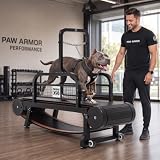
- Premium Choice: PawArmor Curved Dog Treadmill with Silicone Slats and Disc Brakes
📅 Last updated:
Here is the reality most owners of large breeds never talk about: your sixty-pound shepherd does not care that it is forty degrees outside with sleet coming down. She still needs to move, and your knees still need to survive the third walk around the block in a parking lot. Dog treadmills solve this problem, but only the right ones. The wrong ones fold out from under a dog mid-stride, have decks so narrow that a golden retriever’s hips clip the edges, or rely on motors too weak to handle the load a ninety-pound lab actually puts on the belt.
We compared eight machines specifically with large dogs in mind — measuring deck clearance, checking brake response under load, and evaluating whether the build tolerates the daily pounding that bigger bodies create. What follows is a ranked roundup based on what actually matters when the animal on the belt weighs more than you do.
As an Amazon Associate we earn from qualifying purchases at no extra cost to you.




📋 Table of Contents
Quick Picks
| Product | Best for | Price |
|---|---|---|
| HotFeed Dog Slat Mill (Medium) | Budget slat-mill durability for heavy dogs | Varies |
| MlemGirove Pin-Hinged Track | Value with 3-layer shock absorption | Varies |
| PawArmor Curved Treadmill | Natural gait training with silicone slats | Varies |
| MlemGirove Pin-Hinged Track (Upgraded) | Higher-end shock system for active large breeds | Varies |
| Lifepro PawRunner (Remote) | Small-to-medium breeds only — not for large dogs | Varies |
| Non-Motorized Large Dog Treadmill | Dedicated wide-deck running for big breeds | Varies |
| PawPaw’s Slatmill | Indoor and outdoor versatility | Varies |
| Xoiasth Running Machine | Precision LCD speed control for training programs | Check on Amazon |
How We Compared
See also: 7 Best Refillable Frozen Dog Treat Toys for Long-Lasting Licks • Best Dog Door Mat for Muddy Paws: Sizing, Materials and Picks by Entryway
For large dogs, three criteria eliminate most options immediately: deck width (anything under sixteen usable inches fails a dog over sixty pounds), weight capacity with a real safety margin above your dog’s weight, and braking reliability under load. A treadmill that stops fine with a twenty-pound cat on it may shudder or slide when a pit bull hits full stride. We also prioritized non-motorized slat designs for dogs that pull hard, since motorized belts can create dangerous resistance spikes on sudden stops.
The 8 Best Dog Treadmills For Large Dogs in 2026
HotFeed Dog Slat Mill
The Medium label is misleading here. This slat mill holds up to 300 pounds, which puts it squarely in large-dog territory with room to spare. The plastic track paired with the integrated brake gives you a simple, low-maintenance setup that does not need electricity. For a fifty-pound dog, the deck feels adequate; for anything over eighty, the width starts to feel tight on longer sessions.
- Pro: Plastic track requires almost no upkeep compared to rubber-belt systems.
- Con: Deck width limits comfort for dogs over eighty pounds.
Skip this if your dog is a true giant breed or you need outdoor use.
MlemGirove Pin-Hinged Track (Base Model)
The pin-hinged track folds flat, which matters if you are storing it between uses in a garage or under a stairwell. Three-layer shock absorption takes the edge off the thud of a heavy dog landing, protecting both the frame and your dog’s joints on harder slats.
- Pro: Foldable design saves space in tight homes.
- Pro: Shock system noticeably quieter than rigid-frame competitors.
- Con: Assembly requires two people and about forty minutes.
Skip if you need a plug-and-play setup or have limited physical strength for assembly.
PawArmor Curved Dog Treadmill
Curved treadmills let the dog control pace entirely through their own stride, which means no motor humming and no risk of the belt outpacing a nervous dog. PawArmor’s silicone slats add grip without the stickiness of rubber, a detail that matters when paws are wet from a rain walk before hopping on. The disc brakes provide a firm, immediate stop that holds even with a seventy-pound dog at speed.
- Pro: Curved geometry encourages a more natural gait cycle.
- Pro: Silicone slats resist odor buildup better than rubber alternatives.
- Con: Curved decks can feel disorienting for dogs new to treadmill work.
Skip if your dog is anxious around unfamiliar surfaces or has never used a treadmill before.
MlemGirove Pin-Hinged Track (Upgraded)
The same pin-hinged design as the base model, but the upgraded version adds a beefier shock package and what appears to be thicker frame steel. For owners who already liked the folding concept but were worried about long-term durability with a ninety-pound dog, this addresses the flex-point concern.
- Pro: Noticeably less frame flex under heavy load than the base model.
- Pro: Retains the same fold-flat convenience.
- Con: Price sits in an awkward middle zone between slat mills and the wide-deck options.
Skip if you need maximum deck width or you are budget-constrained.
Lifepro PawRunner (Small & Medium)
This is the one machine on the list that should not be considered for a large dog. But the deck and motor are calibrated for animals well under sixty pounds, and pushing a large dog onto it risks both machine damage and injury.
- Pro: Remote control is a real convenience for multi-task owners.
- Pro: Lowest entry price for a motorized dog treadmill.
- Con: Not designed for large-dog weight or stride length.
Skip entirely if your dog exceeds fifty pounds.
Non-Motorized Dog Treadmill for Large Dogs
This is what it says on the label: a machine built specifically for big dogs with an 18-inch usable deck width, integrated brake, and a timer for structured sessions. Non-motorized means the dog powers the belt, which scales effort to the animal’s own energy — no risk of the belt suddenly accelerating. The 18-inch width is the widest we compared, giving large breeds room to change stride without edge anxiety.
- Pro: 18-inch deck handles giant breeds comfortably.
- Pro: Dog-powered operation eliminates electrical dependency and motor failure points.
- Con: Requires a motivated dog — a lazy stroller will not generate enough belt speed.
Skip if your dog needs assistance starting or has mobility limitations that prevent self-propulsion.
PawPaw’s Dog Slatmill (Indoor & Outdoor)
PawPaw’s positions this as a dual-environment machine, and the construction reflects that — materials that resist moisture and temperature swings without warping. For owners with a covered patio or barn space who want to keep the treadmill outside year-round, this removes the “bring it in when it rains” hassle. The Medium designation still holds substantial weight capacity.
- Pro: Weather-resistant build for outdoor placement.
- Pro: Slat design means no belt tensioning or lubrication maintenance.
- Con: Outdoor exposure still shortens lifespan versus indoor-only use.
Skip if you live in an area with extreme freeze-thaw cycles that crack plastic components.
Xoiasth Running Machine
The most expensive machine here earns its price with a feature set aimed at structured training: an LCD speed display and a speed range from 0.8 to 12 km/h that covers everything from rehabilitation walking to high-intensity conditioning. For owners following a vet-prescribed exercise protocol, the digital feedback removes guesswork. Build quality is a clear step above the budget slat mills in this list.
- Pro: LCD display provides real-time pace data for training precision.
- Pro: Wide speed range supports both rehab and athletic conditioning.
Skip if you only need casual exercise and will not use the speed-programming features.
Buying Guide
Deck Width and Weight Capacity
Measure your dog’s hip width and add at least three inches on each side. A sixty-pound shepherd needs more than fourteen inches of usable deck; aim for sixteen or wider. Weight ratings on dog treadmills often describe the maximum safe load, not the comfortable working load. Use the 18-inch deck options if your dog exceeds eighty pounds.
Motorized vs. Slat (Non-Motorized)
Slat mills are self-powered by the dog’s stride, which means no electricity, no motor burnout, and no risk of the belt lurching forward unexpectedly. The tradeoff is that low-energy dogs or dogs in physical rehab may not generate enough force to keep a slat belt moving. Motorized options provide consistent resistance regardless of the dog’s motivation but add maintenance and electrical risk.
Braking and Safety Under Load
A dog that trips or panics needs the treadmill to stop immediately and stay stopped. Disc brakes and mechanical locking systems outperform friction pads when a heavy dog’s momentum is involved. Test the brake response with your dog’s actual weight loaded on the belt before relying on it, because manufacturers often rate braking performance using lighter reference animals.
Our Verdict
The Non-Motorized Dog Treadmill for Large Dogs is our top pick. It is the only option built explicitly for the deck width, braking force, and structural demands that a ninety-plus-pound dog creates, and the 18-inch usable surface means no edge compromises. However, if your dog needs a structured, measurable training program with speed targets, the Xoiasth earns its premium by giving you the data and control range that the simpler machines cannot.
FAQ
How do I get a large dog comfortable on a treadmill?
Start with the belt stopped and let the dog sniff and stand on the deck for several sessions before asking for movement. Reward heavily during the first walks, and keep initial sessions under five minutes. Most dogs need a week or two of short, low-pressure exposure before they settle into a stride.
How much daily treadmill time does a large dog need?
Twenty to thirty minutes of moderate walking replaces a typical outdoor walk for most breeds over sixty pounds. High-energy working breeds may need more, while senior or joint-compromised dogs benefit from shorter, more frequent sessions. Consistency matters more than single-session duration.
Can I leave a dog unattended on a treadmill?
No. Dogs can trip, panic, or become entangled, especially on belt-style machines without enclosed sides. Even with slat mills and automatic brakes, active supervision is required. If you need hands-free exercise, use a treadmill only while you are in the room.
Are curved treadmills better than flat ones for large dogs?
Curved designs encourage a more natural walking gait because the dog controls all speed through their own stride, and the geometry keeps the belt closer to a downhill slope that engages hindquarter muscles. Flat decks are generally easier for dogs to learn and less likely to cause initial confusion, so consider your dog’s temperament over design theory.
Part of our dogs buying guide hub.