Our Short List of 3

- Type: Carbon infrared heat lamp, light emitting
- Wattage: 100 watts
- Base: Standard screw base, ceramic socket fixture required
- Use: Daytime heat and light, switch off at night

- Type: Ceramic heat emitter, no light output
- Wattage: 100 watts per bulb
- Pack: 2 bulbs
- Base: Standard E26 screw base, ceramic socket required

- Type: Ceramic heat emitter, no light output
- Wattage: 150 watts per bulb
- Pack: 2 bulbs
- Base: Standard E26 screw base, ceramic socket required
All 4 Picks at a Glance
| Product | Specs | Action |
|---|---|---|
| 2. Fluker’s Deep Thermal Heat Lamp, 100 Watt |
| Check price on Amazon |
| 3. LUCKY HERP Ceramic Heat Emitter, 100 Watt, 2-Pack |
| Check price on Amazon |
| 4. Simple Deluxe Ceramic Heat Emitter, 150 Watt, 2-Pack |
| Check price on Amazon |
 5. Simple Deluxe Clamp Lamp Light with 150 Watt Ceramic Heat Bulb |
| Check price on Amazon |
📅 Last updated:
Hermit crabs come from warm, humid coastlines, and a crabitat that sits at room temperature is a cold crabitat. Land hermit crabs need air in the 75 to 85 degree range and humidity near 70 to 80 percent, and most homes cannot hold those numbers on their own. A heating pad on the side of the tank is one way to add warmth, and this guide covers the other way: heat from above, with a lamp.
The best choice for a crabitat is usually the one that gives heat without light. This guide covers ceramic emitters, infrared bulbs and one complete lamp kit, all for use above a hermit crab tank. The site already runs a general emitter guide for reptiles; this one is written for crabs, whose tanks must stay as humid as a rainforest floor.
Disclosure: As an Amazon Associate, I earn from qualifying purchases.
📋 Table of Contents
- How to Choose a Heat Lamp for a Crabitat
- 1. Zoo Med ReptiCare Ceramic Infrared Heat Emitter, 100 Watt
- 2. Fluker's Deep Thermal Heat Lamp, 100 Watt
- 3. LUCKY HERP Ceramic Heat Emitter, 100 Watt, 2-Pack
- 4. Simple Deluxe Ceramic Heat Emitter, 150 Watt, 2-Pack
- 5. Simple Deluxe Clamp Lamp Light with 150 Watt Ceramic Heat Bulb
- Comparison Table
- Frequently Asked Questions
- Conclusion
How to Choose a Heat Lamp for a Crabitat
Heat without light is the default. A ceramic heat emitter is a solid ceramic bulb that radiates infrared heat and gives off no visible light at all. That makes it the natural pick for a crabitat, because hermit crabs need a day and night cycle and a glowing bulb left on overnight flattens it. Light-emitting heat bulbs have a place, as a daytime heat source in a room that is cold during the day, but they should go off at night and hand the job to a ceramic emitter.
A lamp dries the air, and that is the real risk. Every overhead heat source pulls moisture out of the tank. A crabitat that was holding 75 percent humidity can drop fast once a lamp runs, and dry air is harder on a hermit crab than slightly cool air, because their modified gills need moisture to work. Any lamp setup needs a hygrometer in the tank, and the honest rule is that a lamp without a humidity check is a guess.
Use a thermostat, always. A heat lamp on a plain on-off switch runs at full output until someone turns it off. A thermostat with a probe inside the tank cuts the lamp when the air reaches the set temperature and brings it back when it falls, which is the only way to hold a steady 75 to 85 degrees through a cold night and a warm afternoon.
Match wattage to tank size. A 150 watt emitter in a 10 gallon tank is a furnace that will dry the substrate and push the air past 90 degrees, while a 60 watt emitter on a 40 gallon tank may never lift the air above the low 70s. The rough guide is 60 to 100 watts for tanks up to about 20 gallons, 100 to 150 watts for tanks from 20 to 40 gallons, and two heat sources rather than one oversized bulb for anything larger.
The socket must be ceramic. Ceramic emitters and high wattage heat bulbs run far hotter at the base than an ordinary bulb, and a plastic socket will soften, smell and fail. Every emitter here uses a standard E26 screw base and belongs in a ceramic-socket fixture with a metal reflector dome.
Keep the lamp where crabs cannot touch it. Hermit crabs climb, and a crab that reaches the top of the tank can reach a lamp mounted inside the lid. A bare emitter surface runs hot enough to burn, so the lamp should sit on top of a mesh lid, outside the tank, or behind a wire guard.
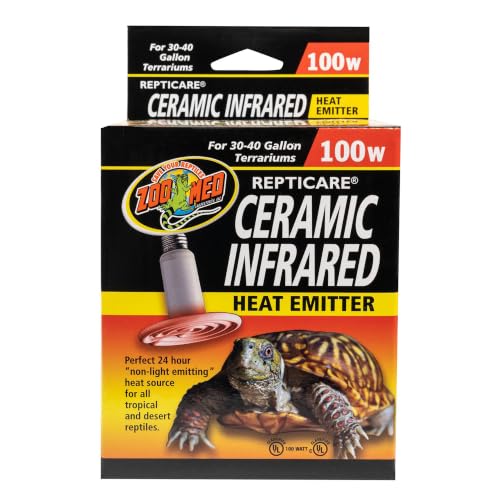
1. Zoo Med ReptiCare Ceramic Infrared Heat Emitter, 100 Watt
See also: Best Automatic Transmission Floor Shifter: Ratchet, Gated and Detent Shifters Compared • Best Automatic Floor Shifter for Truck: Tall, Tough Picks for Pickups and Bench Seats
The Zoo Med ReptiCare emitter is the long-running default in the ceramic emitter class, and it earns the first spot because it is the most widely stocked single emitter with a long record in terrarium use. It is a 100 watt ceramic bulb that radiates infrared heat and emits no light, so it can run around the clock without disturbing the day and night cycle in the crabitat.
Specs
- Type: Ceramic heat emitter, no light output
- Wattage: 100 watts
- Base: Standard E26 screw base, ceramic socket required
- Maker guidance: Suited to tanks of 30 to 40 gallons
- Use: 24 hour heat source, day and night
A single 100 watt emitter is the right size for the most common crabitat, a 20 to 40 gallon tank in a normal room. In a 10 gallon tank it will run hot and dry the air quickly, so it needs a thermostat and a close eye on the hygrometer for the first days. Its strength is simplicity: one bulb, one fixture, no light, and a heat pattern that warms the air and the substrate surface beneath it rather than a single hot spot.
2. Fluker’s Deep Thermal Heat Lamp, 100 Watt
- Type: Carbon infrared heat lamp, light emitting
- Wattage: 100 watts
- Base: Standard screw base, ceramic socket fixture required
- Use: Daytime heat and light, switch off at night
Fluker’s Deep Thermal lamp is the light-emitting pick in this guide, and it is here because some crabitats need daytime heat with visible light, in a cold room or a basement where the tank never sees daylight. It is a 100 watt carbon infrared bulb that gives off heat and light together, and it screws into a clamp lamp or similar fixture with a ceramic socket.
The case for this bulb is a daytime one. A crabitat in a dim room gets both warmth and a visible day cycle from a single fixture, and the infrared output penetrates deeper than a standard basking bulb, warming the substrate rather than just the air. The case against it is that it cannot stay on overnight, because the light breaks the night cycle, so it needs a ceramic emitter as its night partner, which means two fixtures and a timer or thermostat that handles the handover.
3. LUCKY HERP Ceramic Heat Emitter, 100 Watt, 2-Pack
- Type: Ceramic heat emitter, no light output
- Wattage: 100 watts per bulb
- Pack: 2 bulbs
- Base: Standard E26 screw base, ceramic socket required
The LUCKY HERP two-pack is the spare-bulb pick: two 100 watt ceramic emitters in one box, for a keeper who wants a backup on the shelf or heat over two tanks. Each bulb is a ceramic emitter with no light output, in a standard E26 screw base, and the pair covers a single crabitat with a spare ready when the first bulb eventually fails.
A two-pack makes sense because ceramic emitters do fail, and they tend to fail on a cold night when shops are closed. Having the spare in the cupboard means the tank is warm again in minutes instead of the next day. The trade-off against the single Zoo Med emitter is brand record: LUCKY HERP is a newer value brand without the same long terrarium history, and the bulbs are sold as a pair, so a keeper with one tank pays for a spare whether they want one or not.
4. Simple Deluxe Ceramic Heat Emitter, 150 Watt, 2-Pack
- Type: Ceramic heat emitter, no light output
- Wattage: 150 watts per bulb
- Pack: 2 bulbs
- Base: Standard E26 screw base, ceramic socket required
The Simple Deluxe two-pack is the high-wattage pick, for larger crabitats and cold rooms where 100 watts is not enough. Each bulb is a 150 watt ceramic emitter with no light output, in a standard E26 screw base, and the pair gives a keeper a working bulb and a spare, or heat for two tanks.
A 150 watt emitter is the right tool when the tank is 40 gallons or larger, or when the room itself is cold and a 100 watt bulb cannot hold 75 degrees. The two-pack format repeats the spare-bulb logic of the LUCKY HERP pick, and the two Simple Deluxe products in this guide are different roles, not duplicates: this one is a pair of bare high-wattage bulbs, while the fifth pick is a complete fixture and bulb kit.
5. Simple Deluxe Clamp Lamp Light with 150 Watt Ceramic Heat Bulb
- Type: Clamp lamp fixture with ceramic socket plus 150 watt ceramic heat bulb
- Wattage: 150 watts
- Socket: E26 ceramic socket
- Cord: 6 feet
The fifth pick is the only complete kit in this guide: a clamp lamp fixture with a steel cage wire grill, an E26 ceramic socket and a six foot cord, sold together with a 150 watt ceramic heat bulb. It is the pick for a keeper who has no fixture yet and wants the lamp and the bulb in one box.
A kit solves the most common beginner mistake, which is buying a ceramic emitter and screwing it into a plastic-socket desk lamp. The ceramic socket and the steel cage are the two parts that matter: the socket survives the heat, and the cage keeps a climbing crab and curious fingers away from the hot bulb. The clamp lets the lamp sit on the rim of the tank or on a shelf above a mesh lid, and the six foot cord reaches an outlet without an extension.
Comparison Table
| Product | Type | Wattage | Light | Best For |
|---|---|---|---|---|
| Zoo Med ReptiCare Ceramic Emitter | Ceramic emitter | 100W | None | Single 20 to 40 gallon tank |
| Fluker’s Deep Thermal Heat Lamp | Carbon infrared bulb | 100W | Yes | Daytime heat in a cold room |
| LUCKY HERP Ceramic Emitter, 2-Pack | Ceramic emitter | 100W each | None | One tank plus a spare bulb |
| Simple Deluxe Ceramic Emitter, 2-Pack | Ceramic emitter | 150W each | None | Large tanks and cold rooms |
| Simple Deluxe Clamp Lamp with Bulb | Fixture plus bulb kit | 150W | None | First setup with no fixture |
Frequently Asked Questions
Do hermit crabs need a heat lamp, or is a heating pad enough?
Either one can work, and many keepers use both: a pad on the side of the tank for steady background warmth and a lamp above for air temperature. A pad alone often warms the glass and the substrate nearest the pad while the air stays cool, so a lamp is the better tool when the air temperature is the problem.
Can I leave a ceramic heat emitter on all night?
Yes. A ceramic emitter gives off no light, so it can run around the clock without breaking the day and night cycle. A light-emitting heat bulb should go off at night and hand over to a ceramic emitter, or to a heating pad, so the crabs get a real dark period.
What temperature and humidity should a crabitat hold?
Aim for air between 75 and 85 degrees and humidity between 70 and 80 percent. Below 70 degrees the crabs slow down and eat less, and below 70 percent humidity their gills dry out. Check both numbers, not just the temperature.
Where should the lamp sit on the tank?
On top of a mesh lid, outside the tank, or clamped above it, never inside the tank where a climbing crab can touch the bulb. The lamp should sit over one end of the tank rather than the middle, so the crabs get a warm end and a cooler end and can choose where to sit. A wire guard or steel cage over the bulb is worth having in any tank with climbers.
Conclusion
The right heat lamp for a crabitat is almost always a ceramic emitter: heat without light, run through a thermostat, watched by a thermometer and a hygrometer. The Zoo Med 100 watt emitter is the safe default for a 20 to 40 gallon tank, the LUCKY HERP two-pack adds a spare, and the Simple Deluxe 150 watt two-pack covers large tanks and cold rooms. Fluker’s Deep Thermal bulb is the daytime exception for a cold, dim room, and the Simple Deluxe clamp lamp kit is the first-setup pick for a keeper who needs the fixture as well as the bulb. The thermostat and hygrometer are the other half of the setup.