📅 Last updated:
📋 Table of Contents
Quick answer: Our top pick in 2026 is the Large plastic storage tote with a lowered front — our #1 rated choice. See the full ranked comparison, alternatives and buying advice below.
The Short Answer
Yes—most cats do better with a large litter box, provided you have room to place it in a quiet, accessible location. The key condition is size: the box should be at least 1.5 times your cat’s body length, measured from the nose to the base of the tail. Your cat should be able to turn around, dig, squat, and leave without touching the sides.
For an average adult cat, that usually means looking for an interior that is roughly 24 to 30 inches long and 16 to 20 inches wide. Larger cats, long-haired cats, senior cats, and cats that dislike cramped spaces may need more. A box can be labeled “large” or “XL” and still be too small once thick walls, a high rim, or a sifting insert reduce the usable floor area.
As an Amazon Associate we earn from qualifying purchases at no extra cost to you.

Large litter boxes are not automatically better in every home. They take up more floor space, may be harder to clean, and can be difficult for kittens or cats with arthritis to enter. The best choice balances your cat’s size and habits with the space, budget, and cleaning routine you can realistically maintain.
What You Actually Get
See also: Most Trusted Cat Litter Brands in 2026 and What Each Does Best • How to Introduce a Carrier to Cats (2026): Step-by-Step
A large litter box gives your cat more usable space rather than simply more litter capacity. That distinction matters. Many cats circle before eliminating, scratch afterward, or prefer to keep urine and feces in separate areas. A cramped box can make those normal behaviors difficult and may lead to accidents beside the box.
More room can also help contain litter. When a cat has space to dig and turn around, less litter is kicked directly over the edge. High-sided models add another layer of containment, although they do not stop every stray granule. Open-top designs are generally easier for cats to enter and easier for owners to inspect. Covered models can hide odors and litter scatter, but the enclosed interior may feel restrictive to a large or nervous cat.
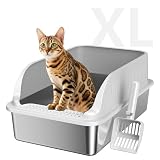
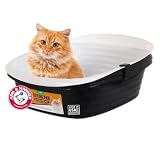
Two examples in this category illustrate different approaches. The Arm & Hammer Large Sifting Cat Litter Box with Microban is listed at $24.99 and emphasizes easier separation of waste from clean litter. The Tevila XL Open Top Stainless Steel Litter Box with High Sides, Light Gray is listed at $29.69 and emphasizes a larger, open design with a nonporous metal surface. Prices can change, and the practical differences depend on the actual interior measurements, rim height, and included components.
Check four measurements before buying:
- Usable length and width: Measure the floor inside the box, not the outside dimensions.
- Entry height: A 5- to 7-inch opening may work for an active adult cat, while kittens and mobility-limited cats may need an entry closer to 3 to 4 inches.
- Side height: High sides around 8 to 12 inches can reduce scatter and urine overspray, but only if the cat can comfortably step over the entrance.
- Placement footprint: Leave several inches around the box so your cat does not feel trapped and you can scoop without moving furniture.
Pros
- More comfortable for most adult cats: Extra space accommodates turning, digging, and positioning without the cat pressing against a wall.
- Fewer location-related accidents: A cat that avoids a small box may be more willing to use one that allows natural movement.
- Better for large and long-bodied breeds: Maine Coons, Norwegian Forest Cats, Ragdolls, and similarly sized cats often outgrow standard boxes.
- More flexibility in litter depth and placement: A bigger floor allows you to maintain the commonly recommended 2 to 3 inches of litter while leaving room for movement.
- Can reduce scatter: High-sided large boxes give cats more room to scratch inside rather than directly at the edge.
- Useful in multi-cat homes: Even when each cat has its own box, a roomy option can reduce crowding and hesitation.
- More forgiving for messy eliminators: Cats that regularly urinate near the edge or kick litter may benefit from added floor area and taller sides.
Cons
- It needs real floor space: A 24-by-18-inch box occupies about 3 square feet before accounting for clearance. A larger setup may not fit comfortably in a small bathroom or apartment.
- More litter can mean more weight: With 2 to 3 inches of litter, a large box can easily weigh 15 to 25 pounds when full, depending on the material and litter type.
- Cleaning may take longer: A bigger surface needs more litter to be scooped, stirred, and replaced. Sifting designs may simplify removal but add parts to rinse.
- High walls can exclude some cats: Kittens, seniors, and cats with joint pain may struggle with a tall entry.
- Open boxes expose odor: They are easy to access and inspect, but odor control depends heavily on daily scooping and regular litter replacement.
- Not every “XL” model is genuinely roomy: Exterior measurements can be misleading when walls slope inward or inserts take up floor area.
- More expensive materials cost more: Stainless steel models commonly range from about $25 to $60, while basic plastic boxes often cost $8 to $25.
Who Should Buy It
Buy a large litter box if your cat is long, heavy, or visibly cramped in its current box. It is also a smart upgrade if your cat turns around repeatedly, perches on the rim, scratches outside the box, urinates over the edge, or leaves waste beside the box despite otherwise normal litter habits.
Large boxes are particularly useful for cats that prefer to dig extensively, cats with long hair that need room to position themselves, and households that want high sides without resorting to a fully covered enclosure. If you are comparing the Arm & Hammer sifting model at $24.99 with the Tevila XL stainless model at $29.69, prioritize the interior floor dimensions and entry design over the small price difference. Sifting convenience may matter more to a frequent cleaner, while stainless steel may appeal to someone who wants a nonporous surface and an open top.
Buy two large boxes if you have one cat and enough space to do so. The widely used rule is one box per cat, plus one extra. In a two-cat home, that means three boxes when practical, placed in separate areas rather than lined up together.
Who Should Skip It
Skip a very large, high-sided box if your cat is a kitten, elderly, recovering from surgery, or showing stiffness when climbing. A large floor area is not helpful if the entrance is physically difficult. Choose a roomy box with a low front entry instead, or provide a low-entry option alongside the larger box.
You may also skip it if the only available location is next to a loud appliance, in a narrow closet, or in a place where the cat can be cornered by another pet. Placement affects litter-box use as much as dimensions. A smaller box in a calm, accessible location can work better than an oversized box in an uncomfortable one.
Cheaper Alternatives
| Option | Cost | Trade-off |
|---|---|---|
| Large plastic storage tote with a lowered front | $10–$20 | Very roomy and inexpensive, but requires cutting or carefully creating an entry and smoothing every edge. |
| Basic open plastic litter pan | $8–$25 | Easy to find and lightweight, but plastic can retain odors and may flex under a heavy litter load. |
| Large cement-mixing or utility tub | $12–$25 | Often deeper and wider than pet-store boxes, but the shape may be awkward and the entry may need modification. |
| Arm & Hammer Large Sifting Cat Litter Box with Microban | $24.99 listed price | Sifting can reduce scooping effort, but inserts may reduce usable space and require additional rinsing. |
| Tevila XL Open Top Stainless Steel Litter Box with High Sides | $29.69 listed price | Open stainless construction is easy to inspect and nonporous, but high sides may be difficult for cats with limited mobility. |
FAQ
How big should a litter box be for an average cat?
Aim for an interior at least 1.5 times your cat’s nose-to-tail-base length. For many adult cats, an interior around 24 to 30 inches long and 16 to 20 inches wide is a practical starting point. Measure the inside, because thick rims and sloped walls can reduce the usable area.
Do cats prefer open or covered litter boxes?
Many cats prefer open boxes because they provide better visibility and ventilation. Covered boxes can work, but some cats dislike the confined space or concentrated odor. If you choose a covered design, make sure the entrance is large enough and remove waste at least once daily.
Can a litter box be too large?
Yes, although excessive floor area is usually less problematic than an undersized box. The main concerns are access and placement. A kitten or senior cat may struggle with a large box that has tall walls, and an oversized box placed in a cramped corner may feel unsafe. Use a low-entry model when mobility is a concern.
How often should a large litter box be cleaned?
Scoop clumps and solid waste at least once daily, and twice daily is better in a multi-cat home. Top up litter as needed to maintain roughly 2 to 3 inches. Wash the box with mild unscented soap when odor remains after scooping, when the litter is fully replaced, or at least every few weeks. Nonporous stainless steel may resist lingering odor better than scratched plastic, but no material replaces regular cleaning.
For 2026, the safest buying rule remains simple: choose the largest box your cat can enter comfortably and you can clean consistently. Interior dimensions, entry height, and placement matter more than the label on the package.
Ready to decide? Our #1 pick for 2026 is the Large plastic storage tote with a lowered front.
Live price & availability on Amazon.