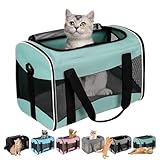
- Top Pick: Amazon Basics Large Cat Litter Box with High Sides, Open Top for Easy Access, Includes Scoop with Storage, 19" x 15" x 11.75", Grey/Beige
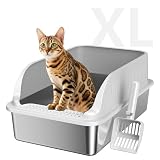
- Best Value: JINXUANTANG XL Cat Litter Box: High-Sided Anti-Urine Leakage for Big Cats
- Premium Choice: Stainless Steel Cat Litter Box, Extra Large XL Odor Free Metal Litter Box with High Sides Lid, Open Top Litter Pan Include Scoop Easy Cleaning Kitty Cat Box Anti-Urine Leakage, Non-Sticky
📅 Last updated:
📋 Table of Contents
The Short Answer
For most large cats, the best litter box dimensions are at least 24 inches long, 18 inches wide, and 10 to 12 inches high. Very large cats, long-bodied breeds, and cats that turn in circles before eliminating may need a box measuring 30 inches long by 20 inches wide.
A useful sizing rule is to choose a litter box at least 1.5 times your cat’s body length, measured from the nose to the base of the tail. The cat should also be able to stand, squat, turn around, and bury waste without pressing against the sides. For a 16-inch cat, that means a minimum length of about 24 inches. For a 20-inch cat, look for roughly 30 inches.
As an Amazon Associate we earn from qualifying purchases at no extra cost to you.


Height requires a balance. High sides help contain litter and urine, but the entrance must remain low enough for easy access. A box with 10- to 12-inch walls and a 5- to 7-inch entry is usually practical for a healthy adult cat. Older, arthritic, or mobility-limited cats may need a lower front entry even if the rest of the box is tall.
Standard Sizes
See also: Most Trusted Cat Litter Brands in 2026 and What Each Does Best • How to Introduce a Carrier to Cats (2026): Step-by-Step
Litter box labels are not standardized. One manufacturer’s “large” may be another manufacturer’s “extra large,” so compare the actual interior or usable floor dimensions rather than relying on the label. The measurements below describe common exterior size categories and are useful starting points for large-cat shopping.
| Category | Typical dimensions | Centimeters | Best for |
|---|---|---|---|
| Compact | 18 x 14 x 6 in. | 45.7 x 35.6 x 15.2 cm | Kittens, small cats, or tight spaces |
| Large | 22 x 16 x 8 in. | 55.9 x 40.6 x 20.3 cm | Average adult cats |
| Extra large | 24 x 18 x 10 in. | 61.0 x 45.7 x 25.4 cm | Most large cats |
| Giant | 30 x 20 x 12 in. | 76.2 x 50.8 x 30.5 cm | Very large breeds or multi-cat homes |
These are exterior reference sizes, so the usable interior can be smaller because of sloped walls, molded corners, a rim, or a lid. A listed size of 24 by 18 inches may provide only 22 by 16 inches of flat floor space. Open-top pans generally make it easier to assess the true usable area.
As a point of comparison, the Amazon Basics high-sided box measures 19 by 15 by 11.75 inches, or approximately 48.3 by 38.1 by 29.8 centimeters. Its tall walls may help with scatter, but its floor length is below the preferred 24-inch minimum for many large cats. Similar XL plastic and stainless-steel models commonly sell for about $17 to $30, depending on the material, lid, scoop, and included accessories.
For a large cat, prioritize floor area first, then wall height. A deep box that is too short can be less comfortable than a lower box with enough room to turn and position properly.
How to Measure Your Space
- Measure the available floor area. Use a tape measure to record the maximum length and width where the box will sit. Measure from wall to wall, including the space needed to open a door or cabinet.
- Allow clearance around the box. Leave at least 3 inches on each side for cleaning and airflow. Add 6 to 12 inches in front of the entrance so your cat can approach, enter, and exit without squeezing through a narrow gap.
- Check vertical clearance. Measure from the floor to the lowest obstruction, such as a shelf, counter, or cabinet top. A high-sided 12-inch box needs more than 12 inches of clearance if it has a raised rim or cover.
- Measure doorways and turns. For a rigid pan, record the narrowest doorway, stair, and hallway. A 30-inch box may fit the room but fail to make a 90-degree turn through a 24-inch doorway.
- Account for the entrance. If the box has a lowered front, ensure that side faces the open walking area. For a covered model, measure the entry height and width, not just the outside dimensions.
- Consider litter depth. Most cats need roughly 2 to 3 inches of litter. This does not change the box’s footprint, but it reduces the remaining interior height and may affect a cat that prefers to stand while urinating.
- Test with a template. Mark the intended dimensions on cardboard and place it in the proposed location. This quickly reveals whether nearby furniture blocks movement or whether the box feels too cramped.
By Room or Use Case
Bathroom or Laundry Room
These rooms often accommodate an extra-large box because they have washable floors and access to ventilation. A 24 by 18-inch pan is a sensible minimum, while a 30 by 20-inch model works if the room has enough walking clearance. Avoid placing the box directly beside a noisy washer, dryer, or furnace. Sudden sounds can make a cat avoid an otherwise well-sized box.
Bedroom
For a bedroom, choose the largest box that can be cleaned without moving heavy furniture. High sides are useful if the box sits on carpet, but a fully enclosed lid may concentrate odors and make the interior feel small. A high-sided open pan around 24 by 18 by 10 inches often provides a better compromise than a small covered box.
Small Apartment
When floor space is limited, use vertical clearance carefully rather than sacrificing length. A narrow box measuring 24 by 16 inches can be more suitable for a large cat than an 18-inch square pan. Place it in a quiet corner with the entrance facing outward. A litter-catching mat can extend beyond the footprint without reducing the cat’s usable space.
Multi-Cat Home
A large cat still needs a box sized for its own body, even when several boxes are available. Ideally, provide one box per cat plus one extra, distributed in separate locations. If space limits the total number, prioritize at least two generously sized boxes rather than several undersized pans. Stainless-steel models such as XL open-top boxes may be easier to wipe clean, though their rigid shape and weight should be checked against the available space.
Senior or Mobility-Limited Cat
Choose a box with a low entry, ideally around 3 to 5 inches, while keeping the back and side walls high enough to contain litter. A large pan with one lowered side is usually more practical than a tall box that requires climbing. Place it on a stable, non-slip surface and avoid stairs or raised platforms.
Common Sizing Mistakes
- Shopping by the word “large.” Always compare the actual length and width. A nominally large box may be too short for a long-bodied cat.
- Measuring the rim instead of the floor. A wide lip does not give your cat more turning space. Look for the interior base dimensions when available.
- Choosing height over floor area. Twelve-inch walls cannot compensate for a 19-inch-long floor when the cat needs 24 or more inches.
- Ignoring the entrance. A high-sided box can be unsuitable if the opening is narrow, tall, or blocked by nearby furniture.
- Using a box that is too shallow for a standing urinator. If your cat raises its rear while urinating, select taller sides or add a removable splash guard without reducing the floor area.
- Forgetting usable space after accessories. A lid, ramp, liner, or internal divider can take away several inches of room. Judge the box as assembled, not as pictured without litter.
- Replacing cleaning with extra capacity. A giant box still needs regular scooping. Size improves comfort and containment, but it does not eliminate odor or maintenance.
FAQ
What litter box dimensions are best for a Maine Coon?
Start with at least 30 by 20 inches, or approximately 76.2 by 50.8 centimeters, if the cat is especially long or heavy. A 24 by 18-inch box may work for a smaller Maine Coon, but measure the individual cat rather than relying on breed alone. Choose walls around 10 to 12 inches high with an accessible entry.
Is a 19 by 15-inch litter box big enough for a large cat?
It may be usable temporarily, but it is smaller than the preferred size for many large adult cats. The cat may be unable to turn comfortably or may hang its rear over the edge. For routine use, look for at least 24 inches of interior length whenever the room allows.
How high should the sides be?
For an active adult large cat, 10 to 12-inch sides provide useful protection against scatter and urine overspray. Keep one entry section lower, usually 5 to 7 inches. Senior cats and cats with joint problems may need a 3- to 5-inch entry, even if the opposite sides are taller.
Are stainless-steel litter boxes better for large cats?
Stainless steel can resist odor absorption and is generally straightforward to wipe clean, while plastic is lighter and often less expensive. Neither material automatically provides enough space. Check the actual floor dimensions, wall height, entry design, weight, and placement clearance before choosing. Many XL stainless-steel options fall in the roughly $29 to $30 price range, but features and dimensions vary.
Ready to decide? Our #1 pick for 2026 is the Compact.
Live price & availability on Amazon.