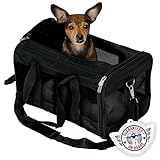
- Top Pick: Sherpa Original Deluxe Travel Pet Carrier, Airline Approved & Guaranteed On Board – Black, Medium
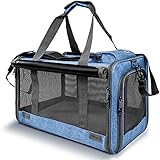
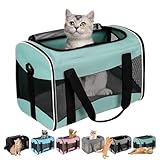
- Best Value: Henkelion Cat Carriers Dog Carrier Pet Carrier For Small / Medium Cats Dogs Puppies (Up To 15lbs), TSA Airline Approved Small Dog Carrier Soft Sided, Collapsible Waterproof Travel Puppy Carrier – Grey
- Premium Choice: Henkelion Cat Carriers Dog Carrier Pet Carrier for Small / Medium Cats Dogs Puppies (Up To 15lbs), TSA Airline Approved Small Dog Carrier Soft Sided, Collapsible Waterproof Travel Puppy Carrier -Black
📅 Last updated:
Choosing the right carrier starts with more than your pet’s weight. Airlines limit the carrier’s outside dimensions, and the available space can vary by aircraft, seat, route, and cabin class. This guide to pet carrier dimensions for airline travel explains common sizes, how to measure your pet and under-seat space, and what to check before buying in 2026.
📋 Table of Contents
The Short Answer
For most in-cabin flights, look for a soft-sided carrier approximately 16 to 18 inches long, 10 to 12 inches wide, and 8 to 11 inches high. A frequently accepted target is about 17 x 11 x 10.5 inches (43.2 x 27.9 x 26.7 cm), although no single size works for every airline or aircraft.
As an Amazon Associate we earn from qualifying purchases at no extra cost to you.


Soft carriers are usually more practical than hard kennels because they can compress slightly beneath the seat. However, the carrier must still provide enough room for your pet to stand, turn around, and lie down comfortably. Confirm the airline’s current under-seat dimensions before purchasing and contact the airline if your pet or carrier is close to the limit.
Standard Sizes
See also: How to Set Up Timed Pet Feeder (2026): Step-by-Step • Water Fountain Buying Guide for Multiple Pets in 2026: What Actually Matters
The table below shows common airline-carrier dimensions and representative products. Dimensions are outside measurements, which airlines generally use when setting limits. Interior space is smaller because of padding, seams, frames, and storage pockets.
| Carrier size or example | Outside dimensions in inches | Outside dimensions in centimeters | Best suited for |
|---|---|---|---|
| Compact soft carrier | 15.7 x 9.8 x 9.8 | 39.9 x 24.9 x 24.9 | Very small cats, toy dogs, and puppies |
| Typical small airline carrier | 16 x 10 x 8 | 40.6 x 25.4 x 20.3 | Small cats and dogs with short bodies |
| Sherpa-style medium carrier | 17 x 11 x 10.5 | 43.2 x 27.9 x 26.7 | Many small cats and dogs; check airline limits |
| Roomier soft airline carrier | 18 x 11 x 11 | 45.7 x 27.9 x 27.9 | Longer-bodied small pets where approved |
| Large soft carrier | 19 x 12 x 12 | 48.3 x 30.5 x 30.5 | Ground travel or airlines with generous limits |
These dimensions are useful comparison points, not a universal airline standard. Some carriers publish a maximum such as 18 x 11 x 11 inches, while others allow a different height or width depending on the aircraft. A carrier advertised as “airline approved” is not automatically accepted on every airline.
As a buying reference, the Sherpa Original Deluxe Medium is commonly listed at about 17 x 11 x 10.5 inches and around $45 to $60, depending on the retailer and color. The Sherpa Delta Medium is also commonly listed near 17 x 11 x 10.5 inches, with prices often around $45 to $60. Henkelion soft carriers marketed for pets up to 15 pounds are commonly listed near 15.7 x 9.8 x 9.8 inches, with prices in the approximate $20 to $30 range. Product measurements, weight ratings, and prices can change, so compare the current listing with your airline’s rules.
Do not select a carrier solely by the advertised weight capacity. A 15-pound rating does not mean every 15-pound dog or cat will fit comfortably. Body length, shoulder height, chest width, and the thickness of the carrier’s base are equally important.
How to Measure Your Space
- Measure your pet’s body length. With your pet standing naturally, measure from the tip of the nose to the base of the tail. Do not include the tail unless the carrier manufacturer specifically requests a full-body measurement.
- Measure standing height. Measure from the floor to the top of the head or the highest point of the ears, whichever is taller. A pet should not be forced to flatten its ears or crouch continuously.
- Measure shoulder width. Measure across the widest part of the chest or shoulders. Add enough room for your pet to turn around without pressing against the carrier walls.
- Compare the interior dimensions. Use the carrier’s interior measurements when available. Exterior dimensions can overstate usable room by 1 to 3 inches because of padding, structure, and rounded corners.
- Measure the airplane space. Ask the airline for the maximum under-seat length, width, and height for your specific aircraft or route. The space may be narrower near the seat supports and can differ between a bulkhead, window, middle, or aisle seat.
- Allow for a thin comfort layer. A washable absorbent pad is useful, but a thick bed can reduce headroom. Pack an extra pad rather than filling the carrier with bulky bedding.
- Test the carrier before travel. Place it beneath a table or furniture opening that approximates the airline’s measurements. Make sure the carrier can slide in without crushing the ventilation panels or blocking the door.
Airlines generally require the pet to remain inside the carrier throughout the flight. The carrier should have secure fasteners, leak-resistant construction, adequate ventilation, and a base that will not collapse under your pet’s weight. Soft sides may flex, but do not count on an agent allowing a carrier that must be severely compressed to fit.
By Room or Use Case
Under-seat cabin travel
Choose a soft-sided carrier in the approximate 16-to-18-inch length range, then match the width and height to the airline’s stated maximum. A lower profile, such as 16 x 10 x 8 inches, is easier to fit beneath restrictive seats. A 17 x 11 x 10.5-inch carrier may provide more usable room, but it requires confirmation because even a half-inch difference can matter.
Airport transfers and road trips
For car rides, train trips, or taxi transfers, you can prioritize structure, storage, and shoulder-strap comfort over strict under-seat dimensions. A 19 x 12 x 12-inch carrier can be more comfortable for a small, long-bodied pet, but it may be too large for cabin use. Secure the carrier with a seat belt only if the design includes a manufacturer-approved attachment point.
Short trips and nervous pets
A compact carrier can feel more secure for brief trips, but it should never be so small that your pet cannot reposition. Look for a firm base, multiple ventilation panels, and an opening large enough for calm loading. A carrier with a removable pad and washable lining is especially useful for stress-related accidents.
Long-bodied cats and small dogs
Length is usually the limiting measurement for dachshunds, slender terriers, larger toy breeds, and long-bodied cats. Compare the pet’s nose-to-tail-base measurement with the carrier’s interior length. If the pet cannot lie down without curling tightly, choose a larger model for ground travel or ask the airline about approved alternatives.
Common Sizing Mistakes
- Confusing exterior and interior measurements: A carrier listed as 17 inches long may offer several inches less sleeping space.
- Relying on weight alone: Two pets with the same weight can need very different carrier sizes.
- Ignoring the carrier’s height: A pet may fit by weight but lack room to sit or turn around.
- Assuming “airline approved” is universal: Airline policies and aircraft under-seat spaces differ.
- Buying a rigid kennel for a soft-carrier requirement: Hard-sided kennels often have less flexibility and may exceed cabin limits.
- Forgetting hardware and pockets: Wheels, exterior storage, frames, and expanded sections can affect the carrier’s usable or measured size.
- Waiting until the airport: Measure at home and reserve the pet space early; cabin pet capacity may be limited.
FAQ
What is the most common pet carrier size for airline travel?
A soft carrier around 17 x 11 x 10.5 inches is a common starting point for small cats and dogs. Some airlines allow approximately 18 x 11 x 11 inches, while others require a shorter or lower carrier. Always use the airline’s published dimensions for your flight.
Can a carrier be slightly larger than the airline’s listed dimensions?
Do not assume it will be accepted. A flexible side may compress slightly, but the carrier still needs to fit beneath the seat without being forced into place. Ask the airline in advance if your selected model is close to the stated limit.
How much room should a pet have inside the carrier?
Your pet should be able to stand naturally, turn around, sit, and lie down. The carrier should not be excessively oversized for cabin travel, but comfort and safe positioning are more important than matching the pet’s weight to the bag’s maximum rating.
Are soft-sided carriers better for airline travel?
Usually, yes, because soft sides can accommodate the irregular shape of under-seat space and often weigh less than hard kennels. Choose a model with a stable base, secure zippers, good ventilation, and enough structure to protect your pet. Confirm that the airline permits soft carriers before departure.
Ready to decide? Our #1 pick for 2026 is the Compact soft carrier.
Live price & availability on Amazon.