Our Short List of 3
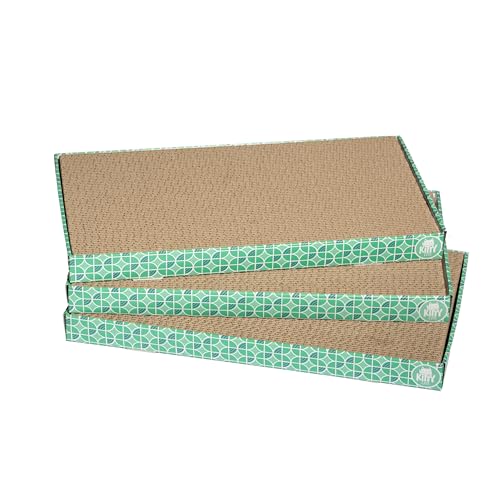
- Pad size: 18 x 10 x 1.5 inches each
- Pack: 3 pads
- Material: Non-toxic recycled corrugated cardboard
- Design: Double-sided flat pads
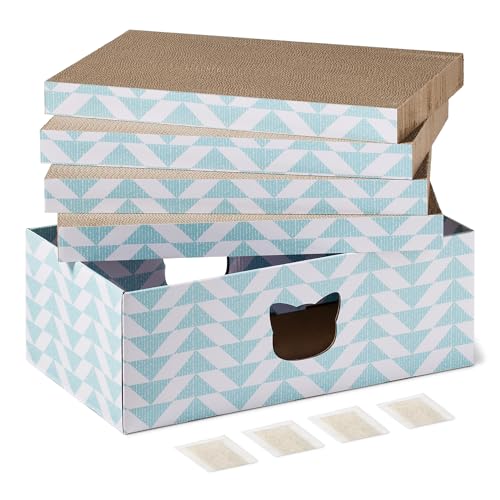
- Pad size: 16.5 x 10 x 1.5 inches each
- Pack: 4 pads
- Material: FSC-certified corrugated cardboard
- Design: Double-sided flat pads, catnip-infused

- Pad size: 16.93 x 7.87 x 1.18 inches each
- Pack: 2 pads
- Material: Heavy-duty 100 percent recycled corrugated cardboard
- Design: Curved, double-sided pads
All 5 Picks at a Glance
| Product | Specs | Action |
|---|---|---|
| 1. Kitty City XL Wide Corrugate Cat Scratchers, 3-Pack |
| Check price on Amazon |
| 2. Amazon Basics Corrugated Cardboard Cat Scratchers, 4-Pack |
| Check price on Amazon |
| 3. TIMHAKA Cat Scratching Board, 2-Pack |
| Check price on Amazon |
 4. FUKUMARU Cat Scratcher Cardboard, 5 PCS with Box |
| Check price on Amazon |
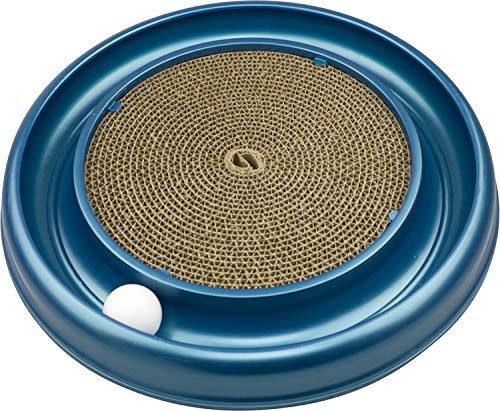 5. Bergan Turbo Scratcher Cat Toy |
| Check price on Amazon |
📅 Last updated:
A kitten does not always scratch the way an adult cat does. Many kittens scratch low, raking at the floor, the rug edge, or the bottom of a door frame, while a tall post sits ignored and the carpet takes the damage. A flat scratcher meets a kitten at floor level: a low pad the kitten can stand on and stretch across.
This guide covers flat scratchers only. Every pick below lies flat on the floor, and none of them is a vertical post, a wall-mounted panel, or a lounge bed. The site already has roundups of short sisal posts for kittens, extra-tall posts for large cats, wall-mounted scratchers, and cardboard loungers, so none of those products appear here.
One honest limit applies to the whole class. A flat pad serves a horizontal scratcher. If your kitten stands on its hind legs and rakes upward against a door frame, it wants a post, and a flat pad will not convert it.
Disclosure: As an Amazon Associate, I earn from qualifying purchases.
📋 Table of Contents
How to Choose a Flat Scratcher for a Kitten
Match the pad to the kitten, not to the room. A kitten scratches with its front paws while its body extends behind them, so the pad needs enough length for a full stretch. For a young kitten, a pad around 16 to 18 inches long gives room to stretch without the paws sliding off the far edge. Width matters too: a pad around 8 to 10 inches wide lets the kitten plant both paws side by side.
Take thickness seriously. A flat pad around 1 to 1.5 inches thick stays put under a scratching kitten and gives the claws something to sink into. Thinner mats can slide on hard floors and curl at the corners, which puts a kitten off.
Understand the cardboard question. Corrugated cardboard is the default material for flat scratchers: the cut edges of the layers give claws grip, the surface feels nothing like furniture, and a worn pad is cheap to replace. Dense, tightly glued cardboard holds up longer than loose layers, and a reversible design doubles the life because you flip the pad when one face wears through.
Treat catnip as a lure, not a guarantee. Several pads here ship with catnip, either infused into the cardboard or as a loose bag to sprinkle on top. Catnip draws a hesitant kitten onto a new pad on the first day, which is its real job. Very young kittens often show little interest in catnip at all, and that is normal.
Place the pad where the scratching already happens. Kittens scratch after waking, near where they sleep, and near the furniture they have already chosen. A flat pad belongs beside the sleeping spot, at the bottom of the stairs, or directly in front of the rug edge currently under attack, not in a quiet corner of a spare room.
Plan the upgrade path now. A flat pad is a first scratcher, not the last one. When the kitten starts standing tall and raking upward, or when its paws run off the end of the pad mid-stretch, it is time for a taller post alongside the pad.
The Five Flat Pads at a Glance
See also: Best Automatic Transmission Floor Shifter: Ratchet, Gated and Detent Shifters Compared • Best Automatic Floor Shifter for Truck: Tall, Tough Picks for Pickups and Bench Seats
| Product | Form | Pad Size | Material | Best For |
|---|---|---|---|---|
| Kitty City XL Wide Corrugate, 3-Pack | Three flat pads | 18 x 10 x 1.5 in each | Recycled corrugated cardboard | Spreading pads around the home |
| Amazon Basics Corrugated, 4-Pack | Four flat pads | 16.5 x 10 x 1.5 in each | Corrugated cardboard, FSC-certified | A spare pad in every room |
| TIMHAKA Scratching Board, 2-Pack | Two curved pads | 16.93 x 7.87 x 1.18 in each | Recycled corrugated cardboard | The smallest kittens and tight spots |
| FUKUMARU Scratcher, 5 PCS with Box | Five pads in a box | 16.5 x 11 x 1.2 in each | Cardboard and paper | A long refill supply in one buy |
| Bergan Turbo Scratcher | Round pad with ball track | About 16 in diameter | Corrugated cardboard | Kittens that scratch and play |
The Picks
1. Kitty City XL Wide Corrugate Cat Scratchers, 3-Pack
- Pad size: 18 x 10 x 1.5 inches each
- Pack: 3 pads
- Material: Non-toxic recycled corrugated cardboard
- Design: Double-sided flat pads
The Kitty City set is the straightforward pick: three wide, flat corrugated pads, each 18 by 10 by 1.5 inches, made from non-toxic recycled cardboard. At 18 inches long, each pad is the longest flat surface here, which gives a stretching kitten room to extend fully. The listing model is CM-0204-CS01, and the pads are double-sided, so you flip a pad when one face wears down.
Three pads in one pack is the practical advantage. You can place one beside the sleeping spot, one at the bottom of the stairs, and one in front of the rug the kitten already targets, instead of choosing a single spot and hoping the kitten finds it. The set also ships with door clips and furniture protectors.
The honest trade-off is mess. Three wide cardboard pads in active use shed flakes. The pads are also light enough that a boisterous kitten can shove one across a hard floor, so place them on a rug or against a wall.
2. Amazon Basics Corrugated Cardboard Cat Scratchers, 4-Pack
- Pad size: 16.5 x 10 x 1.5 inches each
- Pack: 4 pads
- Material: FSC-certified corrugated cardboard
- Design: Double-sided flat pads, catnip-infused
The Amazon Basics set gives you four flat pads, each listed at 16.5 by 10 by 1.5 inches, made from FSC-certified corrugated cardboard. Four pads at this size let you put a scratching spot in every room the kitten uses, which matters because a kitten will not walk to another room to scratch when the rug is right there. Each pad is reversible, and each board is infused with catnip.
Two details need stating plainly. First, the size is listed inconsistently: the Amazon listing gives 16.5 inches long, while some roundups give 17.4 inches for the same set. The listing figure is the one to trust when you measure a spot. Second, availability has been uneven: one listing crawl showed no live offer while other sources showed the set in stock in late November 2026, so confirm a live offer before ordering. The listing model is YJ5965654, first available in October 2025.
The four-pack format is also the simplest way to handle wear. When one pad is shredded, swap in a fresh one and keep the worn pad for a second room until it is finished.
3. TIMHAKA Cat Scratching Board, 2-Pack
- Pad size: 16.93 x 7.87 x 1.18 inches each
- Pack: 2 pads
- Material: Heavy-duty 100 percent recycled corrugated cardboard
- Design: Curved, double-sided pads
The TIMHAKA set is the smallest option here, and that is its point. Each pad measures 16.93 by 7.87 by 1.18 inches, in a gentle curve that lets a kitten lie down and stretch while it scratches. The pads are made from heavy-duty 100 percent recycled cardboard, double-sided, and the pack includes a bag of catnip.
At under 8 inches wide, this is the narrowest pad in the group, and that narrowness cuts both ways. It fits tight spots, beside a sofa leg or in a hallway, where a wider pad would not sit flat. But a fast-growing kitten will outgrow the width sooner than the wider pads here. Treat it as a first pad for a young kitten or a second pad for a tight corner, not as the only pad for a large kitten.
Availability needs a check before ordering: one listing crawl showed no live offer for this set, so confirm the listing is in stock when you buy.
4. FUKUMARU Cat Scratcher Cardboard, 5 PCS with Box
- Pad size: About 16.5 x 11 x 1.2 inches each
- Pack: 5 pads with storage box
- Material: Cardboard and paper
- Design: Reversible flat pads
The FUKUMARU set is the long-supply pick: five reversible cardboard pads in a storage box, each pad 42 by 28 by 3 centimetres, about 16.5 by 11 by 1.2 inches. Five pads is the largest count here, which suits a household with more than one kitten or a kitten that shreds cardboard fast. When one pad is worn, the next is already in the box.
The pads are made from cardboard and paper, reversible so each face gets used before the pad is retired. At about 11 inches wide, they are the widest flat pads here alongside the Kitty City set, giving a stretching kitten room to plant both paws.
The trade-off is thickness. At about 1.2 inches thick, these are the thinnest pads in the group, and a thin pad can slide on a hard floor more easily than a thicker one. The pads are plain, with no toy attached and no catnip stated in the listing.
5. Bergan Turbo Scratcher Cat Toy
- Pad size: About 16 inches in diameter
- Material: Corrugated cardboard pad in a plastic track
- Design: Round pad with rolling ball track, double-sided
- Model: 70128 ASTCAT
The Bergan Turbo Scratcher is the only pick here that is also a toy, and that is why it earns its place. It is a round corrugated cardboard pad, about 16 inches across, set inside a plastic track with a ball that rolls around the rim. A kitten that scratches also bats the ball, and a kitten that comes for the ball stays to scratch.
The listing model is 70128 ASTCAT, from Coastal Pet Products under the Bergan brand, and the pad ships with catnip. The pad is double-sided, so you flip it when one face wears through, and replacement pads are sold separately in a two-pack, which means the toy base can outlast several pads.
The honest limits are shape and size. A round pad gives less straight-line stretch than a rectangular pad of the same length, so a kitten that likes a long, straight rake may prefer one of the rectangles above.
Frequently Asked Questions
Do kittens prefer flat scratchers or tall posts?
It depends on the kitten. A kitten that rakes at rugs, floor edges, and the bottoms of door frames is a horizontal scratcher, and a flat pad suits it. A kitten that stands on its hind legs and rakes upward against furniture wants a vertical post.
How long does a cardboard scratcher last for a kitten?
It depends on how hard the kitten scratches. A daily scratcher can wear through one face of a cardboard pad in a few weeks, while a light scratcher may get months from the same pad. Reversible pads last longer because you flip them for a second face, and a multi-pack means a fresh pad is already in the cupboard when one is finished.
Is catnip safe for kittens on a scratcher?
Catnip itself is safe for kittens, and the small amount infused into a pad or sprinkled from an included bag is a normal lure. Very young kittens often show no interest in catnip at all, and that is normal: the response usually appears as the kitten grows older. If catnip does nothing, try play instead, dragging a toy across the pad.
When should a kitten move up to a taller post?
When the kitten starts standing tall and raking upward, or when its paws run off the end of the pad mid-stretch, it has outgrown the flat pad as its main scratcher. That usually happens as the kitten grows into an older kitten or a small adult. Add a taller post at that point and keep the flat pad in a second room.
Conclusion
A flat scratcher is a small buy with a simple job: give a kitten a low, stable surface to scratch where it already scratches. The Kitty City three-pack spreads wide pads around the home, the Amazon Basics four-pack puts a spare in every room, the TIMHAKA two-pack fits the smallest kittens and the tightest spots, the FUKUMARU five-pack keeps a long refill supply in one box, and the Bergan Turbo Scratcher adds a ball track for kittens that scratch and play. Place the pad where the scratching already happens, watch which surface your kitten chooses, and size up to a taller post when the kitten starts reaching higher than the pad allows.