Our Short List of 3

- Brand: Vitakraft
- Form: Triple-baked treat sticks on a natural wood core
- Flavor: Apple and honey
- Net weight: 3.5 oz, pack of 2 sticks

- Brand: Kaytee
- Manufacturer: Central Garden & Pet
- Form: Crunchy baked bits
- Net weight: 4.75 oz

- Brand: Vitakraft
- Form: Crunchy baked rings
- Main ingredients: Wheat and alfalfa
- Added sugar: None — no sugar, molasses or artificial sweetener in the recipe
All 5 Picks at a Glance
| Product | Specs | Action |
|---|---|---|
| 1. Vitakraft Crunch Sticks Apple & Honey, 3.5 oz (Pack of 2) |
| Check price on Amazon |
| 2. Kaytee Healthy Bits Treat for Hamsters and Gerbils, 4.75 oz |
| Check price on Amazon |
| 3. Vitakraft Nibble Rings, 10.6 oz |
| Check price on Amazon |
 4. Niteangel Freeze-Dried Tofu, 5 mm, 0.7 oz |
| Check price on Amazon |
 5. Niteangel Freeze-Dried Pumpkin, 0.5 oz |
| Check price on Amazon |
📅 Last updated:
A hamster treat is not a food group. The staple mix in the bowl does the nutritional work; a treat exists for a narrower job — building trust during taming, rewarding a step onto an open palm, and giving a foraging animal something worth searching for. Judged by that job, much of the treat shelf is badly designed: a large share of commercial hamster treats are sugar delivery in a friendly shape — honey glazes, molasses binders, and yogurt drops whose ingredient lists lead with sugar. Hamsters take to them instantly, which is precisely the problem.
Two honest notes before the picks. First, sugar content is the deciding spec on this page, ahead of flavor and format, because the dwarf species — Campbell’s, winter white and Chinese hamsters — are prone to diabetes, and a treat habit a Syrian tolerates can do real harm to a dwarf. Second, a treat a hamster pouches and buries is not a treat it ate: hoarding is instinct, a buried piece may sit for days, and it still counts against the weekly total. The five picks below favor formats whose sugar load is visible on the label and whose portions can be counted in pieces. Two of them share the Niteangel brand, because the freeze-dried end of this shelf is thin and both earned their place on plain ingredient lists.
Disclosure: As an Amazon Associate, I earn from qualifying purchases.
📋 Table of Contents
How to Choose Hamster Treats
Read the ingredient list for sugar in its disguises. Sugar, honey, molasses, cane syrup, dextrose, maltodextrin and concentrated fruit juice all do the same work in a recipe. If a sweetener sits in the first few ingredients, the product is candy with a hamster on the bag, whatever the front panel says. Yogurt drops are the clearest case on the shelf: the classic drops are built on sugar and dried whey, the yogurt element is largely a flavoring story, and a hamster’s digestion is not designed around a steady load of either. One drop now and then is a small thing for a healthy Syrian, but drops make a poor default training treat, and they are the wrong habit entirely for a dwarf.
Match the treat to the species, not to the packaging. Most treat bags are printed for small pets in general, but the species differ where it matters. Syrians are comparatively robust and can handle an occasional sweet piece inside a counted weekly budget. Campbell’s, winter white and Chinese hamsters carry a well-documented tendency toward diabetes, so for them the shelf narrows to plain vegetable pieces, unsweetened forage items and small protein bits. Roborovski dwarfs are less studied but far smaller, and portion size should shrink with the animal.
Count pieces per week, not handfuls per day. A workable rule is that treats stay a small fraction of total intake: one or two small pieces, a few times a week, covers a Syrian, and dwarfs get fewer and plainer. Treats spent in a taming session come out of that same budget — a reward handed over for climbing onto a hand is still a treat eaten. When in doubt, halve the piece rather than doubling the occasions.
Watch the hoard, not the bowl. Anything pouched is gone from view, not gone from the diet. Check nest corners, burrows and the backs of hides during cage cleaning, remove stashed soft or sweet pieces before they spoil, and remember that a hamster refusing dinner may simply be full from its own pantry.
Prefer formats that add work. A stick clipped to the cage wall, rings scattered through bedding, pieces tucked into a forage box — formats that make the hamster gnaw, dig and search deliver the enrichment treats are actually for, and they slow the eating down. Loose sweet pieces handed over one after another deliver only the sugar.
The 5 Best Hamster Treats
See also: Best Automatic Transmission Floor Shifter: Ratchet, Gated and Detent Shifters Compared • Best Automatic Floor Shifter for Truck: Tall, Tough Picks for Pickups and Bench Seats
1. Vitakraft Crunch Sticks Apple & Honey, 3.5 oz (Pack of 2)
- Brand: Vitakraft
- Form: Triple-baked treat sticks on a natural wood core
- Flavor: Apple and honey
- Net weight: 3.5 oz, pack of 2 sticks
The classic cage treat, and the one pick here that wears its sugar openly: the glaze is apple and honey, baked in layers onto a natural wood core. What defends the format is the work involved: the coating is triple-baked, the stick mounts with the included clip holder, and the hamster gnaws pieces free over days rather than bolting them in seconds. The honest caveat belongs next to the praise: honey is sugar, so for a diabetes-prone dwarf this is an occasional stick shared in small amounts, not a permanent fixture. The pack carries two sticks, so one can be in the cage while the other waits sealed.
2. Kaytee Healthy Bits Treat for Hamsters and Gerbils, 4.75 oz
- Brand: Kaytee
- Manufacturer: Central Garden & Pet
- Form: Crunchy baked bits
- Net weight: 4.75 oz
The training treat of the list. Healthy Bits are small, crunchy baked bits sized for hand-feeding, and that size is the whole point: one bit is one reward, easy to count across a taming session — one for approaching the hand, one for stepping on, one for staying. The recipe is grain-based and honey-sweetened, and there is no point pretending otherwise; honey is part of why hamsters work for these. The advantage over drops is portion discipline, not purity. A baked bit is a measured unit with a crunch that takes a moment to finish, which suits step-by-step taming far better than a sticky handful of anything. Kaytee has sold this line for years under model 100037262, and the 4.75 oz bag lasts a long while at a few bits per session.
3. Vitakraft Nibble Rings, 10.6 oz
- Brand: Vitakraft
- Form: Crunchy baked rings
- Main ingredients: Wheat and alfalfa
- Added sugar: None — no sugar, molasses or artificial sweetener in the recipe
The forage pick. Nibble Rings are crunchy baked rings built on wheat and alfalfa, and the maker’s recipe carries the line that matters most on this page: no added sugar — no sugar, molasses or artificial sweetener in the mix. Rings are made for scattering rather than hand-feeding. Worked into bedding or spread across a dig area, they turn treat time into searching time, which is the enrichment a treat is supposed to provide. The bag is labeled across rabbits, guinea pigs and hamsters, so at 10.6 oz it should be stored sealed to keep the crunch. Grain-based rings are still a treat rather than a staple, but with no sweetener doing the persuading, this is the safest everyday default here for dwarf species alongside the freeze-dried picks below.
4. Niteangel Freeze-Dried Tofu, 5 mm, 0.7 oz
- Brand: Niteangel
- Form: Freeze-dried tofu cubes
- Piece size: 5 mm
- Net weight: 0.7 oz (20 g)
The protein pick. These are plain freeze-dried tofu cubes cut to 5 mm — no glaze, no binder, no sweetener — and tofu brings the protein that the grain-based treats above mostly lack, a useful piece of variety for an omnivore whose wild diet includes insects and other animal matter. The small cube size suits dwarf mouths as well as Syrian ones, and the pieces work both as a hand-fed reward and scattered as forage. The bag holds 0.7 oz (20 g), which reads as tiny until the pieces are in hand: freeze-dried tofu is mostly air, and a serving is a few cubes, so the bag covers many sessions. For a dwarf whose treat list has narrowed to the plain end of the shelf, this is the pick that keeps some protein in it.
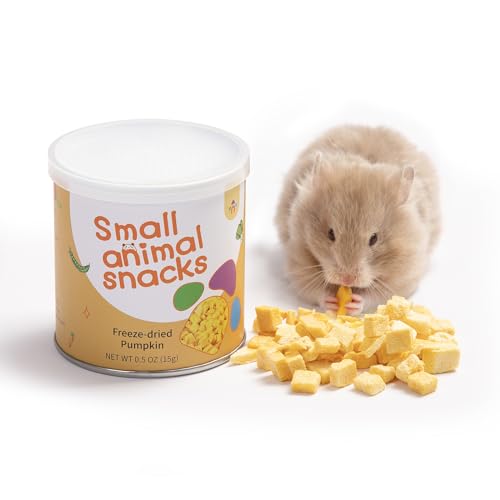
5. Niteangel Freeze-Dried Pumpkin, 0.5 oz
- Brand: Niteangel
- Form: Freeze-dried pumpkin pieces
- Net weight: 0.5 oz (15 g)
- Added sugar: None
The plain vegetable pick, and the easiest recommendation on this page for a dwarf. The bag contains freeze-dried pumpkin pieces and nothing else — no sugar, no oil, no glaze — so the flavor doing the persuading is the pumpkin itself, with fiber as a genuine nutritional contribution rather than a label decoration. Pieces can be offered by hand during taming, scattered through bedding, or crumbled over the staple mix as a forage topper. At 0.5 oz (15 g) the bag is light for the same reason the tofu bag is: freeze-drying removes water, not servings. For owners of Campbell’s, winter white or Chinese hamsters who want a treat with no rationing anxiety at all, this is the shelf to start from.
Comparison Table
| Treat | Form | Added Sugar | Best For |
|---|---|---|---|
| Vitakraft Crunch Sticks Apple & Honey | Baked stick on a wood core | Yes — honey glaze | Gnawing work, Syrian hamsters |
| Kaytee Healthy Bits | Crunchy baked bits | Yes — honey in the recipe | Hand-feeding and taming sessions |
| Vitakraft Nibble Rings | Baked forage rings | None | Scattering and digging enrichment |
| Niteangel Freeze-Dried Tofu | Freeze-dried cubes, 5 mm | None | Protein variety, small mouths |
| Niteangel Freeze-Dried Pumpkin | Freeze-dried pieces | None | Diabetes-prone dwarf species |
FAQ
How many treats can a hamster have each week?
Fewer than most bags imply. One or two small pieces, a few times a week, is a sound budget for a Syrian, and dwarfs should get fewer pieces of plainer treats. Treats are a taming and training allowance measured in pieces per week, not a second food bowl, and pieces handed over during handling sessions count toward the same total. Pieces the hamster pouches count too: a buried treat is a treat served, just eaten later and out of sight.
Are yogurt drops safe for hamsters?
As an occasional piece for a healthy Syrian, they are a small indulgence rather than a hazard. As a habit, they are the weakest choice on the treat shelf: the classic drop recipes lead with sugar, the yogurt content is modest, and the format invites handful feeding. For Campbell’s, winter white and Chinese dwarfs — the species prone to diabetes — drops are best skipped altogether in favor of plain vegetable pieces and unsweetened forage treats, where the sugar question never comes up.
What treats suit a diabetes-prone dwarf hamster?
Plain ones. Freeze-dried vegetables such as the pumpkin above, unsweetened forage rings, and tiny protein pieces like the tofu cubes keep treats inside a dwarf’s narrower margin. Skip honey-glazed sticks as a fixture, drops of any flavor, and mixes sweetened with fruit sugars or syrups. The deciding check is the ingredient list: if a sweetener of any name appears, the treat belongs to a Syrian’s occasional list, not a dwarf’s regular one.
Why does my hamster pouch treats instead of eating them?
Because pouching is what a hamster is for. Cheek pouches are transport, and a carried treat is being moved to a hoard, not refused and not yet eaten. That has two practical consequences: the piece still counts against the weekly treat budget, and buried soft or sweet pieces can spoil where they sit. Check the nest and burrow corners during cleaning, remove old stashed treats, and if the hoard keeps growing, the offerings are larger than the appetite — serve less, and let the pantry shrink.
Conclusion
Hamster treats earn their place as tools: a reason for a shy animal to approach a hand, a reward that marks a step in taming, a few minutes of honest foraging in the bedding. They fail at that job when they become a sugar habit, which is why the deciding spec on this page is the sweetener line of the ingredient list. The Crunch Sticks give a Syrian gnawing work with its sugar in the open, Healthy Bits portion taming rewards one bit at a time, Nibble Rings scatter with no added sugar at all, and the two Niteangel freeze-dried picks cover protein and plain vegetable variety for the dwarfs who need the strictest shelf. Count the pieces per week, check the hoard, and the treats stay what they should be.