Our Short List of 3

- Material: resin
- Pack count: 2 bowls
- Dimensions: 4.33 x 3.3 x 0.55 in (maker figures)
- Capacity: 15 g (maker figure)

- Material: ceramic
- Pack count: 6 bowls
- Dimensions: 2.7 x 2.7 x 0.8 in each (maker figures)
- Edge profile: curved, smooth finish
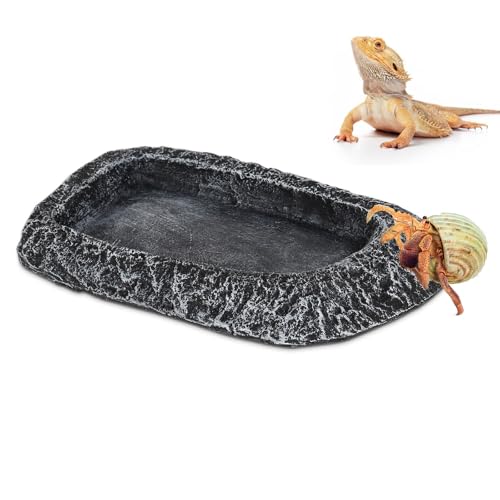
- Material: resin-style terrarium bowl (maker listing)
- Shape: corner rock
- Dimensions: 6.8 x 4.2 x 0.59 in (maker figures)
- Model: HZ010
All 5 Picks at a Glance
| Product | Specs | Action |
|---|---|---|
| 1. CATDABIR 2-Pack Shallow Reptile Food Bowls |
| Check price on Amazon |
| 2. Tfwadmx 6-Pack Mini Ceramic Food Bowls |
| Check price on Amazon |
| 3. Hygger Zoo Corner Rock Feeding Bowl (HZ010) |
| Check price on Amazon |
 4. Neeenn 3-Pack Reptile Food Dish |
| Check price on Amazon |
 5. NestChroix Hermit Crab Food Bowl with Grid |
| Check price on Amazon |
📅 Last updated:
Disclosure: As an Amazon Associate, I earn from qualifying purchases.
This guide is about food dishes only: the shallow dishes that hold dry food in a land hermit crab tank. Water is a different problem with different rules. A pool has to be deep enough for a crab to submerge and climb back out, and that topic has its own guide. A food dish has the opposite job. It should be shallow, stable, and easy to pull out of the tank every day.
That daily removal matters because of how hermit crabs eat. A crab does not sit politely at a bowl and finish a meal. It tears off pieces, drags food across the substrate, and buries leftovers in the bedding, where they mold in the warm, humid air. A dish does not stop a crab from being a crab, but it slows the scatter and gives you one defined place to clear each morning. The dish is a containment tool and a cleanup tool. Presentation has nothing to do with it.
With that job in mind, the buying rules are simple. Shallow beats deep, because even a small crab has to climb in and out without a ramp problem. Weight beats decoration, because a light dish gets flipped, dragged, and repurposed as a hide. A smooth, non-porous surface beats a textured one, because residue in pits and grooves molds fast at crabitat humidity, and a dish that cannot be scrubbed clean in seconds is the wrong dish. Every dimension and capacity figure below is a maker figure, so measure your tank and your largest crab before ordering.
📋 Table of Contents
How to Choose a Hermit Crab Food Dish
Start with depth, and keep it low. A food dish is not a pool. Dry staple mix, dried protein, and fresh offerings should sit in a dish whose wall a small crab can step over easily. Walls around half an inch to just under an inch suit most pet crabs. Deep bowls sold for soaking or for larger lizards force small crabs to haul themselves over a rim, and some simply feed less from them. If a dish needs a ramp for food, it is the wrong dish.
Weigh the dish against your diggers. Hermit crabs excavate. They tunnel under decor, bulldoze the substrate, and test anything light enough to move. A featherweight plastic dish will be tipped, emptied, and occasionally slept under. Heavier resin and ceramic dishes resist that treatment, and any dish stays put longer with its base pressed into the substrate so the bedding braces the edges. Treat any tip-proof claim as a helper, not a guarantee, and plan to seat the dish into the substrate either way.
Material decides the cleaning routine. A crabitat runs warm and humid, which is exactly the environment mold wants, and residue smeared into a porous or textured surface can fuzz over between one feeding and the next. Glazed ceramic and smooth resin scrub clean fastest. Wash daily with hot water and a brush, and dry the dish before it goes back in. Sets with two or more dishes earn their keep here: one in the tank, one drying, no excuse to skip a day.
Match the footprint to the colony, not the photo. One medium dish works for a pair of small crabs. A group of larger crabs crowds a single dish, and dominant crabs can guard it. Several small dishes spread around the tank feed more crabs with less conflict and separate the offerings: dry mix in one, protein in another, fresh produce in a third. Small dishes also portion better, and uneaten fresh food should come out within a day anyway.
Place the dish on the quiet side of the tank. Keep food away from the water pools so dragged sand and crumbs stay out of the water, and set the dish on a flattened patch of substrate so it sits level. A dish found dragged against the glass or buried to the rim each morning is telling you it is too light for your crabs.
The 5 Best Hermit Crab Food Dishes
See also: Best Automatic Transmission Floor Shifter: Ratchet, Gated and Detent Shifters Compared • Best Automatic Floor Shifter for Truck: Tall, Tough Picks for Pickups and Bench Seats
1. CATDABIR 2-Pack Shallow Reptile Food Bowls
- Material: resin
- Pack count: 2 bowls
- Dimensions: 4.33 x 3.3 x 0.55 in (maker figures)
- Capacity: 15 g (maker figure)
The CATDABIR pair is the most straightforward answer to the daily-feeding problem: two identical shallow resin bowls sized for small animals. Each bowl measures 4.33 by 3.3 by 0.55 inches by maker figures, so the wall is low enough for small crabs to step over, and the rock-styled black finish disappears into most substrate blends. The maker lists a capacity of 15 grams, which suits a measured serving of dry staple mix for a small colony without piling food deep enough that the bottom layer stales.
The two-pack format is the real feature. One bowl serves while the other is at the sink, and the rotation makes the daily scrub a habit. The resin has enough heft to stay where it is seated, especially pressed into the substrate, and the smooth interior wipes clean without grooves for residue to hide in. For a first food dish, this is the sensible default.
2. Tfwadmx 6-Pack Mini Ceramic Food Bowls
- Material: ceramic
- Pack count: 6 bowls
- Dimensions: 2.7 x 2.7 x 0.8 in each (maker figures)
- Edge profile: curved, smooth finish
The Tfwadmx bowls take the opposite approach: instead of one or two dishes, you get six small ceramic ones, each 2.7 by 2.7 by 0.8 inches by maker figures. The count lets you run several feeding stations around a larger tank, separate the dry mix from protein and fresh items, and hold clean spares for the rotation. Small dishes also enforce small portions, and a small portion eaten beats a large portion buried.
Ceramic is the other half of the appeal. Glazed ceramic is dense for its size, so these minis stay put better than plastic dishes of the same footprint, and the glazed surface scrubs clean quickly, giving mold little to grip. The trade-off is the obvious one: ceramic chips if dropped on a hard floor, so handle the set at the sink rather than over tile. For keepers of small and medium crabs who like the multi-station setup, this is the strongest format in the roundup.
3. Hygger Zoo Corner Rock Feeding Bowl (HZ010)
- Material: resin-style terrarium bowl (maker listing)
- Shape: corner rock
- Dimensions: 6.8 x 4.2 x 0.59 in (maker figures)
- Model: HZ010
Corners are dead space in most crabitats, and this Hygger Zoo dish is shaped to use one. The corner rock design pushes the feeding station against two walls of the tank, out of the main digging lanes, and its listed dimensions of 6.8 by 4.2 by 0.59 inches (maker figures) give it the widest feeding surface in this roundup at one of the lowest profiles. That suits bigger crabs and small groups that feed side by side, where the minis above would crowd.
The low wall matters as much as the footprint. At roughly half an inch of depth by the maker’s own sizing, even a modest crab steps in and out without a climb, and the feeding surface stays smooth enough to scrub. Seated into the substrate, the corner placement and wide base make it one of the harder dishes for a crab to shift. If your tank has one obvious feeding corner, this is the dish built for it.
4. Neeenn 3-Pack Reptile Food Dish
- Material: resin
- Pack count: 3 dishes
- Capacity: 30 cubic centimeters (maker figure)
- Model: HSJJXWSW003
The Neeenn set is a three-piece resin kit, and its value is rotation depth. With three matching dishes you can run one in the tank, keep one drying after its wash, and hold one true spare for the day a dish gets buried beyond finding. The maker lists a capacity of 30 cubic centimeters, a modest serving that fits the small-and-often pattern hermit crabs do best on.
Two honest notes. First, the maker lists these as hand wash only, so they join the sink routine rather than a dishwasher load; that is normal for resin terrarium pieces and no burden at this size. Second, resin dishes of this kind are light enough that placement does the anti-tip work: press the base into the substrate and let the bedding brace it. As a simple way to build the wash rotation for a mid-size tank, the three-pack format is hard to argue with.
5. NestChroix Hermit Crab Food Bowl with Grid
- Material: plastic
- Design: grid insert bowl
- Length: 7.87 in (maker figure)
- Model: N04
The NestChroix bowl is the specialist in this roundup. It is a plastic food bowl with a grid insert, listed by the maker at 7.87 inches long, and the grid changes how the dish interacts with the crabs. Food sits on and between the grid bars instead of in an open pan, which slows the classic move of a crab sitting in its dinner and shoveling the rest into the substrate. The maker positions the wide base as less prone to tipping, and the larger footprint suits colonies and bigger crabs.
The honest caveat is material. This is a plastic bowl, and plastic is light. The grid and the wide base help, but a determined digger can still shift a plastic dish that a resin or ceramic dish would shrug off, so bury the rim in the substrate and check its position at the morning cleanup. In exchange you get the largest feeding area here and a design aimed squarely at hermit crabs rather than adapted from general reptile gear.
Comparison Table
| Dish | Material | Pack | Size (maker figures) | Best for |
|---|---|---|---|---|
| CATDABIR Shallow Bowls | Resin | 2 | 4.33 x 3.3 x 0.55 in | Everyday dry food with a wash rotation |
| Tfwadmx Mini Bowls | Ceramic | 6 | 2.7 x 2.7 x 0.8 in | Multiple stations and small portions |
| Hygger Zoo Corner Bowl | Resin-style | 1 | 6.8 x 4.2 x 0.59 in | Corner placement, larger crabs |
| Neeenn Food Dish | Resin | 3 | 30 cc capacity | Rotation depth on a simple setup |
| NestChroix Grid Bowl | Plastic | 1 | 7.87 in long | Colonies, cutting down scatter |
FAQ
Why not just scatter food on the substrate?
Because buried food is the main mold source in a humid tank. Hermit crabs drag and bury leftovers by instinct, and food hidden in warm, damp substrate spoils where you cannot see it. A dish keeps the serving in one place you can clear each morning. Scattering dry items works as occasional enrichment, but the daily staple belongs in a dish.
How deep should a hermit crab food dish be?
Shallow enough that your smallest crab steps over the wall without climbing. For most pet crabs that means a wall around half an inch to just under an inch, which is where every dish in this roundup sits. Depth is for water pools, where a crab needs to submerge. A dish a crab has to scale is a dish it may stop using.
How often should a hermit crab food dish be washed?
Daily, when you remove uneaten food. Crabitat humidity grows mold on residue quickly, and a dish that goes back in dirty seeds the next serving. Hot water and a brush handle most residue, and a multi-dish rotation means a clean, dry dish is always ready.
Can fresh food and dry food share one dish?
They can, but separate dishes work better. Fresh produce and protein spoil within a day in the humidity and foul any dry mix they touch, while dry staple food can stay down longer. One dish for each keeps both on their own removal schedule.
Conclusion
A hermit crab food dish has an unglamorous job: hold dry food in one place, survive being dug around, and come out of the tank every day for a scrub. Judged on that job, the CATDABIR pair is the easy default, the Tfwadmx ceramic minis suit multi-station feeding and strict portions, the Hygger Zoo corner bowl claims the dead space in bigger tanks, the Neeenn three-pack builds the deepest wash rotation, and the NestChroix grid bowl takes on scatter in colony setups. Pick the format that matches your crabs and your sink habits, seat it into the substrate, and keep the rotation going.