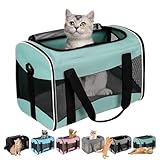
- Top Pick: Henkelion Cat Carriers Dog Carrier Pet Carrier For Small / Medium Cats Dogs Puppies (Up To 15lbs), TSA Airline Approved Small Dog Carrier Soft Sided, Collapsible Waterproof Travel Puppy Carrier – Grey
- Best Value: Henkelion Cat Carriers Dog Carrier Pet Carrier for Small / Medium Cats Dogs Puppies (Up To 15lbs), TSA Airline Approved Small Dog Carrier Soft Sided, Collapsible Waterproof Travel Puppy Carrier -Black
- Premium Choice: Cat Dog Carriers Soft-Sided Pet Carrier Large Cats for Medium Big Cat Small Dog Puppy up to 16lbs TSA Airline Approved Animal Collapsible Cat Carrier Carriers Travel Carrier Cat Bag (17x11x11)
📅 Last updated:
Buying a pet carrier for a flight is not the same as buying one for a car ride or a trip to the veterinarian. The most common mistake is choosing a bag by its advertised weight limit, then discovering that the carrier is too tall for the airline’s under-seat space. Another is treating “TSA approved” as a universal airline certification. Airlines set their own cabin dimensions, pet fees, and acceptance rules, and some aircraft have tighter spaces than others.
Shoppers also overlook structure. A soft carrier that folds flat for storage may sag around a pet, block ventilation, or collapse when placed beneath a seat. Others focus on the lowest price and miss practical details such as a washable liner, locking zippers, a luggage sleeve, or a shoulder strap that becomes uncomfortable after 20 minutes. This carrier buying guide for airline travel focuses on the specifications that matter before you pay, with realistic price ranges and check points for 2026 travel.
As an Amazon Associate we earn from qualifying purchases at no extra cost to you.



📋 Table of Contents
- Decide These 3 Things First
- Size: Fit the Airline Space and Your Pet
- Material: Balance Weight, Ventilation, and Cleanup
- Construction: Prevent Escapes and Sagging
- Comfort and In-Flight Performance
- Price Tiers: Know What Your Money Buys
- Warranty and Returns
- Delivery and Assembly
- Spec Checklist
- Red Flags
- FAQ
Decide These 3 Things First
- Will your pet travel in the cabin? This guide is primarily for cats and small dogs traveling under the seat. Larger pets generally require a different airline-approved transport arrangement.
- What are your airline and aircraft limits? Confirm the maximum exterior dimensions, combined pet-and-carrier weight allowance, pet fee, and whether your route permits animals in the cabin. Do this after booking, and check again before departure.
- What is your pet’s real size and behavior? Measure the pet while standing, from nose to the base of the tail, and from the floor to the top of the head or ears. A nervous chewer needs sturdier construction than a calm cat that sleeps through a flight.
Size: Fit the Airline Space and Your Pet
See also: How to Remove Litter Box Odor Buildup (2026): Step-by-Step • How to Fix a Jammed Automatic Feeder (2026): Step-by-Step
Size is the decisive factor. Measure the carrier’s exterior length, width, and height, including wheels, handles, and protruding pockets. Many under-seat carriers fall near 16–18 inches long, 10–12 inches wide, and 9–11 inches high, but there is no universal standard. Some airlines publish a maximum height closer to 8–10 inches.
Your pet should be able to stand, turn around, and lie down in a natural position. A carrier that is barely large enough may technically fit under the seat but leave the animal cramped for a multi-hour journey. As a practical starting point, add approximately 2–4 inches to your pet’s body length for carrier length, while keeping the carrier within the airline’s limits. The pet and carrier together may also need to stay below 15–20 pounds, depending on the airline.
Do not rely on labels such as “small,” “medium,” or “TSA airline approved.” For example, several Henkelion soft carriers are marketed for pets up to 15 pounds, while another 17-by-11-by-11-inch soft carrier lists a 16-pound capacity. Those numbers describe the product’s intended load, not a guarantee that the carrier fits every aircraft or that every pet of that weight will be comfortable.
Material: Balance Weight, Ventilation, and Cleanup
Most cabin carriers use polyester, nylon, mesh, or a combination of these materials. Polyester is common in budget bags because it is lightweight and affordable; nylon generally offers a tougher feel and better abrasion resistance. Neither material alone tells you how durable the carrier will be. Look for dense fabric, reinforced seams, and mesh panels attached with secure stitching rather than thin edging.
Ventilation should cover at least two sides, and preferably three or four, without turning the bag into an exposed mesh box. Mesh openings should be large enough for airflow but small enough to prevent claws from becoming caught. A waterproof or water-resistant exterior helps with accidents and airport floors, but it does not make the carrier leakproof.
A removable, machine-washable pad is more useful than a permanently sewn-in cushion. A base with a rigid or semi-rigid insert should resist bending when lifted. Check the stated empty weight: a soft carrier weighing about 2–4 pounds leaves more of a typical 15–20-pound combined allowance available for the pet than a wheeled model weighing 6–9 pounds.
Construction: Prevent Escapes and Sagging
Construction determines whether a carrier remains usable after repeated handling. A supportive frame around the top and sides helps maintain headroom, while a reinforced bottom prevents the floor from bowing under the pet’s weight. If the sides collapse when you pick up the empty carrier, they may also fold inward around an animal.
Inspect the zipper path before purchase. Two-way zippers that meet at the top can accept a small lock or clip, but the closure should not be so tight that it separates under pressure. Internal tether straps are useful for attaching to a harness, not a collar; never rely on a tether as a substitute for a secure door or zipper.
Useful construction features include a luggage sleeve, seat-belt loops for ground transportation, a removable shoulder strap, and a top opening for gentle access. Wheels can reduce carrying effort but add weight, bulk, noise, and another part that may not fit beneath a seat. For most cabin trips, a stable soft-sided carrier with a firm base is simpler than a rolling model.
Comfort and In-Flight Performance
Comfort comes from more than padding. The carrier should allow air to circulate while giving your pet a partially covered area for security. A privacy flap can help some animals settle, but it should roll up and secure neatly so it does not block ventilation.
Use a washable pad about 0.5–1 inch thick, leaving enough interior clearance for the pet to turn around. Avoid adding a thick bed that reduces the usable height by several inches. Pack an absorbent liner, waste bags, a small towel, and a familiar item that does not shed excessively or obstruct airflow.
Practice at home at least 1–2 weeks before the flight. Start with the carrier open, then try short closed-door sessions of 10–15 minutes and gradually increase the duration. Carry it through a terminal-like environment if possible. Do not sedate a pet for air travel unless a veterinarian specifically advises it; many animals need monitoring rather than medication.
Price Tiers: Know What Your Money Buys
Budget soft carriers typically cost about $20–$35. They may include mesh panels, a washable mat, a shoulder strap, and collapsible sides. The sample Henkelion carriers listed around $23.48 and $27.99 fall into this tier. They can be suitable for occasional travel when the dimensions match the airline, but inspect the base, zipper, and frame carefully.
Value midrange carriers generally cost $35–$75. This tier often adds denser fabric, better edge reinforcement, a more stable base, and improved hardware. The Sherpa Delta Airlines Travel Pet Carrier listed at $49.99 is an example of a product positioned in this range. Airline-specific claims still require verification against your itinerary.
Premium soft carriers commonly cost $75–$150 or more. You are paying for stronger framing, smoother hardware, better padding, replaceable parts, improved organization, and sometimes wheels. A higher price does not override an airline’s size limit. If the carrier is too tall, an inexpensive compliant bag is a better choice than an expensive oversized one.
Warranty and Returns
Check the warranty length, what it covers, and whether the seller or manufacturer handles claims. A one-year limited warranty is common; coverage may exclude normal fabric wear, chewing, stains, or damage caused by airline handling. Keep the receipt and photograph the carrier before its first trip.
Returns matter because fit cannot be confirmed from a product title. Look for a return window of at least 30 days, and check whether the carrier must be unused, free of pet hair, and in its original packaging. Test the dimensions and zipper at home before letting your pet sleep in it. Also confirm whether return shipping is deducted from your refund.
Delivery and Assembly
Most soft carriers arrive ready to use, but collapsible models may need 5–15 minutes to fully expand. Allow the frame to settle, insert the base, and make sure every support rod or stiffener is seated correctly. A carrier that arrives crushed may need several hours to regain its shape.
Order at least 7–10 days before a domestic flight when possible. That leaves time to inspect the product, exchange an incorrect size, and practice with your pet. If your departure is soon, prioritize in-stock delivery with a clearly stated arrival date rather than a lower price with uncertain fulfillment.
Spec Checklist
| Spec | Budget | Mid | Premium |
|---|---|---|---|
| Typical price | $20–$35 | $35–$75 | $75–$150+ |
| Typical exterior size | 16–18 x 10–12 x 9–11 in. | 16–19 x 10–12 x 9–11 in. | Airline-specific; often 16–20 x 10–12 x 9–12 in. |
| Pet capacity | Up to 15–16 lb. | Up to 16–20 lb. | Usually 15–25 lb.; verify airline limit |
| Empty carrier weight | 2–4 lb. | 3–6 lb. | 5–9 lb. |
| Base | Removable pad; may flex | Firm insert with washable cover | Reinforced or semi-rigid, often replaceable |
| Useful extras | Mesh windows and shoulder strap | Luggage sleeve, tether, privacy flap | Premium hardware, wheels, replacement parts |
Red Flags
- The listing gives only a pet weight limit and no exterior dimensions.
- “Airline approved” appears without naming a standard, airline, or actual measurements.
- The height changes when the carrier is placed on its side or under pressure.
- The base has no support and sags noticeably when lifted.
- Mesh is limited to one small panel, creating questionable ventilation.
- Zippers open easily with one hand or lack a way to prevent accidental opening.
- Reviews repeatedly mention broken handles, ripped mesh, strong chemical odors, or inaccurate sizing.
- The seller provides no clear return policy or delivery estimate.
FAQ
What size carrier is best for airline travel?
The best size is the largest carrier your airline and aircraft permit while still allowing your pet to stand, turn, and lie down. Common dimensions are around 16–18 inches long, 10–12 inches wide, and 9–11 inches high, but verify the exact limit for your flight.
Are soft-sided carriers better than hard-sided carriers for the cabin?
Usually, yes, because soft carriers can fit more easily beneath a seat and compress slightly around the available space. They must still have a stable base, secure closures, and adequate ventilation. A hard carrier may be preferable for a pet that chews fabric, but it can be harder to fit in a cabin.
Can I use a carrier rated for a 15-pound pet if my pet weighs 15 pounds?
Not automatically. Weight is only one measurement. Compare your pet’s body length and standing height with the carrier’s interior dimensions, then account for the pad. Also include the carrier’s empty weight when checking the airline’s combined pet-and-carrier limit.
When should I buy and test the carrier?
Buy it at least 7–10 days before departure, or earlier for an international trip. Confirm the measurements, inspect the seams and zippers, and practice gradually. Your pet should have enough time to treat the carrier as a familiar resting space rather than a surprise on travel day.
Ready to decide? Our #1 pick for 2026 is the Typical price.
Live price & availability on Amazon.