- Top Pick: Amazon Basics Gravity Pet Food Feeder for Dogs and Cats, Easy to Clean, Easy to Fill, Removable Lid, 152fl.oz Capacity, Small
- Best Value: Wefeedy Automatic Cat Feeder and Water Dispenser in Set with Pet Food Bowl,Gravity Dog Waterer and Food Feeder for Small Medium Dog Cat Puppy Kitten Large Capacity(3.3L,Black)
- Premium Choice: ANDOLL HOME Automatic Cat Feeder, 4L Cat Food Dispenser with 10s Voice Recorder, Pet Feeder up to 8 Meals per Day, Timed Dog Feeder with Dry Food Sealed Ring
📅 Last updated:
Choosing between a gravity feeder and an automatic feeder is less about finding the most sophisticated product and more about matching the feeder to your home, schedule, and pet’s eating habits. A gravity feeder keeps a reservoir full as food is consumed. An automatic feeder releases measured portions on a timer.
The real decision is whether your pet needs constant access to food or controlled access to specific portions at specific times. That distinction affects overeating, daily routines, travel flexibility, cleanup, counter space, and long-term cost. For a healthy pet who self-regulates and has a predictable household schedule, a gravity feeder may be all you need. For a fast eater, a pet on a diet, or a household that is empty during mealtimes, an automatic feeder is usually the more useful choice.
As an Amazon Associate we earn from qualifying purchases at no extra cost to you.


📋 Table of Contents
Quick Verdict
Choose a gravity feeder if you want the lowest upfront cost, simple operation, no batteries or outlet, and an easy way to keep dry food available. It is particularly practical for cats and dogs that graze throughout the day and do not overeat.
Choose an automatic feeder if portion control, scheduled meals, or reliable feeding during workdays matters more than simplicity. Automatic models are also better for pets that wake owners early, eat too quickly, or need several small meals.
Neither style is automatically healthier. A gravity feeder can encourage overeating because food is continuously available, while an automatic feeder requires programming and regular cleaning. The right option depends on the animal as much as the room.
Side by Side
See also: How to Remove Litter Box Odor Buildup (2026): Step-by-Step • How to Fix a Jammed Automatic Feeder (2026): Step-by-Step
| Consideration | Gravity Feeder | Automatic Feeder |
|---|---|---|
| Comfort | Easy access and no operating noise; best for grazers | Predictable meals; some units make a motor or dispensing sound |
| Durability | Fewer moving parts, so there is less to malfunction | More components to maintain, including a motor, timer, and dispenser |
| Price range | About $10–$30 for basic household models | About $25–$80 for common dry-food models |
| Maintenance | Wash the bowl and reservoir; check for stale food | Clean the bowl, chute, reservoir, and occasionally the dispensing mechanism |
| Space needed | Typically about 8–12 inches wide and 10–15 inches tall | Typically about 8–12 inches wide and 10–16 inches tall, plus cord or battery access |
| Look | Simple plastic design that blends into utility areas | More appliance-like, with buttons, a display, or a visible lid |
| Resale | Limited resale value, but simple models are easy to give away | Better appeal if clean, working, and supplied with the original accessories |
| Best for | Self-regulating pets, multiple pets sharing food, and budget buyers | Portion control, timed meals, busy owners, and early-morning feeding |
Where Gravity Feeder Wins
The main advantage of a gravity feeder is simplicity. Fill the reservoir, place the bowl in a stable location, and the food moves down as your pet eats. There is no programming, Wi-Fi connection, motor, or electrical cord to troubleshoot. That makes it useful in kitchens, laundry rooms, garages, and other places where an outlet is inconvenient.
Gravity feeders are also inexpensive. A basic unit commonly costs $10 to $30. For example, the Amazon Basics Gravity Pet Food Feeder listed at $12.25 offers a 152-fluid-ounce capacity, a removable lid, and a simple fill-and-clean format. Capacity specifications are not directly equivalent to pounds of kibble, because kibble size and shape vary, but that size is intended to reduce frequent refilling for a small dog or cat.
With fewer moving parts, a gravity feeder can remain usable for years if the plastic does not crack and the bowl is cleaned regularly. It can also be a practical backup even if your primary feeder is automatic. During a power outage, a gravity unit continues working without batteries or electricity.
The drawback is that it does not measure servings. Food may continue dropping into the bowl whenever space becomes available. That can lead to overeating, weight gain, food guarding, or stale kibble in homes where pets eat slowly. It is also less suitable when two pets have different diets or when one animal pushes another away from the bowl.
Where Automatic Feeder Wins
An automatic feeder earns its higher price through control. Depending on the model, you can schedule several meals per day and select a portion size for each release. That is helpful for pets that need smaller meals, owners who work long shifts, and households trying to prevent begging at dawn.
Many dry-food models hold approximately 3 to 5 liters, although actual food capacity varies by kibble. The ANDOLL HOME Automatic Cat Feeder, priced at $29.99, is a 4-liter model with a 10-second voice recorder and settings for up to eight meals per day. A recorded message can help a pet associate the feeding sound with mealtime, but it is not a substitute for checking that food is dispensing correctly.
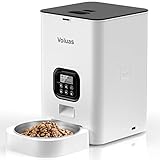
The VOLUAS Automatic Cat Feeder is another 4-liter timed dry-food format, listed at $41.79. A product such as the Wefeedy automatic cat feeder and water dispenser set, listed at $16.98, combines feeding and watering equipment in one purchase. These examples show the broad price range: entry-level automatic options may cost less than $20, while more feature-heavy or larger models often cost $40 to $80.
Automatic feeders are not maintenance-free. The bowl should generally be washed every few days, while the hopper and chute need periodic cleaning to remove oil and crumbs. Do not assume every electronic unit is dishwasher-safe. Follow the manufacturer’s instructions, and keep the feeder on a level surface so portions are released consistently.
Power is another consideration. Plug-in models commonly use a small adapter in the approximate 2- to 5-watt range, while some also accept batteries as a backup. Battery life depends on the schedule and design. A battery backup is valuable, but you should still test it before relying on the feeder during travel.
Cost Over 5 Years
Over five years, the purchase price is only part of the calculation. A basic gravity feeder costing $12 to $30 may need little beyond replacement bowls or a new reservoir if the plastic becomes scratched or damaged. Allow roughly $15 to $50 over five years for replacement parts or a second unit, putting a reasonable total at about $27 to $80.
An automatic feeder costing $25 to $80 may require batteries, replacement power components, or a new bowl. If batteries cost about $8 to $20 per year, that adds $40 to $100 over five years. A reasonable ownership range is therefore about $65 to $180, not including electricity, food, or repairs.
These estimates assume ordinary household use and do not represent a guaranteed service life. A gravity feeder may last longer because it has fewer components, while an automatic feeder may justify its price by preventing overfeeding or reducing the need for paid drop-in visits. If scheduled feeding solves a daily problem, the extra cost may be worthwhile.
Which One for Your Home
Small apartment
Choose based on your pet’s eating behavior and available floor space. A gravity feeder is usually the best budget choice for a cat that grazes and can maintain a healthy weight. Its quiet operation and lack of cord make it easy to place in a kitchen corner.
Choose an automatic feeder if you need measured portions or want to keep feeding away from a shared living area. Look for a stable footprint, a narrow hopper, and a bowl that does not project far into a walkway. Measure the intended spot before buying; a feeder that is only a few inches wider can be awkward in a compact apartment.
Family with kids or multiple pets
A gravity feeder is convenient when several pets eat the same dry food, but it can be emptied quickly by the hungriest animal. Children may also knock over a lightweight reservoir. Select a heavier base or place the feeder against a wall.
An automatic feeder is better when one pet needs controlled portions or when meals must occur at predictable times. However, one standard feeder does not automatically solve competition between animals. You may need separate stations, microchip access, or supervision.
Rental
Both styles work well in rentals because they do not require installation. A gravity feeder has the lowest risk of damage and does not need an outlet. An automatic feeder is still renter-friendly, but keep cords secured and avoid placing the unit where a pet can pull it from a counter.
Long-term home
In a long-term home, choose for routine rather than portability. A gravity feeder is a dependable supplement or backup, especially during outages. An automatic feeder is the stronger primary option if your pet benefits from portion control or you expect work schedules, travel, or household routines to change.
FAQ
Is a gravity feeder better than an automatic feeder for cats?
It is better for cats that naturally nibble and maintain a healthy weight. An automatic feeder is better for cats that overeat, wake the household for food, or need meals divided into measured portions.
Can a gravity feeder help prevent overeating?
Not by itself. Because food remains available, a gravity feeder can make overeating easier. You can fill it with a measured daily amount, but that still requires monitoring and refilling rather than unlimited access.
Do automatic feeders work with wet food?
Some specialized models are designed for wet food and may include removable trays or cooling features. Most affordable automatic feeders, including the common 3- to 5-liter hopper style, are intended for dry kibble only. Confirm compatibility before using wet food.
Should I keep both types of feeder?
Keeping both can be practical. Use the automatic feeder for normal scheduled meals and the gravity feeder as an emergency backup or temporary solution. Do not leave both filled without a plan, since your pet could eat from both and exceed its daily portion.
Ready to decide? Our #1 pick for 2026 is the Comfort.
Live price & availability on Amazon.