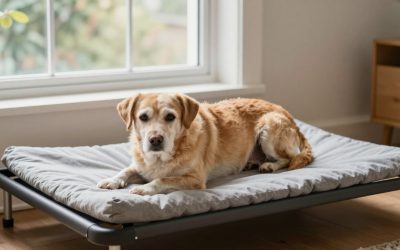
- Top Pick: EHEYCIGA Orthopedic Extra Large Dog Bed, Waterproof Washable XL Pet Bed 44"
- Best Value: EHEYCIGA Orthopedic Dog Beds Large Sized Dog, Waterproof Memory Foam Pet Bed with Sides, Non-Slip Bottom Large Pet Bed with Washable Removable Cover, Grey
- Premium Choice: Bedsure Orthopedic Dog Beds Large Sized Dog Washable Original Design
📅 Last updated:
📋 Table of Contents
The Short Answer
The right orthopedic bed should let your dog lie fully on their side without their head, hips, or legs hanging over the edge. To find the correct size, measure your dog from nose to the base of the tail, then measure from the top of the head or shoulders to the floor when they are standing. Add 6 to 12 inches to the length and 4 to 8 inches to the width, depending on how much your dog stretches out.
For example, a dog measuring 30 inches from nose to tail base usually needs a bed with an interior sleeping area at least 36 to 42 inches long. If your dog curls up, sleeps in a crate, or prefers bolsters, you may be able to choose a smaller overall bed. If your dog is elderly, stiff, overweight, or recovering from surgery, prioritize a generous sleeping surface and a low, easy-entry front.
As an Amazon Associate we earn from qualifying purchases at no extra cost to you.


Orthopedic beds vary widely in how their dimensions are listed. A product described as a “44-inch bed” may measure 44 inches from outside edge to outside edge, while its usable interior may be several inches smaller because of thick bolsters. Always check both the exterior dimensions and the sleeping area before buying. In this 2026 guide, measurements are shown in inches and centimeters to make comparison easier.
Standard Sizes
See also: 7 Best Refillable Frozen Dog Treat Toys for Long-Lasting Licks • Best Dog Door Mat for Muddy Paws: Sizing, Materials and Picks by Entryway
These categories are useful starting points, but your dog’s measurements and sleeping style matter more than breed labels. For dogs between sizes, choose the larger bed unless the bed must fit a specific crate, kennel, or furniture space.
| Bed size | Typical exterior dimensions | Approximate sleeping area | Best for |
|---|---|---|---|
| Small | 24 x 18 in (61 x 46 cm) | 18 x 12 in (46 x 30 cm) | Toy breeds and small dogs up to about 15 lb (7 kg) |
| Medium | 28 x 22 in (71 x 56 cm) | 22 x 16 in (56 x 41 cm) | Dogs about 15 to 35 lb (7 to 16 kg) |
| Large | 36 x 27 in (91 x 69 cm) | 30 x 21 in (76 x 53 cm) | Dogs about 35 to 60 lb (16 to 27 kg) |
| Extra large | 44 x 32 in (112 x 81 cm) | 38 x 26 in (97 x 66 cm) | Dogs about 60 to 90 lb (27 to 41 kg) |
| Giant | 52 x 40 in (132 x 102 cm) | 46 x 34 in (117 x 86 cm) | Dogs over 90 lb (41 kg) or dogs that stretch out |
Weight ranges are only general guidelines. A long, slim 45-pound dog may need more surface area than a compact 55-pound dog. Similarly, a dog that sleeps curled up may prefer a round or oval bed, while a side sleeper needs a rectangular bed with enough length.
Larger dimensions, thicker foam, waterproof liners, and replacement covers can increase the price.
How to Measure Your Space
- Measure your dog while standing. Use a soft tape measure from the tip of the nose to the base of the tail. Do not include the tail unless your dog regularly sleeps with it extended.
- Measure the sleeping width. Measure across the widest part of your dog’s body, usually the shoulders, rib cage, or hips. Add at least 4 inches (10 cm) for a dog that curls up and 8 inches (20 cm) for a dog that sprawls.
- Observe the sleeping position. Watch your dog nap for several minutes. If they sleep on their side with legs extended, measure the longest position and add 6 inches (15 cm). If they curl tightly, use the curled-up measurement plus 4 to 6 inches.
- Account for bolsters. A 36-by-27-inch bed with 5-inch side bolsters may have only about 26 to 28 inches of usable width. Look for interior dimensions, not just the package size.
- Measure the available floor area. Mark the bed’s intended footprint with painter’s tape or newspaper. Leave at least 12 inches (30 cm) around the easiest entry side so your dog can approach without bumping into walls or furniture.
- Check the height. A thick mattress can make entry difficult for dogs with arthritis. A step-in front around 2 to 4 inches (5 to 10 cm) high is generally easier than a tall, enclosed edge.
- Confirm washable-cover dimensions. Removable covers may shrink slightly after washing. Check the care instructions and avoid a fit so tight that the cover is difficult to reinstall.
By Room or Use Case
Living room
For a living room, choose a bed that gives your dog a clear view of the family without blocking walkways. A rectangular large bed around 36 x 27 inches (91 x 69 cm) works for many medium-to-large dogs. Measure between coffee tables, sofas, and door openings before purchasing. If the bed will sit beside a sofa, a low bolster is easier for an older dog to enter and exit.
Bedroom
A bedroom bed can be more spacious if floor area allows. Extra-large beds around 44 x 32 inches (112 x 81 cm) are useful for large dogs, senior dogs that change position frequently, or two small dogs that share. Leave enough clearance to walk around the bed at night, and avoid placing it directly against a heater or under a drafty window.
Crate or kennel
For crate use, measure the crate’s interior rather than relying on the crate’s advertised exterior size. The bed should cover most of the floor without pressing tightly against the walls. A bed that is 1 to 2 inches smaller than the crate’s interior length and width can be easier to insert and remove. Avoid a thick mattress that reduces headroom or prevents the crate door from closing safely.
Senior or mobility-limited dogs
Choose a firm but cushioning mattress with a low step-in edge. The bed should be large enough for your dog to turn around without twisting their joints. A washable waterproof liner is especially useful for dogs with incontinence. Position the bed on a non-slip surface and keep it close to food, water, and the door to reduce unnecessary walking.
Travel and office use
For travel, measure the vehicle floor, cargo area, or office corner first. A foldable medium bed around 28 x 22 inches (71 x 56 cm) may suit a small or medium dog, while a large dog may need a foldable 36-inch bed. Look for handles, a lightweight insert, and a cover that can be washed separately. Do not sacrifice enough sleeping length simply to make the bed easier to carry.
Common Sizing Mistakes
- Choosing by breed alone: Individual dogs of the same breed can differ substantially in length, weight, and sleeping style.
- Using the outside measurement: Bolsters and raised edges reduce the interior space available for sleeping.
- Buying a bed that is too small for stretching: Dogs that sleep on their side need extra length for extended legs.
- Ignoring mattress compression: Soft or thin foam can flatten under a heavier dog, reducing support and usable thickness.
- Prioritizing thickness over entry: A very tall bed is not necessarily better for an arthritic dog. Easy access and stable support are more important.
- Forgetting shared use: Two dogs need enough room to lie side by side, not merely enough space to curl up individually.
- Skipping the return policy: Let your dog try the bed at home, especially when choosing between two sizes.
FAQ
What size orthopedic bed does a 50-pound dog need?
Many 50-pound dogs fit a large bed around 36 x 27 inches (91 x 69 cm), but a long-bodied or side-sleeping dog may need an extra-large bed around 44 x 32 inches (112 x 81 cm). Measure the dog from nose to tail base and compare that number with the bed’s interior length.
Should an orthopedic dog bed be bigger than the dog?
Yes. The sleeping surface should provide several inches of clearance on every side. Add about 6 to 12 inches to your dog’s extended body length and 4 to 8 inches to their body width. More space is beneficial for dogs that stretch, change positions often, or have joint pain.
Is a firm or soft orthopedic bed better?
A supportive mattress is usually preferable to one that collapses under the dog’s weight. It should cushion pressure points while allowing the dog to stand up without sinking deeply. The best firmness depends on body weight, age, mobility, and personal preference. A removable cover and waterproof liner are practical features for long-term use.
Can two dogs share one orthopedic bed?
They can if the bed allows both dogs to lie fully on their sides without overlapping or pushing each other off. Measure the combined width of both dogs and add at least 6 to 12 inches of extra space. If either dog is elderly, possessive, or restless, separate beds may provide better comfort and undisturbed rest.