- Top Pick: ANDOLL HOME Automatic Cat Feeder, 4L Cat Food Dispenser with 10s Voice Recorder, Pet Feeder up to 8 Meals per Day, Timed Dog Feeder with Dry Food Sealed Ring
- Best Value: VOLUAS Automatic Cat Feeder, 4L Timed Dry Food Dispenser for Cats & Dogs
- Premium Choice: Automatic Dog Feeder – 8L/34 Cups Large Capacity Automatic Cat Food Dispenser with LCD Screen, Large Food Tray, Battery Operated, Timed Cat Feeder, Up to 50 Portions 6 Meals Per Day, Keeps Fresh
📅 Last updated:
Choosing the right automatic feeder means matching two measurements: the amount of food your pet needs and the amount of space the feeder occupies. A compact feeder may fit neatly beside a kitchen cabinet but hold only a few days of food, while a large-capacity model can reduce refills but take up valuable floor space. This automatic feeder portion size guide covers hopper capacity, serving measurements, footprint, clearance, and practical placement for cats and dogs.
📋 Table of Contents
The Short Answer
For most cats and small dogs, a feeder with a 3- to 4-liter hopper, a footprint of about 8 by 8 inches, and programmable servings of 1/8 to 1/4 cup is a practical starting point. Larger dogs generally need an 8-liter feeder or a model with a wide, stable tray, especially if they eat more than 2 cups of dry food per day.
As an Amazon Associate we earn from qualifying purchases at no extra cost to you.

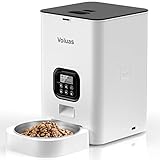


Feeder “portions” are not standardized. One machine may treat one portion as approximately 1/8 cup, while another dispenses closer to 1/4 cup. Always measure the food dispensed by your specific unit with a dry measuring cup or kitchen scale. As a general reference, 1/4 cup of dry kibble often weighs about 25 to 35 grams, but the exact weight varies by recipe and kibble shape.
Typical retail prices for the feeder sizes covered here range from about $30 to $56. Compact and mid-size models commonly use batteries or a low-voltage adapter. Plug-in feeders often use approximately 3 to 5 watts while operating, though the rating depends on the model. Battery life can range from several weeks to many months when the motor runs only a few times per day.
Standard Sizes
See also: How to Remove Litter Box Odor Buildup (2026): Step-by-Step • How to Fix a Jammed Automatic Feeder (2026): Step-by-Step
| Feeder size | Typical dimensions | Hopper capacity | Approximate dry-food capacity | Best for | Typical price |
|---|---|---|---|---|---|
| Compact | 7.1 × 7.1 × 10.2 in (18 × 18 × 26 cm) |
2–3 L | 4–7 lb (1.8–3.2 kg) |
One cat or small dog | $30–$38 |
| Standard | 8.3 × 8.3 × 12.6 in (21 × 21 × 32 cm) |
4 L | 7–10 lb (3.2–4.5 kg) |
One or two cats; small to medium dogs | $30–$45 |
| Large | 9.8 × 9.8 × 14.2 in (25 × 25 × 36 cm) |
6–8 L | 12–18 lb (5.4–8.2 kg) |
Medium and large dogs | $50–$70 |
| Extra-wide tray | 10.6 × 11.0 × 15.0 in (27 × 28 × 38 cm) |
6–8 L | 12–18 lb (5.4–8.2 kg) |
Large kibble or dogs needing a broad bowl | $55–$80 |
These are common size ranges, not universal standards. A 4-liter feeder may hold more or less food depending on hopper shape and kibble density. Most dry-food dispensers work best with kibble roughly 1/4 to 3/4 inch (6 to 19 mm) in diameter. Oversized, irregular, or oily pieces can increase the risk of bridging or jams.
For portion planning, first determine your pet’s daily food allowance. Divide that amount by the number of meals, then test the feeder’s smallest setting. For example, if a cat needs 3/4 cup per day across three meals, each meal should dispense 1/4 cup. If the feeder releases 1/8 cup per portion, program two portions at each meal. A digital kitchen scale is the most reliable way to confirm the result.
How to Measure Your Space
- Measure the floor width. Use a tape measure to find the clear side-to-side space where the feeder will sit. Add at least 2 inches (5 cm) beyond the feeder’s listed width so the bowl and your pet’s head are not pressed against a wall or cabinet.
- Measure the depth. Include the feeder body, bowl, and any front-facing tray. A unit listed as 8 inches deep may need 11 to 14 inches of total front-to-back space once the bowl is attached.
- Check vertical clearance. Measure from the floor or shelf to the lowest obstruction. Leave 3 inches (7.5 cm) above a removable lid, and more if you need to lift the entire hopper off for cleaning.
- Plan cord clearance. For plug-in models, measure to the nearest outlet and leave room for the adapter. Keep cords away from chewing pets and avoid routing them beneath rugs where they can be pinched.
- Mark the feeding zone. Use painter’s tape to outline the feeder’s footprint. Include a landing area of at least 6 inches (15 cm) in front of the bowl for a cat and 10 to 18 inches (25 to 46 cm) for a medium or large dog.
- Test the bowl height. The bowl rim should generally sit near a cat’s lower chest or a dog’s lower chest, depending on the animal’s comfort and veterinary guidance. Many automatic feeders place the bowl close to floor level, so a stable riser may be useful.
By Room or Use Case
Kitchen or Dining Area
A standard 4-liter feeder is usually the easiest fit in a kitchen corner or beside a pantry. Reserve a footprint of about 12 by 14 inches (30 by 36 cm), including access in front of the bowl. Keep the feeder away from the dishwasher, sink splash, stove heat, and direct sunlight. A sealed lid and removable bowl are especially useful in this location because food particles can attract pests.
Living Room
Choose a compact or standard feeder with a quiet motor and a stable base. Allow roughly 2 inches of side clearance and avoid placing it directly beside a high-traffic walkway. A feeder weighing about 2 to 4 pounds (0.9 to 1.8 kg) is common, but a heavier or rubber-footed base is preferable for pets that nudge equipment. Hide or secure the power cord along the wall.
Small Apartment or Studio
Prioritize footprint over maximum capacity. A 3-liter unit around 7 by 7 inches (18 by 18 cm) can serve one cat for multiple days without taking over a narrow corner. If counter placement is necessary, verify that the surface can support at least 10 pounds (4.5 kg) and that the pet can safely reach the bowl. Do not place a feeder on an unstable stool or a crowded appliance top.
Multi-Pet Homes
A single feeder may not provide fair portions when pets eat at different speeds. A 4- to 8-liter hopper can hold enough food, but it does not prevent one animal from taking another’s meal. Consider separate feeders, a microchip-access model, or placement in different rooms. For two cats sharing one feeder, look for a wide tray of at least 7 inches (18 cm), and monitor whether both animals can eat comfortably.
Medium and Large Dogs
Large dogs may outgrow a compact feeder quickly. An 8-liter model holding up to roughly 34 cups by manufacturer claim can reduce refills, but confirm that the dispensing opening accepts your kibble size. Look for a broad base, a tray at least 8 inches (20 cm) wide, and a total footprint near 10 by 10 inches (25 by 25 cm) or larger. Use the manufacturer’s portion chart rather than assuming each programmed serving equals a cup.
Common Sizing Mistakes
- Confusing hopper volume with portion size: A larger tank stores more food; it does not necessarily dispense larger meals.
- Skipping a portion test: Run at least five dispensing cycles into a measuring cup and average the result. Small variations can add up over a week.
- Measuring only the body: The bowl, lid, cord, and front clearance all affect where the feeder can go.
- Buying by pet weight alone: Activity level, age, food calorie density, and veterinary recommendations affect daily portions.
- Ignoring kibble shape: A feeder designed for small, uniform pieces may jam with large or triangular food.
- Overlooking stability: A tall, lightweight feeder can tip when a dog pushes the tray. Choose a broad base or secure it to a wall-resistant location.
- Filling too far ahead: Even a sealed hopper should be cleaned regularly. Fill according to your pet’s schedule and the food manufacturer’s freshness guidance.
FAQ
How many portions should an automatic feeder dispense?
Program the feeder according to your pet’s total daily food allowance, not a preset number. Divide the daily amount into two to four meals for many adult pets, then convert each meal into the machine’s actual portion increment. Confirm the output by weight whenever possible.
What size automatic feeder is best for one cat?
A 3- or 4-liter feeder is suitable for most single cats. Choose a compact model around 7 to 9 inches wide and deep if counter or floor space is limited. A 4-liter hopper is useful when you want several days between refills, provided the food remains fresh and the hopper is cleaned regularly.
How large should an automatic dog feeder be?
Small dogs can usually use a 3- or 4-liter model, while medium dogs often benefit from 4 to 6 liters. Large dogs may need 6 to 8 liters and a wider, more stable tray. Match the dispenser to the dog’s kibble size and daily volume rather than choosing capacity by liters alone.
Can an automatic feeder dispense a precise weight?
Most consumer feeders dispense timed volume-based portions, not guaranteed gram weights. Kibble density changes the weight of every serving. Measure several test servings on a kitchen scale, record the average, and adjust the programmed portions with your veterinarian’s recommended daily amount.
Ready to decide? Our #1 pick for 2026 is the Compact.
Live price & availability on Amazon.