- Top Pick: ANDOLL HOME Automatic Cat Feeder, 4L Cat Food Dispenser with 10s Voice Recorder, Pet Feeder up to 8 Meals per Day, Timed Dog Feeder with Dry Food Sealed Ring
- Best Value: VOLUAS Automatic Cat Feeder, 4L Timed Dry Food Dispenser for Cats & Dogs
- Premium Choice: Amazon Basics Gravity Pet Food Feeder for Dogs and Cats, Easy to Clean, Easy to Fill, Removable Lid, 152fl.oz Capacity, Small
📅 Last updated:
Choosing between an automatic feeder vs gravity feeder is less about which gadget is “better” and more about how your household actually works. Do you need meals delivered on a schedule when you are asleep, at work, or away for a weekend? Or do you simply want a clean, low-effort way to keep dry food available throughout the day?
An automatic feeder uses a timer, motor, and portion mechanism to dispense measured servings. A gravity feeder relies on a hopper: as your pet eats from the bowl, more food falls down from above. That difference affects feeding control, cost, cleaning, noise, counter space, and how well each option fits your home.
As an Amazon Associate we earn from qualifying purchases at no extra cost to you.



For many cats and dogs, either style can work. The right choice depends on your pet’s eating habits, your schedule, and whether convenience or simplicity matters most.
📋 Table of Contents
Quick Verdict
Choose an automatic feeder if your pet needs scheduled portions, you work irregular hours, or you want to reduce early-morning wake-up calls. Most household models hold about 3 to 6 liters of dry food, provide several daily feeding times, and cost roughly $30 to $100. They typically use batteries, a wall adapter, or both, and require more parts to clean and maintain.
Choose a gravity feeder if your pet self-regulates, eats dry food gradually, and you want the lowest purchase price and simplest setup. Gravity models commonly cost about $10 to $35, have no electronics, and can hold several days of food. They are not a good substitute for portion control, however. A food-motivated pet may continue eating until the hopper is empty.
Side by Side
See also: How to Remove Litter Box Odor Buildup (2026): Step-by-Step • How to Fix a Jammed Automatic Feeder (2026): Step-by-Step
| Factor | Automatic feeder | Gravity feeder |
|---|---|---|
| Comfort | Delivers meals at consistent times, even when you are away | Provides constant access to food with no scheduled dispensing |
| Durability | Usually lasts several years, but motors, sensors, and electronics can fail | Often lasts many years because it has few or no moving parts |
| Price range | About $30–$100 for common dry-food models | About $10–$35 for plastic or stainless-steel models |
| Maintenance | Requires cleaning the bowl, hopper, chute, and sometimes the dispensing wheel | Usually limited to washing the bowl and wiping or washing the hopper |
| Space needed | Typically about 8–12 inches wide and 10–15 inches deep | Often about 7–12 inches wide and 8–14 inches deep |
| Look | More appliance-like, with a display, buttons, or a visible power cord | Simple container-and-bowl design with fewer visual distractions |
| Resale | Limited unless it is clean, complete, and still has its power accessories | Generally modest resale value, but a clean, durable unit is easy to donate |
| Best for | Measured meals, busy schedules, medication routines, and pets that eat too quickly | Self-regulating pets, backup food access, and budget-conscious households |
| Food compatibility | Usually dry kibble; kibble size must fit the dispensing mechanism | Dry kibble and some larger pieces, depending on the hopper opening |
Where Automatic Feeder Wins
The strongest advantage of an automatic feeder is timing. You can set breakfast for 6:30 a.m., lunch for midday, and dinner for the evening without being physically present. That can make life easier for people who commute, work shifts, sleep late, or occasionally stay away from home overnight.
Portion control is another major benefit. Instead of filling a bowl and guessing how much your pet has eaten, you can program several smaller releases. This is especially useful for cats that beg between meals, dogs that gulp food, or pets that need a more predictable routine. A feeder does not replace veterinary guidance for weight management, but it can make a feeding plan easier to follow.
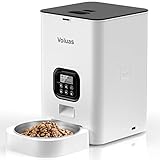
Automatic models can also help in multi-meal households. A 4-liter unit may offer enough capacity for several days, depending on your pet’s size and daily ration. The ANDOLL HOME Automatic Cat Feeder, for example, is listed at $29.99 and is designed around scheduled dry-food dispensing, with up to eight meals per day and a voice-recording feature. The VOLUAS Automatic Cat Feeder is listed at $41.79 and follows the same general category: a timed 4-liter dispenser for cats and dogs.
Some owners appreciate a recorded voice message, which can signal mealtime without requiring a phone notification or kitchen timer. Others prefer battery backup in case a pet eats while the power is out. When shopping, check whether batteries are the primary power source or only an emergency backup. Also confirm the recommended kibble size. Very large, unusually shaped, or oily pieces may bridge inside the chute or dispense inconsistently.
Automatic feeders are not maintenance-free. Expect to wash the bowl regularly and wipe food-contact components according to the manufacturer’s instructions. Keep the unit on a level surface, protect the power cord from chewing, and test the dispensing schedule before relying on it during travel.
Where Gravity Feeder Wins
Gravity feeders win on simplicity. Fill the hopper, place the bowl in a stable location, and food flows down as your pet eats. There is no programming, app, motor, or clock to reset. That makes this style particularly appealing as a backup for busy mornings, a second feeding station, or a low-cost option for a pet that already eats responsibly.
They are also quieter. A gravity feeder does not make a motor sound at mealtime, beep when settings change, or require an outlet. That can be useful in bedrooms, compact apartments, and homes where cords are difficult to hide.
The Amazon Basics Gravity Pet Food Feeder for Dogs and Cats is listed at $12.25 and has a 152-fluid-ounce capacity in the small version. A product in this category can provide a substantial supply of dry food without taking up much more floor space than an automatic model. The Wefeedy automatic cat feeder and water dispenser set is listed at $16.98 and combines gravity-style food and water dispensing, illustrating how inexpensive a basic, low-tech feeding station can be.
The main limitation is access. A gravity feeder encourages food availability rather than a defined schedule. If your pet overeats, guards the bowl, or bothers another animal for food, the hopper may make the problem worse. Food can also sit in the container for days, so you should avoid endlessly topping it off. Empty and clean the hopper periodically, inspect for stale kibble or moisture, and place the feeder away from direct sunlight and water splashes.
Gravity feeders are not ideal for wet food. They are generally intended for dry kibble, and the open bowl can attract insects if food is left out. A covered design may slow contamination, but it does not eliminate the need for regular cleaning.
Cost Over 5 Years
Purchase price is only part of the calculation. A basic gravity feeder costing $12 to $25 may need little beyond soap, water, and occasional replacement of a worn bowl. Over five years, a careful owner might spend roughly $15 to $45 total, assuming the unit remains intact.
An automatic feeder priced from $30 to $100 may cost roughly $40 to $150 over five years. That estimate allows for the original purchase, batteries, and the possibility of replacing a removable bowl, lid, or power adapter. Higher-end connected models can cost more, while a straightforward timed feeder may stay near the lower end of the range.
Electricity is usually a minor expense. Many small automatic feeders use a low-voltage adapter and draw only a few watts while operating, with the motor running briefly at meal times. Battery costs can matter more if the unit does not use an adapter or if you replace batteries frequently. The larger financial issue is food waste: a gravity feeder may encourage overeating, while a properly set automatic feeder can help keep portions consistent.
Which One for Your Home
Small apartment
Choose an automatic feeder if your schedule is unpredictable and you need to protect sleep or avoid rushed morning routines. Measure the footprint before buying; a feeder around 10 inches wide by 12 inches deep can occupy valuable floor space. A gravity feeder is better if your pet self-regulates and you want a quiet, cord-free setup.
Family with kids and pets
An automatic feeder can reduce arguments over who fed the pet and help maintain a consistent schedule. Select a stable, tip-resistant model with a locking lid if children may play with the controls. For multiple pets, remember that one feeder cannot prevent food stealing unless pets are separated or the unit uses identification features.
Rental
Gravity feeders are easy to move and do not require an outlet near the bowl. They are a practical choice for renters who want minimal equipment and no cord management. An automatic feeder still works well, but place it where the cable cannot become a trip or chewing hazard and use a removable mat beneath it to protect the floor.
Long-term home
Either style can make sense. Choose automatic dispensing if your pet’s weight, medication timing, or meal routine is likely to require structure over the years. Choose gravity dispensing if reliability, low maintenance, and easy replacement matter most. Some households use both: an automatic feeder for scheduled meals and a small gravity feeder as a carefully monitored backup.
FAQ
Is an automatic feeder better than a gravity feeder for cats?
It is better for cats that need measured portions, scheduled meals, or multiple small feedings. A gravity feeder can work for a cat that naturally stops eating when full, but it makes portion tracking more difficult.
Can dogs use a gravity feeder?
Yes, but only if the dog does not overeat, tip the container, or aggressively guard the food. For many dogs, an automatic feeder is safer for portion control. A slow-feeding bowl may also help reduce rapid eating.
How often should either feeder be cleaned?
Wash the food bowl at least every few days and more often if it becomes greasy or wet. Empty and clean the hopper regularly rather than continually adding fresh kibble on top of old food. Follow the manufacturer’s instructions for electronic components.
Will an automatic feeder work during a power outage?
It depends on the design. Some models include battery backup, while others stop when the adapter loses power. If uninterrupted feeding matters, choose a unit with a clearly stated battery option, keep fresh batteries available, and test the backup before an outage occurs.
Ready to decide? Our #1 pick for 2026 is the Comfort.
Live price & availability on Amazon.