Our Short List of 3
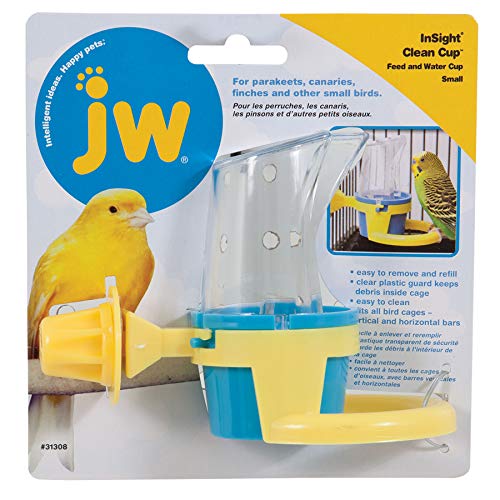
- Best for: parakeets, canaries, finches and other small birds See the JW Pet InSight Clean Cup on Amazon
- Type: hooded feed cup
- Capacity: 2 fl oz, maker figure for the small size
- Mount: screw-on bracket, vertical or horizontal bars
- Material: plastic cup with clear hood

- Best for: parakeets, canaries, cockatiels, lovebirds and finches See the GURECOD No-Mess Feeder on Amazon
- Type: enclosed gravity box feeder
- Dimensions: 6.3 x 6.3 x 6.3 in, maker figure for this size
- Material: acrylic with stainless steel hooks
- Mount: hook-on, inside or outside the cage; flat-sided cages only per maker

- Best for: small birds in cages with a feeder door or matching bar spacing See the Living World Outside Hooded Cup on Amazon
- Type: hooded seed cup, outside mount
- Mount: hooks onto the outside of the cage
- Colour: white
- Maker: Living World (Hagen)
All 5 Picks at a Glance
| Product | Specs | Action |
|---|---|---|
| 1. JW Pet InSight Clean Cup, Small |
| Check price on Amazon |
| 2. GURECOD Automatic Acrylic No-Mess Feeder |
| Check price on Amazon |
| 3. Living World Outside Hooded Cup |
| Check price on Amazon |
 4. Lixit Quick Lock Cage Bowl, 10 oz |
| Check price on Amazon |
 5. PINVNBY Stainless Steel Feeding Cups, 2 Pack with Perch |
| Check price on Amazon |
📅 Last updated:
Every pet bird eats the same way: pick up a seed, crack it, drop the hull, flick the rejects sideways. The seed lands in the cup, but the hulls and rejects land everywhere else, and the feeder you choose decides how much debris stays in the cage and how much ends up on your floor. This guide covers five designs that live on a cage: a hooded cup, an enclosed no-mess box, an outside-mount hooded cup, a twist-lock crock and clamp-on steel cups.
The scope is narrower than our earlier cages-and-gardens feeder guide, which split its picks between a pet bird indoors and wild birds outside. Everything here is for a pet bird in a cage, and water is left out on purpose: drinkers and silo bottles have their own guide on this site. All dimensions and capacities below are maker figures.
Disclosure: As an Amazon Associate, I earn from qualifying purchases.
📋 Table of Contents
How to Choose
Understand how no-mess designs actually work. Hooded cups and enclosed boxes do not stop a bird from flicking seed. They work by keeping the bird’s head inside a hood or a box while it eats, so the flicked hulls land in an enclosed space instead of across the room. That comes with a condition: the bird has to be willing to put its head in. Some birds refuse enclosed feeders outright, especially nervous birds, and a feeder the bird will not enter is worse than a messy cup it uses happily. Introduce any hooded or boxed design next to the old cup, not instead of it.
Blow off the hulls every day. A cup of seed mix that looks full may be mostly empty hulls, because birds drop the shells back into the dish as they eat. The feeder looks stocked while the bird picks through shells for the few whole seeds left. Blowing off the hulls and topping up daily decides real nutrition far more than feeder design does, and it takes seconds.
If it does not come apart, it does not get clean. Seed dust, hull fragments and moisture collect in seams, threads and corners, and bacteria grow in exactly those places. A feeder that cannot be fully disassembled cannot be fully cleaned, so look for cups that lift out of their holders, boxes that open completely and crocks that twist free of their brackets.
Placement decides more than brand. A feeder hung at perch height, with its opening facing the perch the bird already uses, gets eaten from. The same feeder hung too high, too low or facing a wall gets ignored. Keep feeders out from under a favourite roosting perch, because droppings fall straight down into open cups. For outside-mount designs, first check that your cage has a feeder door or bar spacing that lines up with the opening.
Match the mount to the beak. Finches and budgies cannot move a hook-on cup. Cockatiels, conures and small parrots learn to lift, tip and dump anything merely hooked. For those birds a screw mount, a twist-lock bracket or a bolted clamp is not an upgrade, it is the baseline. Nothing here is built for large parrots such as Amazons, cockatoos or macaws, which need heavier bowls sold for big birds.
The 5 Picks
See also: Best Automatic Transmission Floor Shifter: Ratchet, Gated and Detent Shifters Compared • Best Automatic Floor Shifter for Truck: Tall, Tough Picks for Pickups and Bench Seats
1. JW Pet InSight Clean Cup, Small
- Best for: parakeets, canaries, finches and other small birds See the JW Pet InSight Clean Cup on Amazon
- Type: hooded feed cup
- Capacity: 2 fl oz, maker figure for the small size
- Mount: screw-on bracket, vertical or horizontal bars
- Material: plastic cup with clear hood
parakeets, canaries, finches and other small birds See the JW Pet InSight Clean Cup on Amazon
The Clean Cup is the gentlest step up from a plain open dish: a small cup under a clear hood, on a bracket that screws to the cage bars. The hood keeps flicked seed and hulls inside the cup’s footprint while staying transparent, so the bird can see the seed and you can see the level at a glance. The screw-on design fits vertical and horizontal bars, and the cup twists and lifts out of its holder for washing. The maker rates it as dishwasher safe. The small size suits parakeets, canaries and finches; a medium size exists for cockatiels and conures. For a bird wary of fully enclosed boxes, this open-front hood is usually the design it accepts first.
See the JW Pet InSight Clean Cup on Amazon
2. GURECOD Automatic Acrylic No-Mess Feeder
- Best for: parakeets, canaries, cockatiels, lovebirds and finches See the GURECOD No-Mess Feeder on Amazon
- Type: enclosed gravity box feeder
- Dimensions: 6.3 x 6.3 x 6.3 in, maker figure for this size
- Material: acrylic with stainless steel hooks
- Mount: hook-on, inside or outside the cage; flat-sided cages only per maker
parakeets, canaries, cockatiels, lovebirds and finches See the GURECOD No-Mess Feeder on Amazon
This is the fully enclosed approach: a clear acrylic box with a feeding chamber the bird steps into and a storage chamber above that gravity-feeds seed down as the level drops. Hulls and flicked seed fall into the lower part of the box instead of out of it, and uneaten seed can be poured back rather than swept up. Stainless steel hooks mount it inside or outside the cage. The maker lists three sizes; the linked listing is the 6.3 inch cube. Two honest limits: no fit on round or curved cages, and a protective film to peel off the acrylic before use. Like every enclosed design, it only works once the bird accepts eating inside a box, so budget a few days of running it beside the old cup.
See the GURECOD No-Mess Feeder on Amazon
3. Living World Outside Hooded Cup
- Best for: small birds in cages with a feeder door or matching bar spacing See the Living World Outside Hooded Cup on Amazon
- Type: hooded seed cup, outside mount
- Mount: hooks onto the outside of the cage
- Colour: white
- Maker: Living World (Hagen)
small birds in cages with a feeder door or matching bar spacing See the Living World Outside Hooded Cup on Amazon
Living World’s hooded cup takes the opposite mounting approach: the cup hangs on the outside of the cage and the bird reaches it through the bars or a feeder door. That keeps your hands out of the cage at refill time, which matters for territorial birds and aviary setups where opening the door is an escape risk. The hood keeps droppings from above out of the seed and stops most flicked hulls from travelling. It is a plain, light plastic cup with none of the gravity machinery of the box feeders, so it holds a day or two of seed. Check the fit against your cage first; on the right cage this is the lowest-effort daily feeder here.
See the Living World Outside Hooded Cup on Amazon
4. Lixit Quick Lock Cage Bowl, 10 oz
- Best for: cockatiels, conures, budgies and any bird that dumps hook-on cups See the Lixit Quick Lock Cage Bowl on Amazon
- Type: twist-lock crock bowl
- Capacity: 10 fl oz
- Material: polystyrene, per listing
- Mount: quick-lock bracket clamps to cage wire; bowl twists on and off
cockatiels, conures, budgies and any bird that dumps hook-on cups See the Lixit Quick Lock Cage Bowl on Amazon
The Quick Lock is the answer to the dumped-cup problem. A bracket clamps to the cage wire and stays there; the crock twists into it and locks, and twists back out for washing and refilling without tools. A cockatiel can still throw seed out of it, because it is an open bowl, but it cannot lift the bowl off and empty it in one move. The 10 fl oz capacity is generous for a single small parrot or a pair of budgies and works for chopped vegetables and egg food as well as seed, jobs a gravity box cannot do. The listing specifies polystyrene construction and hand washing, so keep it out of the dishwasher.
See the Lixit Quick Lock Cage Bowl on Amazon
5. PINVNBY Stainless Steel Feeding Cups, 2 Pack with Perch
- Best for: budgies, parakeets, cockatiels, conures and lovebirds See the PINVNBY Stainless Steel Feeding Cups on Amazon
- Type: clamp-on coop cups with perch stand
- Cups: 2 stainless steel cups, about 4.7 x 1.8 in each, maker figures
- Mount: clamp holders, clip about 2.7 in, maker figure
- Extras: sanded perch stand platform included
budgies, parakeets, cockatiels, conures and lovebirds See the PINVNBY Stainless Steel Feeding Cups on Amazon
Steel survives beaks, scrubbing and years of daily washing without holding odours or grime in scratches, and this set pairs two stainless cups with clamp holders and a perch stand. Each cup is about 4.7 inches across and 1.8 inches deep by the maker’s figures, a sensible size for budgies through small conures. The clamps grip the bars so the cups stay put, and the cups lift out of the holders for cleaning. The included perch platform has a sanded surface and mounts in front of the cups, giving the bird a flat place to stand instead of balancing on the cup rim, which is how rims get bent and cups get tipped. Seat the clamp on a sturdy bar and check it after the first day.
See the PINVNBY Stainless Steel Feeding Cups on Amazon
Comparison Table
| Feeder | Type | Mount | Size or capacity | Best for |
|---|---|---|---|---|
| JW Pet InSight Clean Cup | Hooded cup | Screw-on bracket | 2 fl oz | Small birds new to hooded feeders |
| GURECOD No-Mess Feeder | Enclosed gravity box | Stainless hooks | 6.3 in cube | Maximum hull and scatter control |
| Living World Hooded Cup | Hooded cup | Outside hook-on | Day or two of seed | Refills without opening the cage |
| Lixit Quick Lock Bowl | Twist-lock crock | Clamp bracket | 10 fl oz | Birds that dump hook-on cups |
| PINVNBY Steel Cups | Coop cups | Clamp holders | 4.7 in cups, pair | Steel durability and fresh food |
FAQ
Why does my bird refuse to eat from a no-mess feeder?
Because the design asks it to put its head, or its whole body, inside an unfamiliar enclosed space; caution around new objects is normal bird behaviour. Hang the new feeder beside the old cup with the same seed in both and let the bird investigate for several days. Most small birds move over within a week. If a bird still will not enter after a week or two, accept the answer and use a hooded open-front cup instead; a bird that eats calmly from a messy cup is better off than one going hungry next to a tidy box.
How often should a cage feeder be washed?
Rinse and wipe cups daily when you blow off the hulls and top up the seed, and wash properly with hot water and a brush at least weekly. Feeders used for chopped vegetables, fruit or egg food need washing the same day, because wet food grows bacteria far faster than dry seed. This is why the picks above all lift out of their holders or come apart fully: a feeder that takes five minutes to remove gets washed monthly instead of weekly, and the seams of an unwashed feeder are where bacteria concentrate.
What feeder suits a cockatiel that keeps dumping its cup?
One it cannot lift. Hook-on cups are the first thing a cockatiel learns to unhook, so move to a mount the bird cannot defeat: a twist-lock crock like the Lixit, a screw-on hooded cup like the JW, or clamp-held steel cups. Position also helps, because a cup hung beside a favourite swing gets used as a toy. Move the feeder to a quieter wall of the cage at perch height, and most dumping stops once the cup is both locked and boring to reach.
Can one feeder handle both seed and fresh food?
An open cup or crock can, a gravity box cannot. Chopped vegetables, fruit and egg food jam the chutes of enclosed feeders and spoil inside them, so those foods belong in an open cup that comes out and gets washed the same day. Many cages run two feeders: the enclosed box for the seed staple, and one open cup for everything fresh. If you buy only one feeder, buy the open cup and accept the sweeping.
Conclusion
There is no single best cage feeder, because the right answer depends on the bird in front of you. For the least scatter, an enclosed box like the GURECOD works once the bird accepts it. For a wary bird, the JW Clean Cup’s open-front hood is the design most likely to be used today rather than next week. The Living World cup suits keepers who refill from outside, the Lixit crock suits birds that dump anything hooked, and the PINVNBY steel cups suit anyone tired of replacing plastic. Whichever you choose, daily habits matter more than hardware: blow off the hulls, wash what comes apart, and hang it where the bird already likes to sit.