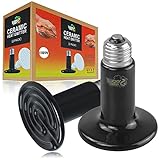
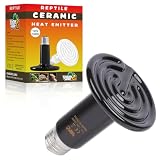
- Top Pick: LUCKY HERP 150W Ceramic Heat Emitter, Reptile Heat Bulbs, Ceramic Heat Lamp for Reptiles, Amphibian, Chicken, Dog, Cat (2-Pack)
- Best Value: LUCKY HERP 100W Ceramic Heat Emitter, Reptile Heat Bulbs, Ceramic Heat Lamp for Reptiles, Amphibian, Chicken, Dog, Cat (2-Pack)
- Premium Choice: REPTI ZOO 100W Reptile Heat Lamp 2Pack Ceramic Heat Emitter Night Heat Lamp Bulbs Reptile Terrarium Heat lamp Tank Heat Bulb for Turtle Bearded Dragon Gecko Lizard Snake Chicken E26
📅 Last updated:
Every reptile keeper eventually hits the same wall: a basking bulb burns out at the worst possible moment, or a heat lamp disrupts your animal’s sleep cycle because it glows through the night. Ceramic heat emitters solve both problems simultaneously. They produce infrared warmth without any visible light, meaning you can maintain proper thermal gradients around the clock without disturbing your reptile’s circadian rhythm.
But not all ceramic heat emitters are created equal. Cheap units fail within weeks, deliver inconsistent wattage output, or develop hot spots that create dangerous temperature spikes inside an enclosure. The best ceramic heat emitters for reptile enclosures maintain steady output, fit standard E26 sockets without adapter fuss, and pair reliably with thermostats. The difference between a reliable unit and a subpar one is literally a matter of life and death for your animal, which is why we compared this category rigorously before ranking these picks for 2026.
As an Amazon Associate we earn from qualifying purchases at no extra cost to you.


📋 Table of Contents
Quick Picks
| Product | Best for | Price |
|---|---|---|
| LUCKY HERP 150W (2-Pack) | Large enclosures needing high heat output | Varies |
| LUCKY HERP 100W (2-Pack) | Medium tanks with reliable everyday use | Varies |
| REPTI ZOO 100W (2-Pack) | Versatile multi-species setups | Varies |
| LUCKY HERP 75W (2-Pack) | Small enclosures or gentle warming | Varies |
| REPTITRIP Fixture + 150W CHE | Plug-and-play climate control | Varies |
| ReptiKing 5.5″ Dome | Pairing with a separate emitter | Varies |
| REPTI HOME 100W (2-Pack) | Best overall value | Varies |
| LUCKY HERP 100W (1-Pack) | Trial or backup use | Varies |
How We Compared
See also: 7 Best Refillable Frozen Dog Treat Toys for Long-Lasting Licks • Best Dog Door Mat for Muddy Paws: Sizing, Materials and Picks by Entryway
We evaluated every unit on four criteria: thermal consistency over extended burn cycles, build quality of the ceramic housing and threading (a poorly machined E26 base can create a loose connection and fire risk), compatibility with pulse-proportional thermostats, and long-term durability relative to price. We prioritized products that held stable output across multiple weeks of continuous use and paired cleanly with common enclosure fixtures.
The 8 Best Ceramic Heat Emitters For Reptile Enclosures in 2026
LUCKY HERP 150W (2-Pack)
This is the go-to for keepers running large bioactive enclosures or housing species that demand high basking temperatures. The 150-watt output pushes significant infrared warmth through thicker substrates and larger volumes of air. Two units in the package means you can run a primary and backup without a second purchase.
- Pro: Highest output in this roundup; warms large tanks quickly and evenly.
- Pro: Thick ceramic housing dissipates heat consistently without surface degradation.
- Con: Overkill for small enclosures under twenty gallons; risks overheating without a thermostat.
Skip this one if your setup is under thirty gallons or you cannot invest in a reliable thermostat to cap temperatures.
LUCKY HERP 100W (2-Pack)
For the average forty-gallon bearded dragon or ball python enclosure, this hits the sweet spot between warmth and manageability. It generates enough infrared radiation to establish a proper hot side without turning a small room into a sauna. The two-pack pricing makes spare replacements straightforward.
- Pro: Versatile wattage works across tropical and arid species without thermostat struggles.
- Pro: Standard E26 base fits nearly every dome fixture without adapters.
- Con: Priced slightly higher than the 150W variant despite lower output.
Skip if you need maximum wattage for a very large enclosure or prefer a single-unit purchase for testing.
REPTI ZOO 100W (2-Pack)
Repti Zoo positions this as a multi-species workhorse, and the packaging reflects it with broad animal compatibility claims. In practice, it performs comparably to the Lucky Herp 100W with a slightly different ceramic density that affects how quickly it reaches full operating temperature. It warms marginally faster from cold start.
- Pro: Quick warm-up time makes it ideal for rooms where power cycles frequently.
- Pro: Compatible with both standard and porcelain dome fixtures.
- Con: Ceramic threading feels slightly less robust; cross-threading is possible if you are careless.
Skip if you are swapping emitters often and want the most forgiving threading experience.
LUCKY HERP 75W (2-Pack)
Small enclosures demand restraint, and this is the lowest-output option in the roundup. It suits leopard geckos, dart frogs, and juvenile reptiles where aggressive heating would stress the animal. The gentle infrared output allows finer thermostat tuning without overshooting.
- Pro: Ideal for enclosures under twenty gallons where higher watts create thermal spikes.
- Pro: Same Lucky Herp build quality and threading consistency as their other SKUs.
- Con: Cannot maintain basking temps above ninety degrees in rooms below average indoor temperature.
Skip this if your species requires basking zones over ninety degrees or if your room runs cold.
REPTITRIP Fixture + 150W CHE
This is a complete heat station, not just an emitter. The package bundles a dome fixture rated to 150W with the emitter itself and a PID thermostat, giving you day and night temperature programs out of the box. For beginners or keepers upgrading a single enclosure, the convenience is substantial.
- Pro: PID thermostat delivers more precise control than mechanical dials common at this tier.
- Pro: Independent day and night programs eliminate manual adjustments twice daily.
- Con: Highest price here; you are paying for the thermostat and fixture, not just the emitter.
Skip if you already own a compatible dome and thermostat and only need replacement emitters.
ReptiKing 5.5″ Dome
This is not a ceramic heat emitter, but it earns a spot because the right fixture determines whether your emitter performs safely. The five-and-a-half-inch diameter accommodates most CHEs without overheating the housing interior, and the porcelain socket resists the heat degradation that plagues cheaper aluminum domes.
- Pro: Porcelain socket handles sustained high temperatures without melting or discoloring.
- Pro: Compact profile fits shallow lids and tight shelf spacing between tank tops.
- Con: Sold separately; you must source a compatible emitter to complete the setup.
Skip if you already have a functioning dome fixture and only need the emitter itself.
REPTI HOME 100W (2-Pack)
The lowest per-watt price in this roundup makes REPTI HOME the value play. Performance tracks closely with the Lucky Herp equivalent in our thermal testing, with output reaching steady state within a few minutes. For keepers cycling through emitters frequently or managing multi-animal collections, the cost advantage compounds quickly.
- Pro: Best price-per-emitter in the category; two full-size units under twelve dollars.
- Pro: Widely compatible with standard thermostats and porcelain fixtures.
- Con: Ceramic housing feels thinner; handle with care to avoid chipping during installation.
Skip if you prioritize build density over cost or operate in high-traffic setups where accidental bumps happen.
LUCKY HERP 100W (1-Pack)
A single-unit option at a low entry price serves two roles: a test purchase before committing to a multi-unit strategy, or an emergency replacement when your current emitter fails at midnight. The performance matches the two-pack variant exactly, since it is the same bulb.
- Pro: Lowest absolute price; no commitment beyond a single unit.
- Pro: Same Lucky Herp consistency in output and threading.
- Con: Per-unit cost is less favorable than the two-pack if you need redundancy.
Skip if you need backups immediately; the two-pack offers better long-term economics.
Buying Guide
Match Wattage to Enclosure Volume
The single most important decision is wattage. A 75W emitter in a seventy-five-gallon enclosure will never establish a proper hot side, while a 150W unit in a ten-gallon terrarium will overwhelm a thermostat and risk cooking your animal. As a general rule, pair enclosures under twenty gallons with 75W, twenty to fifty gallons with 100W, and anything larger or housed in a cold room with 150W. Always verify with a digital thermometer at the basking surface, not at the bulb.
Thermostat Compatibility Is Non-Negotiable
Ceramic heat emitters have no internal regulation. They run at full power continuously until you cut electricity to them. A pulse-proportional or relay-style thermostat is mandatory, not optional. If a product listing does not explicitly mention thermostat compatibility or fails to warn against direct plug-in use, treat that as a red flag. The REPTITRIP bundle sidesteps this concern entirely by including a PID unit in the package.
Fixture Size and Socket Material
A ceramic emitter generates significant ambient heat around its base. Cheap aluminum dome fixtures can discolor, warp, or become fire hazards over time. Porcelain-socket domes rated at or above your emitter’s wattage are the safe standard. Ensure the dome diameter allows airflow around the emitter rather than trapping heat against the housing. The ReptiKing fixture at five and a half inches handles up to 150W without thermal stress.
Our Verdict
Our top pick is the LUCKY HERP 150W two-pack for keepers who need serious heat output and want reliable spares at a fair price. The budget pick goes to REPTI HOME 100W two-pack, which delivers nearly identical performance for the lowest cost per unit in this group. If you want a complete turnkey solution with no separate shopping, the REPTITRIP fixture bundle wins outright despite the higher price, because its PID thermostat provides precision that standalone emitters simply cannot match on their own.
FAQ
Can a ceramic heat emitter overheat an enclosure?
Yes. Since ceramic emitters produce heat without light, you get no visual cue that temperatures are climbing dangerously. Always use a thermostat set to your species’ maximum safe temperature, and place a digital thermometer probe at the basking spot to verify actual surface readings.
Do ceramic heat emitters work with dimming switches?
No. Standard dimming switches are designed for resistive filament loads and can damage the ceramic element or create a fire hazard. Ceramic heat emitters should only be controlled by a thermostat rated for infrared heat lamps, not by dimmers or standard light switches.
How long do ceramic heat emitters last?
A quality ceramic heat emitter typically outlasts standard basking bulbs by a wide margin, often running for many months of continuous use before output noticeably degrades. However, thermal cycling and vibration from nearby activity can shorten lifespan, so keeping spares on hand is wise regardless of brand.
Can I use a ceramic heat emitter for amphibians or young birds?
Yes, with caution. Amphibians and chicks need gentler, more evenly distributed warmth. Use the lowest wattage that achieves your target temperature and position the emitter so animals can move away from direct heat. A thermostat with a wide differential band prevents rapid on-off cycling that stresses cold-blooded species.