📅 Last updated:
Here is the uncomfortable thing about shopping for an indoor rabbit hutch: most of the hutches sold as suitable for a rabbit are too small for a rabbit. The category is built on a decades-old idea of what a bunny needs, which was never based on the animal’s actual behaviour, and the listings inherited it. A cage that lets a rabbit take two hops and sit with her ears brushing the roof is legally sellable, widely bought, and not enough. If you take one thing from this page, take that — and then judge every product below, including the ones we recommend, against the space your rabbit actually needs rather than against the other products on the shelf.
The good news is that the fix is cheap. Welfare organisations generally advise a minimum enclosure of around twelve square feet per pair of rabbits, plus a substantially larger attached exercise area — and a rabbit should be able to take three consecutive hops in a straight line, stretch out fully on her side, and stand upright on her back legs without her ears touching anything. A fifty-dollar puppy pen delivers that. A one-hundred-and-fifty-dollar wooden hutch usually does not. What follows compares what is on the market honestly, pairs each option with a proper litter tray, and explains the flooring issue that causes more suffering in pet rabbits than almost anything else.
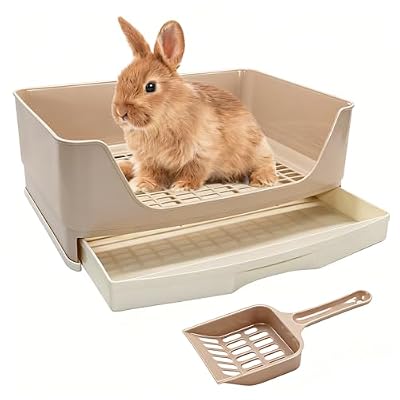
BWOGUE Large Rabbit Litter Box, Bunny Litter Box with Drawer, White
Selected for "best indoor rabbit hutch with litter tray": this listing is a pet supplies product (BWOGUE Large Rabbit Litter Box, Bunny Litter Box with Drawer, White), matching the product category this article compares.
View on Amazon
RUBYHOME Oversize Rabbit Litter Box with Drawer, Corner Toilet Box with Grate Potty Trainer, Bigger Pet Pan for Adult Guinea Pigs, Chinchilla, Ferret, Galesaur, Small Animals, 16.9 inch Long (White)
Selected for "best indoor rabbit hutch with litter tray": this listing is a pet supplies product (RUBYHOME Oversize Rabbit Litter Box with Drawer, Corner Toilet Box with Grate Po), matching the product category this article compares.
View on Amazon
Yuoaes Large Rabbit Litter Box Bunny Potty Training Corner Litter Pan with Drawer Comes with Liners Rabbit Pee Pads, Small Animal Bedding Toilet for Adult Guinea Pig, Ferret, Hamster, Bunnies
Selected for "best indoor rabbit hutch with litter tray": this listing is a compostable bags product (Yuoaes Large Rabbit Litter Box Bunny Potty Training Corner Litter Pan with Drawe), matching the product category this article compares.
View on Amazon
WUWEOT 2 Pack Large Rabbit Litter Box, Shallow Bunny Restroom Litter Tray, Small Animals Litter Pan Toilet Potty Trainer with Grate for Rabbit Hamster Ferret Rats Guinea Pigs Hedgehog Chinchillas
Selected for "best indoor rabbit hutch with litter tray": this listing is a pet supplies product (WUWEOT 2 Pack Large Rabbit Litter Box, Shallow Bunny Restroom Litter Tray, Small), matching the product category this article compares.
View on Amazon📋 Table of Contents
Quick answer: For most people in 2026, the best indoor rabbit hutch with litter tray is the Suumerpety Rabbit Playpen — our #1 rated choice. See the full ranked comparison, alternatives and buying advice below.
Quick Verdict
Best overall setup: Suumerpety Rabbit Playpen, 48″ x 48″ x 24″, with Waterproof Mat ($54.99), plus the BWOGUE Large Rabbit Litter Box with Drawer ($25.49). Sixteen square feet of solid-floored, open-topped space for eighty dollars all in. It is not a hutch and it does not look like furniture, but it is the only option here that comfortably clears the space guidance, and the waterproof mat protects your floor while giving the rabbit a solid surface to sit on. This is the setup an experienced rabbit keeper would choose.
Best actual hutch: GUTINNEEN Large Rabbit Hutch Indoor with Chew-Proof Ramp, 62″ Long, Two Storey, 6 Casters, 2 Pull-Out Trays ($149.99). If you want a cabinet-style hutch, this is the shape to buy: long rather than tall, two pull-out trays for cleaning, casters so you can move it, and chew-proof edging. At roughly five feet by two the ground floor still falls short of the twelve square foot guideline on its own, so treat it as a base with the door left open into a pen, not as the rabbit’s whole world.
Best full-metal build: GUTINNEEN 2-Story Rabbit Hutch, Chew-Proof Full Metal Frame, 62″, 6 Locking Casters, 2 Pull-Out Trays ($174.99). Wood absorbs urine and rabbits chew it; a metal frame solves both. The most durable hutch here.
Best budget hutch: GUTINNEEN 2-Story Rabbit Hutch with Chew-Proof Ramp and Locking Leak-Proof Trays, 39.3″ ($99.99). Honest about what it is — a compact two-storey unit. Only acceptable as a sleeping and litter base attached to free-roaming space, never as a full-time enclosure.
Best litter tray: Dmnnlp Stainless Steel Rabbit Litter Box with Hay Feeder and Low Entry, 15.4″ x 11.2″ x 4.8″ ($30.99). Stainless wipes clean, the low entry suits older or arthritic rabbits, and the attached hay rack matches how rabbits actually behave — they eat while they toilet, constantly.
| Product | Price | Size | Floor | Verdict |
|---|---|---|---|---|
| Suumerpety Rabbit Playpen | $54.99 | 48″ x 48″ x 24″ | Waterproof mat | Best space per dollar; use as main enclosure |
| GUTINNEEN 62″ Hutch, 2 Trays, Casters | $149.99 | 62″ long, 2 storeys | Solid with trays | Best hutch; still needs attached run |
| GUTINNEEN 62″ Full Metal Frame | $174.99 | 62″ long, 2 storeys | Solid with trays | Most durable; chew-proof |
| GUTINNEEN Indoor/Outdoor, Waterproof Roof | $149.99 | 61.2″ x 22.6″ x 33.5″ | Pull-out trays front and back | Easiest to clean |
| Garvee 63″ Bunny Hutch, 2-Tier | $139.99 | 63″ long, 2 tiers | Solid | Good footprint for the money |
| GUTINNEEN 39.3″ 2-Story | $99.99 | 39.3″ long | Solid with trays | Base only, not a full enclosure |
| Aivituvin Rabbit Hutch, Wire Floor | $119.99 | Hutch with plastic tray | Wire floor | Cover the wire or avoid — see below |
| Oiibo Deluxe Rabbit Cage | $208.99 | 32″ x 21″ x 26″ | Pull-out tray | Too small for the price |
| HOMESTEAD 24″ Breeding Cage | $85.99 | 24″ | Wire with urine guard | Not a pet rabbit home |
| Dmnnlp Stainless Litter Box, Hay Feeder | $30.99 | 15.4″ x 11.2″ x 4.8″ | Low entry | Best litter tray |
| BWOGUE Large Litter Box with Drawer | $25.49 | Large | Drawer | Best value tray |
| RUBYHOME Oversize Litter Box with Drawer | $27.48 | 16.9″ long | Drawer, grate | Largest tray here |
How to Choose
See also: How to Remove Litter Box Odor Buildup (2026): Step-by-Step • How to Fix a Jammed Automatic Feeder (2026): Step-by-Step
Wire flooring causes sore hocks, and it is not a minor problem
This is the single most important thing on this page. Rabbits have no pads on the soles of their feet — just fur over bone — and standing on wire or mesh compresses and abrades that fur until the skin underneath breaks down. The result is pododermatitis, commonly called sore hocks: raw, ulcerated pressure sores on the hind feet that are painful, slow to heal and prone to deep infection. Large breeds, heavy rabbits and rabbits that spend long periods sitting in one spot are the most affected. Any enclosure with a wire or mesh floor — the Aivituvin’s wire floor is stated in its own listing, and the HOMESTEAD breeding cage is built that way by design — must be covered with solid flooring, fleece over a mat, or seagrass matting before a rabbit lives on it. Better still, buy a solid floor to begin with. If you ever see redness, hair loss or scabbing on the underside of a rabbit’s back feet, that is a veterinary appointment, not a bedding adjustment.
Measure against the rabbit, not against the listing
Product titles say “large” at 24 inches and “deluxe” at 32 by 21. Neither is large for an animal that in the wild travels a couple of miles a day. Use three practical tests instead of the marketing copy. Can she take three consecutive hops without turning? Can she stand fully upright on her hind legs with her ears clear of the roof? Can she lie completely stretched out on her side, twice over, with room left? A single Netherland dwarf might pass in a 62-inch hutch; a French lop will fail in almost everything sold as a hutch. Buy for the adult size of the breed, and if you have a pair — and rabbits should be kept in bonded pairs, because they are intensely social — double the space you were considering.
The hutch is a bedroom; the run is the house
The most successful indoor rabbit setups treat the hutch as a den and the pen as the living space, with the hutch door left permanently open into it. That is why the cheap playpen is the strongest recommendation here: at 48 by 48 inches it provides sixteen square feet on its own, and two pens clipped together provide thirty-two. A hutch bought as a self-contained home will always disappoint, no matter what it cost; a hutch bought as a sleeping and litter station inside a much larger pen works very well.
A litter tray must be big enough to sit in, with hay attached
Rabbits litter train readily, and they choose a corner whether or not you provide a tray there. The tray needs to be large enough for the whole rabbit to sit inside comfortably — the RUBYHOME at 16.9 inches and the BWOGUE large are the right scale, and the stackable cat-sized trays sold in supermarkets are not. Position a hay rack or hay pile directly at the tray, because rabbits graze while toileting; that single arrangement does more for litter training success than anything else. Note that grates and grids, fitted to several of these trays to keep feet clean, are another wire surface — fine for a rabbit that hops in and out, less so for one that settles on it for hours. Many keepers remove the grate and use a deep layer of paper-based litter topped with hay instead.
Litter material: paper, not clumping cat litter
Use paper-based pellets, kiln-dried aspen shavings or plain shredded paper under a generous covering of hay. Avoid clumping clay cat litter entirely, since rabbits ingest bedding as they graze and clumping material is a genuine hazard. Avoid untreated pine and cedar shavings too — the aromatic oils are widely considered unsuitable for small mammals. Scoop daily and strip the tray completely at least twice a week; rabbit urine is high in calcium and leaves a chalky residue that is much easier to remove before it sets, which is where stainless trays like the Dmnnlp and the BWOGUE stainless ($38.99) earn their premium over plastic.
Doors, ramps and casters are practical features, not luxuries
Front-opening doors at floor level let a rabbit come and go on her own terms; top-opening-only cages force you to lift her out, and rabbits hate being picked up. Ramps between storeys need a non-slip surface and a gentle angle, and chew-proof edging — which GUTINNEEN advertises on several models — matters because a rabbit will test every exposed edge of a wooden hutch with her teeth. Casters make weekly cleaning genuinely easier and mean the enclosure can move away from a radiator in summer.
Temperature and placement indoors
Rabbits cope far better with cold than with heat, and an indoor rabbit beside a sunny window or a radiator can overheat quickly. Choose a spot that stays cool and shaded, out of draughts, away from the television, and not in a high-traffic corridor. Prey animals need somewhere to hide as well as somewhere to sit, so a cardboard castle or a covered section is not decoration — it is what stops a rabbit living in a permanent state of low-level alarm.
The Picks in Detail
The Suumerpety playpen ($54.99) is the recommendation a rabbit would make. Forty-eight inches square, twenty-four inches high, a door panel so she can be let out, and a waterproof mat that protects your floor while giving a solid surface to rest on. It is metal panelling rather than a piece of furniture, and it will not win any interior design awards, but it provides roughly three times the usable floor area of a typical hutch for a third of the price. Add a litter tray in one corner, a hay feeder beside it, a cardboard hide and a food bowl, and the enclosure is complete. Clip a second pen on later and you have a setup no commercial hutch can match.
Among true hutches, the GUTINNEEN 62″ two-storey with chew-proof ramp and two pull-out trays ($149.99) is the best balance. Length is what rabbits use; height is mostly for our benefit. Two pull-out trays make daily cleaning fast, the six casters mean you can pull it out to sweep behind, and the chew-proof ramp addresses the part of these hutches that normally fails first. The full-metal-frame version at $174.99 is the one to buy if your rabbit is a determined chewer or you want it to last a decade. The indoor/outdoor model at $149.99 (61.2″ x 22.6″ x 33.5″) adds trays that pull out from both front and back, which is the easiest cleaning arrangement of the lot, plus a waterproof roof if it ever moves to a covered porch.
Garvee’s 63″ two-tier hutch ($139.99) is the value pick among the long-footprint models, and GUTINNEEN’s 39.3″ two-storey ($99.99, or $119.99 in the wooden version) is the honest compact option — fine as a base station opening into a pen, inadequate as an entire home for any rabbit.
Two products warrant a warning rather than a recommendation. Aivituvin’s rabbit hutch ($119.99) states a wire floor with a leakproof plastic tray beneath; that construction makes cleaning easy and makes sore hocks likely, so cover the wire completely before use. HOMESTEAD’s 24-inch metal breeding cage ($85.99) is exactly what its title says — breeding equipment, with a wire base and a urine guard. It is not a home for a pet rabbit. The Oiibo Deluxe ($208.99) is not unsafe, simply poor value: two hundred dollars for 32 by 21 inches of floor when fifty-five buys sixteen square feet.
For trays, the Dmnnlp stainless with hay feeder ($30.99) is the best combination of hygiene, low entry and the hay-at-the-toilet arrangement that makes litter training stick. The BWOGUE large with drawer ($25.49) and RUBYHOME oversize ($27.48) are the value options, both big enough for a medium rabbit to sit in properly, and BWOGUE’s stainless with grid ($38.99) is the long-term choice if you can live with removing the grid. WUWEOT’s two-pack of shallow trays ($26.99) suits a two-rabbit household or a second toileting spot in the exercise pen, which is worth having.
Related guides: best automatic pet feeder with camera, best gps pet collar battery life compared, best pet camera with treat dispenser, best pet water fountain for multiple cats, best self cleaning litter box
FAQ
How big should an indoor rabbit hutch actually be?
Larger than nearly everything marketed as a rabbit hutch. Welfare guidance generally points to a minimum of around twelve square feet of enclosure for a bonded pair, plus a considerably bigger attached exercise area, with the rabbit able to take three consecutive hops, stand fully upright with ears clear, and stretch out flat. A 48-inch square playpen meets the enclosure figure on its own; a typical five-foot hutch does not, which is why the hutch-plus-pen combination is the standard advice.
Is a wire floor really that bad?
Yes. Rabbits have furred soles with no protective pads, and prolonged contact with wire causes pressure sores on the hocks that are painful and can become seriously infected. If a hutch you already own has a wire base, cover it with solid board, a waterproof mat, seagrass matting or thick fleece over padding. Check the undersides of your rabbit’s back feet periodically, and see a vet at the first sign of redness or hair loss.
Can I litter train a rabbit?
Usually, and often easily — particularly once neutered, since hormonal territory marking is the main cause of scattered droppings. Put a large tray in the corner the rabbit already uses, fill it with paper-based litter topped with plenty of hay, and place a hay feeder right at it. Expect a few stray droppings around the edges regardless; that is normal communication, not a failure.
What litter is safe for rabbits?
Paper-based pellets, kiln-dried aspen shavings or plain shredded paper, always with hay on top. Do not use clumping clay cat litter, and avoid untreated pine and cedar shavings. Rabbits eat while they toilet, so anything in the tray will be ingested in small quantities and must be safe on that basis.
Should I keep one rabbit or two?
Two, in nearly all cases. Rabbits are highly social and a lone rabbit is a lonely one, however much human attention it receives. Bonded pairs — usually a neutered male and a neutered female, introduced carefully — groom each other, sleep together and are visibly calmer. That doubles the space requirement, which is another argument for the pen rather than the cabinet hutch. Talk to a rescue about bonding; they do this routinely and it is far easier than attempting it blind.
Ready to decide? Our #1 pick for 2026 is the Suumerpety Rabbit Playpen.
Live price & availability on Amazon.