📅 Last updated:
Choosing a cat water fountain is less about buying the largest reservoir and more about matching capacity to the number of cats, drinking habits, refill schedule, and available floor space. A fountain that is too small may run dry quickly, while an oversized model can take up valuable room and hold stagnant water if it is not cleaned regularly.
📋 Table of Contents
The Short Answer
Plan on 24 to 32 ounces of fountain capacity per cat for a comfortable everyday refill schedule. For one cat, a 50- to 100-ounce fountain is usually practical. For two cats, look for 84 to 108 ounces. Three or more cats generally benefit from 120 to 168 ounces, or from multiple fountains placed in separate areas.
As an Amazon Associate we earn from qualifying purchases at no extra cost to you.



Capacity is not the same as daily water consumption. A healthy adult cat may drink roughly 4 to 8 ounces of total water per day, including moisture from wet food. A fountain needs extra capacity because you should not fill it to the absolute top, evaporation reduces the water level, and some water is displaced or splashed during drinking.
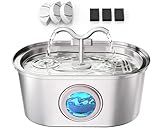
For most homes, a 108-ounce fountain, equal to about 3.2 liters, is a useful middle-size choice. It typically works well for one to three cats when the water is checked daily and refreshed regularly. In 2026, many stainless-steel models in this size range sell for approximately $28 to $40, depending on the pump, filter design, sensors, and finish.
Standard Sizes
See also: Most Trusted Cat Litter Brands in 2026 and What Each Does Best • How to Introduce a Carrier to Cats (2026): Step-by-Step
The table below shows common fountain capacities and representative exterior dimensions. Dimensions are measured in the approximate footprint-by-height format and can vary by brand, bowl shape, spout, and whether the listed measurement includes the raised drinking tower.
| Reservoir capacity | Best for | Approximate dimensions | Dimensions in centimeters | Typical empty weight |
|---|---|---|---|---|
| 50–60 oz / 1.5–1.8 L | One cat, compact spaces | 7.5 × 7.5 × 5.5 in | 19.1 × 19.1 × 14.0 cm | 1.5–2.5 lb / 0.7–1.1 kg |
| 84 oz / 2.5 L | One or two cats | 8.7 × 8.7 × 6.5 in | 22.1 × 22.1 × 16.5 cm | 2–3 lb / 0.9–1.4 kg |
| 108 oz / 3.2 L | One to three cats | 8.7 × 8.7 × 7.1 in | 22.1 × 22.1 × 18.0 cm | 2–3.5 lb / 0.9–1.6 kg |
| 128 oz / 3.8 L | Two to three cats | 10.2 × 10.2 × 7.5 in | 25.9 × 25.9 × 19.1 cm | 3–4.5 lb / 1.4–2.0 kg |
| 168 oz / 5.0 L | Three or more cats | 11.4 × 9.1 × 7.5 in | 29.0 × 23.1 × 19.1 cm | 3.5–5.5 lb / 1.6–2.5 kg |
For a single cat, capacity above 108 ounces is rarely necessary unless you are away for longer periods or have difficulty refilling the fountain each day. A larger tank does not mean the water can safely remain unchanged for weeks. Bowls, pumps, and filters still need routine cleaning according to the manufacturer’s instructions.
How to Measure Your Space
- Choose the location first. Select a quiet, cool area away from litter boxes, food crumbs, direct sunlight, and busy walkways. Cats may avoid a fountain placed next to a noisy appliance.
- Measure the usable floor area. Measure width and depth in inches, then convert to centimeters by multiplying each measurement by 2.54. Leave room around the fountain for wiping spills.
- Add a spill margin. Keep at least 2 to 3 inches of open space on every side when possible. A fountain measuring 9 inches wide needs roughly a 13- to 15-inch area to be easy to access and clean.
- Check vertical clearance. Measure from the floor to the lowest shelf or cabinet above it. Allow extra height for the drinking spout, lid, and your hand when removing the reservoir.
- Locate the outlet. Most plug-in fountains use a low-voltage pump, but the power adapter still needs a nearby outlet. Keep the cord away from standing water and do not use an extension cord where it can be stepped on or chewed.
- Account for refill access. A fountain may fit under a counter but still be inconvenient if you cannot lift the lid or carry the filled reservoir without tipping it.
- Protect the floor. A washable mat can catch splashes and condensation. Make sure the mat itself does not reduce the fountain’s stability.
By Room or Use Case
Kitchen or Dining Area
A 50- to 108-ounce fountain is usually sufficient for one or two cats near a kitchen feeding station. Stainless steel is a practical choice because it is durable, easy to wipe, and less likely to retain odors than scratched plastic. Keep the fountain several feet from the food bowl if your cat dislikes water near meals, and avoid placing it directly beside a sink where soap or food residue may enter the reservoir.
Living Room
Living rooms often offer more floor space but also more foot traffic. Choose a low, wide model with a stable base rather than a tall, narrow fountain that can be knocked over. An 84- to 108-ounce model is a good balance for one to three cats. If the fountain will sit on hardwood or a rug, prioritize a broad footprint and nonslip feet.
Bedroom or Quiet Area
For a bedroom, pump noise matters as much as capacity. A compact 50- to 84-ounce model may be preferable to a large fountain with a louder pump. Place it far enough from the bed that splashing and motor vibration are not distracting. Check the stated wattage and look for a low-voltage pump; many small fountains use approximately 1 to 3 watts, although the exact figure varies.
Multi-Cat Homes
For two cats, 84 to 108 ounces is a practical starting point. Three cats may need 108 to 168 ounces, especially if they eat mostly dry food or drink heavily. However, multiple fountains can be better than one giant unit. Two 84-ounce fountains in separate rooms give cats more access and reduce competition. They also provide backup if one pump stops working.
Travel, Office, or Backup Use
A small 30- to 60-ounce fountain or a traditional water bowl is easier to transport. For a temporary setup, focus on stability, easy cleaning, and replacement filters rather than maximum capacity. A portable fountain should not be left unattended for long periods unless it is designed for that use and has adequate protection against running dry.
Common Sizing Mistakes
- Buying by ounces alone: A 108-ounce tank may have an 8.7-inch footprint, but another 108-ounce model can be wider or taller. Always compare exterior dimensions.
- Ignoring the minimum fill line: Pumps often need a specific water depth. Usable capacity can be lower than the headline capacity.
- Choosing a tall fountain for a kitten or small cat: A lower drinking surface may be easier to reach. Consider bowl height and access, not just reservoir volume.
- Assuming a large tank needs less maintenance: Capacity extends the time between refills, not the time between cleanings. Hair, food particles, and slime can accumulate in any size.
- Forgetting splash space: Cats may paw at streams or drink enthusiastically. A tight fit against a wall makes cleanup difficult.
- Using one fountain for every cat: In a multi-cat household, separate water stations can help shy cats drink comfortably and give you a backup during cleaning.
- Overlooking filter costs: A fountain priced at $28 to $40 may require replacement filters every few weeks or months. Include recurring filter costs in the buying decision.
FAQ
How much water fountain capacity does one cat need?
One cat generally does well with 50 to 100 ounces, or about 1.5 to 3 liters. A 108-ounce fountain provides extra room for evaporation and daily use, but a smaller 50- to 84-ounce model may be easier to clean and refill.
Is a 108-ounce fountain enough for two cats?
Usually, yes. A 108-ounce, 3.2-liter fountain is a sensible choice for two average adult cats. If they eat dry food, drink heavily, or you cannot check the fountain daily, consider a 128- to 168-ounce model or add a second water station.
How often should a cat fountain be refilled?
Check the water level every day. Refill whenever it approaches the pump’s minimum line, even if the reservoir is not empty. Fresh water should be added during routine checks, while full cleaning and filter replacement should follow the fountain’s instructions and the amount of debris in your home.
Is a bigger cat fountain always better?
No. The best size combines adequate capacity with a stable footprint, comfortable drinking height, quiet operation, and easy cleaning. For many households, 84 to 108 ounces per fountain offers the most practical balance. In homes with several cats, two appropriately placed medium fountains may work better than one oversized reservoir.
Ready to decide? Our #1 pick for 2026 is the 50–60 oz / 1.5–1.8 L.
Live price & availability on Amazon.