📅 Last updated:
📋 Table of Contents
The Short Answer
For two cats, choose a litter box that is at least 36 inches long by 18 inches wide (91 by 46 cm). A better target for most adult cats is 40 to 42 inches long and 20 to 24 inches wide (102 to 107 by 51 to 61 cm), especially if both cats may use the box at the same time.
The right answer to “what size litter box for two cats” also depends on the cats’ size, the box design, and where it will sit. A covered box needs enough interior room for a cat to turn around without touching the walls or lid. High-sided pans can be practical for cats that scatter litter, but the entry must still be easy to step over. If you have space, two large boxes are usually more useful than one oversized box. Many behavior specialists recommend one box per cat, plus one extra, although room and budget may limit that arrangement.
As an Amazon Associate we earn from qualifying purchases at no extra cost to you.


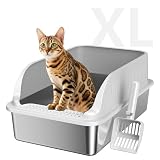
For a shopping budget, large stainless-steel boxes commonly range from about $45 to $70, while simple plastic pans may cost roughly $15 to $40. Stainless steel is often easier to wipe clean because it does not absorb odors as readily as scratched plastic.
Standard Sizes
See also: Most Trusted Cat Litter Brands in 2026 and What Each Does Best • How to Introduce a Carrier to Cats (2026): Step-by-Step
Use the inside floor area—not just the outside measurement—to compare boxes. Enclosures, rims, hinges, and sloped walls can reduce usable space. As a general rule, the box should be at least 1.5 times the length of the cat from nose to the base of the tail, and wide enough for a full turn.
| Box size | Typical outside dimensions | Approximate dimensions in centimeters | Best for |
|---|---|---|---|
| Small | 18 x 14 x 5 in | 46 x 36 x 13 cm | Kittens, travel, or very small cats |
| Standard | 24 x 18 x 6 in | 61 x 46 x 15 cm | One average-size adult cat |
| Large | 30 x 20 x 8 in | 76 x 51 x 20 cm | One large cat or a compact option for two cats |
| Extra large | 36 x 22 x 10 in | 91 x 56 x 25 cm | Two average adult cats when space is limited |
| Multi-cat oversized | 42 x 24 x 12 in | 107 x 61 x 30 cm | Two cats, large breeds, or cats that share one box |
These are useful shopping categories, not universal industry standards. A “large” label can describe a 30-inch pan from one manufacturer and a 36-inch pan from another. Check the listed length, width, height, doorway opening, and interior floor dimensions before ordering.
For two average cats, start with a 36 x 22-inch pan. If either cat weighs more than about 15 pounds (6.8 kg), has a long body, or likes to dig and circle, step up to 40 to 42 inches long. A box that is 10 to 12 inches high can help contain litter, but the entry should generally be no higher than about 5 to 7 inches for healthy adult cats. Senior cats or cats with arthritis may need a low entrance, even when the rest of the box is extra large.
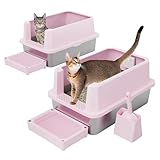
Some multi-cat products are sold as two-packs. A pair of high-sided large boxes may cost around $60 to $70 and can be more flexible than one giant container. Extra-large covered stainless-steel models often sell for approximately $50 to $60. Examples in this category include enclosed stainless-steel designs with lids, removable pans, mats, and scoops. Treat listed accessories as conveniences, not substitutes for adequate interior space.
How to Measure Your Space
- Measure the floor footprint. Use a tape measure to record the available length and width. Leave at least 2 to 3 inches (5 to 8 cm) of clearance around each side so you can remove the pan or lift the lid.
- Check the doorway and route. Measure hallways, stair turns, cabinet openings, and the narrowest doorway between the delivery point and the box location. A 42-inch box may not fit through a tight bathroom or closet entrance.
- Measure vertical clearance. For a covered model, measure from the floor to the lowest obstruction, such as a counter, shelf, or cabinet. Allow room to lift the lid and remove the waste liner or pan.
- Account for the entry. Record the entry height and opening width, not just the overall box height. A tall rim with a small doorway may be difficult for a senior, heavy, or nervous cat.
- Plan a cleaning zone. Keep enough room to stand or kneel beside the box. You will need space for a scoop, waste container, and litter refill. A cramped box is less likely to be cleaned frequently.
- Test the footprint with cardboard. Cut a rectangle to the box’s outside dimensions and place it on the proposed floor area for a day. This quickly reveals whether doors, drawers, or walking paths are blocked.
By Room or Use Case
Bathroom
A bathroom can accommodate a 36 x 22-inch box if it does not block the door, toilet, or cabinet. Choose a covered model only when ventilation is reasonable and the cat already accepts enclosed spaces. Keep the box away from the food and water station, and avoid placing it directly beside a loud exhaust fan or frequently used appliance.
Laundry Room
Laundry rooms often have useful floor space, but washers and dryers create noise and vibration. A high-sided 36 x 22-inch pan can work well, provided the cats can enter when the machines are running. Do not wedge the box between an appliance and a wall where a cat could feel trapped.
Small Apartment
In a small apartment, prioritize floor area over excessive height. A 36 x 18-inch box is a reasonable minimum for two average cats, but two separate 30 x 20-inch boxes may be easier to place and clean. Consider a low-profile, open pan under a table or in a ventilated utility area. Never reduce the box below the size your cats can comfortably use simply to hide it.
Large Cats or Long-Haired Cats
For Maine Coon-sized cats, heavy cats, or cats with long coats, choose at least 40 x 24 inches (102 x 61 cm) when possible. Long-haired cats may benefit from an open design because it provides more room to turn and makes daily inspection easier. A broad entry and stable base are more important than a tall decorative rim.
Senior Cats and Kittens
Kittens and older cats need easy access. Use a box with a 2- to 4-inch (5- to 10-cm) entry, even if the back and sides are 8 to 12 inches high. You can add a ramp or low step, but make sure it does not reduce the usable floor area. As kittens grow, replace a starter box with an adult-size model rather than relying on the small pan long-term.
Common Sizing Mistakes
- Buying by weight rating alone: A sturdy box may support a heavy cat but still have too little floor space. Length and width matter more than a product’s maximum load.
- Counting the rim as usable space: A 36-inch outside length may provide only 30 inches of interior room once the walls and molded corners are considered.
- Choosing a small covered box: A lid can reduce odors and scatter, but it also reduces headroom and airflow. Compare interior dimensions and doorway size.
- Using one box because it is oversized: A huge pan does not eliminate territorial stress or guarantee that both cats will want to share. Place additional boxes in separate quiet areas when possible.
- Ignoring litter depth: Most cats need roughly 2 to 3 inches (5 to 8 cm) of litter. A shallow pan can spill, while an extremely deep box may be difficult for a senior cat to enter.
- Forgetting stability: A lightweight pan that slides or tips can make cats avoid it. Look for a broad base and place a washable mat underneath.
FAQ
Is a 24 x 18-inch litter box big enough for two cats?
Usually, no. That size is better suited to one average adult cat. It may work temporarily for kittens or as a second box, but two adult cats generally need at least a 36 x 18-inch box, with 36 x 22 inches or larger being more comfortable.
Do two cats need two litter boxes?
Ideally, yes. The commonly recommended setup is one box per cat plus one extra, so two cats would have three boxes. If that is not practical, provide at least two large boxes in separate accessible locations and scoop them frequently.
Are covered litter boxes good for two cats?
They can work if the interior is genuinely spacious, the entrance is wide, and both cats willingly use them. Covered boxes may hold in odors and offer less ventilation. An open box at least 36 x 22 inches is often the safer starting choice, particularly for cats that are cautious or large.
How often should a two-cat litter box be cleaned?
Scoop waste at least once daily, and preferably twice daily when two cats share one box. Remove clumps and solids, top up litter as needed, and wash the box according to the material and product instructions. Stainless-steel pans may be easier to scrub clean, while scratched plastic can retain odors over time. A correctly sized box still needs regular maintenance to remain appealing.
Ready to decide? Our #1 pick for 2026 is the Small.
Live price & availability on Amazon.