📅 Last updated:
📋 Table of Contents
The Short Answer
For two small cats, choose a carrier with an interior floor area of at least 22 to 24 inches long by 14 to 16 inches wide (about 56 to 61 cm by 36 to 41 cm) for short trips, provided the cats are calm, compatible, and together weigh no more than about 16 to 18 pounds combined. For longer car rides, vet visits with delays, or cats that dislike close contact, move up to approximately 28 to 32 inches long by 18 to 20 inches wide (71 to 81 cm by 46 to 51 cm).
The best carrier size for two small cats is not simply the largest bag that fits in your car. Both cats should be able to lie down at the same time, turn around without climbing over one another, and sit upright without their ears pressing hard against the roof. A divider is useful for cats that need separation, but it reduces each cat’s usable space, so size up rather than assuming one large compartment will work as two smaller ones.
As an Amazon Associate we earn from qualifying purchases at no extra cost to you.


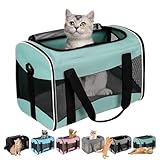
For most pairs of adult small cats weighing 6 to 9 pounds each, a double-compartment soft carrier or hard-sided kennel in the 28- to 32-inch range is the most practical choice. Budget double carriers commonly run about $19 to $46; at the lower end, expect soft-sided fabric construction, while larger structured or divided models tend to cost more.
Standard Sizes
See also: Most Trusted Cat Litter Brands in 2026 and What Each Does Best • How to Introduce a Carrier to Cats (2026): Step-by-Step
Use the table below as a planning guide. Dimensions refer to minimum usable interior space, not the exterior measurement printed on a product listing. Soft-sided carriers can taper at the top, and hard carriers have thick walls, door frames, and rounded corners that reduce the available floor area.
| Use and Cat Pair | Recommended Interior Size | Recommended Exterior Size Range | Combined Cat Weight | Best For |
|---|---|---|---|---|
| Very short trip; two kittens or very petite adults | 22 x 14 x 14 in. 56 x 36 x 36 cm |
24–26 x 16–18 x 16–18 in. 61–66 x 41–46 x 41–46 cm |
Up to 14 lb 6.4 kg |
Brief vet rides or moving cats from house to car |
| Typical pair of small adult cats | 24 x 16 x 16 in. 61 x 41 x 41 cm |
26–30 x 18–20 x 18–20 in. 66–76 x 46–51 x 46–51 cm |
14–18 lb 6.4–8.2 kg |
Routine vet visits and local car travel |
| Two small cats on a longer drive | 28 x 18 x 18 in. 71 x 46 x 46 cm |
30–34 x 20–22 x 20–22 in. 76–86 x 51–56 x 51–56 cm |
16–20 lb 7.3–9.1 kg |
Trips longer than 1 hour, waiting rooms, temporary containment |
| Double carrier with center divider | 30 x 18 x 18 in. total 76 x 46 x 46 cm total |
32–36 x 20–22 x 20–22 in. 81–91 x 51–56 x 51–56 cm |
Up to maker’s stated limit | Cats that travel better with separate compartments |
Check the manufacturer’s weight limit as well as dimensions. A carrier rated for 20 pounds should not automatically be used for two cats totaling 20 pounds: the rating may describe the maximum load the handles, base, and zipper can support, not a comfortable capacity. Leave a practical margin of at least 2 to 4 pounds below the stated maximum whenever possible.
How to Measure Your Space
- Measure each cat from nose to tail base. Have your cat stand naturally and measure from the tip of the nose to where the tail begins. Do not include the tail itself. Add the two measurements together only when comparing side-by-side floor length; cats do not need to lie in a perfectly straight line.
- Measure shoulder height. Measure from the floor to the top of the shoulders while the cat is standing. Add 2 to 3 inches (5 to 8 cm) for comfortable upright clearance. For many small adult cats, this means looking for at least 15 to 18 inches of interior height.
- Weigh both cats together and separately. Use a bathroom scale: weigh yourself, then weigh yourself holding one cat, and subtract. Repeat for the second cat. The combined number must stay below the carrier’s published weight capacity.
- Plan for their travel position. If the cats curl up together peacefully, a shared compartment can work for short trips. If one sprawls, guards space, or becomes anxious, choose a longer carrier with a divider or use two separate carriers.
- Measure the car location. For a rear-seat carrier, measure the flat seat width and front-to-back depth. For a cargo area, measure between wheel wells and check hatch clearance. A 32-inch-long carrier may fit across many rear benches but can be too long for a compact car’s footwell.
- Check doors and access points. Measure narrow apartment doors, stair landings, and the space between car seats if you expect to carry the carrier through them. Also confirm that the carrier’s top or front opening is large enough to lift each cat out safely.
By Room or Use Case
Quick Vet Visits
For a 10- to 30-minute ride and a brief appointment, a shared soft-sided carrier around 24 x 16 x 16 inches internally can suit two calm small cats. Look for a reinforced base, locking zippers, mesh on at least two sides, and a removable washable pad. A carrier in the roughly $19 to $30 range may be adequate for occasional use, but inspect the seams, handle stitching, and base board before trusting it with two cats.
Long Car Trips
For drives over an hour, prioritize floor space over portability. Aim for at least 28 x 18 x 18 inches of interior room, with ventilation on three or four sides. A carrier that opens from the top is especially helpful when you need to offer water, adjust a blanket, or check on the cats without fully opening a front door. Place the carrier on a level rear seat or secure cargo floor, never loose in the front passenger seat.
Air Travel
Most in-cabin airline pet carriers are intended for one cat, not two. Under-seat dimensions vary by airline and aircraft, and a carrier that is marketed as airline approved may still be too large for a particular flight. Two small cats may sometimes travel together only if the airline allows it, their combined weight meets the policy, and the carrier fits fully beneath the seat. Confirm the exact airline rules before buying; for many travelers, two individual under-seat carriers are the safer plan.
Emergency Evacuation or Temporary Shelter
For emergency readiness, a divided carrier or two separate carriers is more versatile than one shared bag. Choose a model around 30 to 36 inches long if it will serve as short-term containment for two small cats. Keep absorbent pads, a lightweight blanket, ID information, and a small water bowl nearby. A carrier is not a substitute for a roomy crate during extended stays, but a larger double model gives cats more breathing room during transport and intake.
Common Sizing Mistakes
- Buying by exterior dimensions only. A listed 24-inch carrier may offer only 21 or 22 inches of usable internal length after padding, wall thickness, and tapered sides.
- Using one-cat weight limits for two cats. Two 8-pound cats need a carrier designed to support at least 16 pounds, preferably more.
- Assuming bonded cats always want to share. Even friendly cats can become reactive when stressed by travel, unfamiliar smells, or a veterinary waiting room.
- Choosing height but not floor area. Cats need room to settle on the base. Extra headroom does not make a narrow carrier comfortable for two animals.
- Ignoring the carrier’s empty weight. A large structured carrier can weigh 5 to 8 pounds before the cats are inside. Add that to the cats’ combined weight before deciding whether you can carry it safely.
- Forgetting the divider’s impact. A 30-inch carrier divided in half provides roughly 15 inches per cat before allowing for divider thickness and curved side panels.
FAQ
Can two small cats fit in one carrier?
Yes, for short trips, if they are compatible and the carrier has enough usable floor space. For most pairs totaling 14 to 18 pounds, start with a 24 x 16 x 16-inch interior minimum. Use a larger 28- to 32-inch option for longer travel or cats that need more personal space.
What size carrier is best for two 8-pound cats?
For two 8-pound cats, choose at least a 24 x 16 x 16-inch interior for a short local trip. A 28 x 18 x 18-inch interior is a more comfortable all-purpose target. Look for a carrier rated above 16 pounds, ideally 18 to 20 pounds or more.
Should I buy one large carrier or two small carriers?
Two carriers are usually better for air travel, cats that fight under stress, or situations where each cat may need separate handling. One large carrier is convenient for bonded cats on short car trips, provided it has a strong base, secure closures, and enough room for both cats to rest.
Is a soft-sided or hard-sided carrier better for two cats?
Soft-sided carriers are lighter, easier to store, and often more forgiving in a car. Hard-sided carriers generally offer better impact protection and are easier to disinfect after accidents. For two cats, the deciding factors are a rigid, non-sagging floor, secure hardware, ample ventilation, and a weight rating that exceeds the cats’ combined weight.
Ready to decide? Our #1 pick for 2026 is the Very short trip; two kittens or very petite adults.
Live price & availability on Amazon.